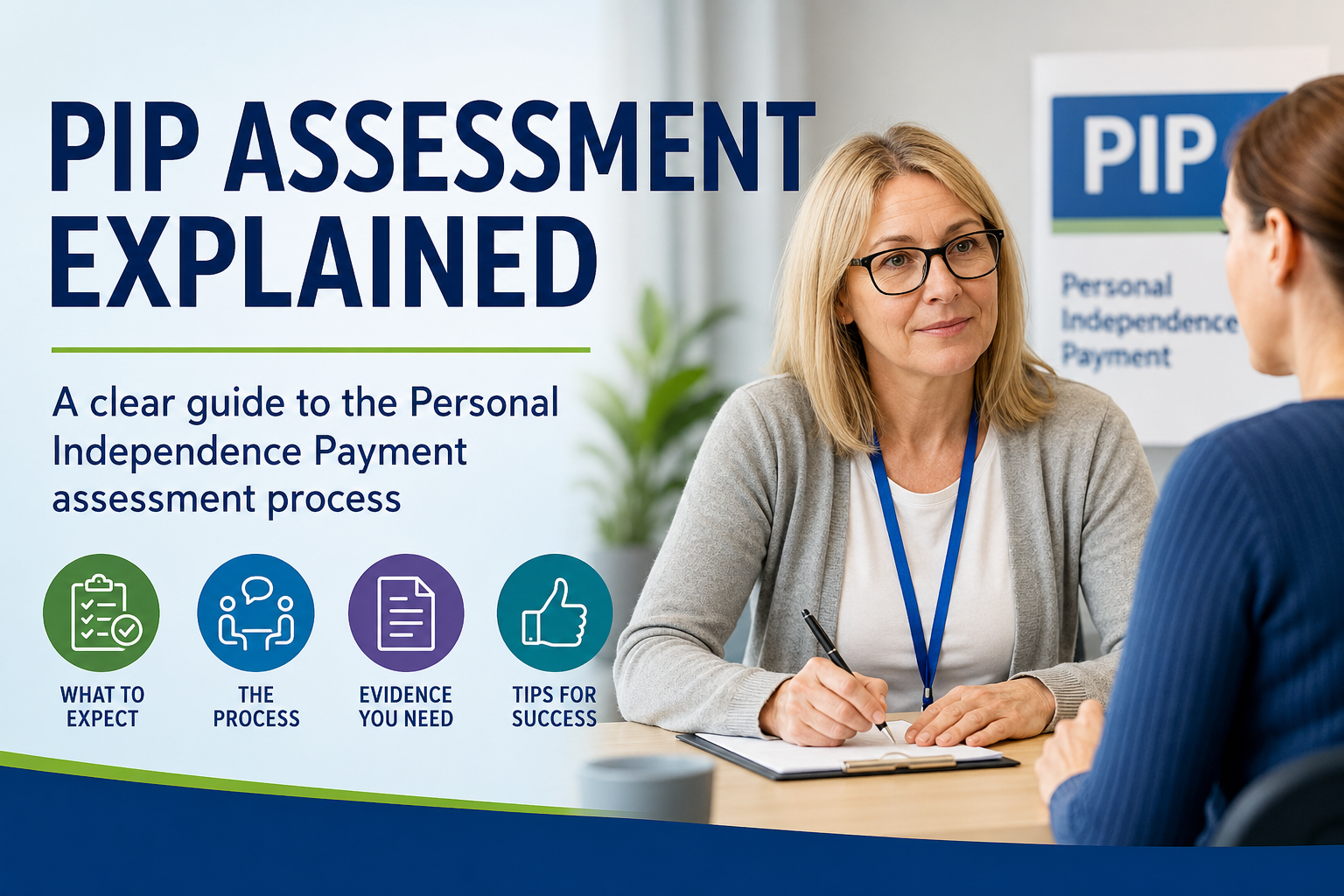
PIP Assessment Explained

PIP Assessment Explained

Applying for Personal Independence Payment, commonly known as PIP, can feel overwhelming, especially when you reach the assessment stage. Many people worry about what will happen, what questions will be asked and how the Department for Work and Pensions (DWP) decides whether they qualify.

Understanding the assessment process can make it much less stressful. Knowing what the assessor is looking for, how points are awarded and what evidence to provide gives you the best opportunity to present an accurate picture of how your health condition or disability affects your daily life.

This guide explains everything you need to know about the PIP assessment in clear, straightforward language.


Quick Answer

What is the PIP assessment?

The PIP assessment is an independent assessment used by the Department for Work and Pensions to understand how your physical or mental health condition affects your daily living and mobility. It is not a medical examination designed to diagnose your condition. Instead, it focuses on how your condition affects your ability to complete everyday activities safely, reliably, repeatedly and within a reasonable time.


What Is PIP Assessment Explained?

What does the PIP assessment involve?

The PIP assessment is a conversation between you and a trained healthcare professional working for an assessment provider on behalf of the DWP.

The purpose is to gather information about how your condition affects your daily life.

The assessor considers:

  • Your completed PIP claim form
  • Medical evidence
  • Information from healthcare professionals
  • Any supporting evidence you provide
  • Your answers during the assessment

They then prepare a report for the DWP.

The DWP Decision Maker makes the final decision, not the assessor.

The assessment is based on function rather than diagnosis

Having a diagnosis alone does not automatically qualify someone for PIP.

Instead, the assessment looks at how your condition affects your ability to carry out specific activities.


PIP Assessment Process at a Glance

Stage What Happens
Submit claim Contact DWP and start your application
Complete PIP2 form Explain how your condition affects you
Provide evidence Send medical and supporting documents
Attend assessment Telephone, video, face to face or paper based
Assessment report Sent to DWP
Decision DWP awards or refuses PIP
Mandatory Reconsideration If you disagree with the decision
Appeal Independent tribunal if necessary

Who Can Claim PIP Assessment Explained?

Who needs a PIP assessment?

Most people applying for Personal Independence Payment will need an assessment.

However, some claims may be decided using paperwork alone if enough evidence has been provided.

You may need a PIP assessment if you:

  • Have a long term illness
  • Have a physical disability
  • Have a mental health condition
  • Have autism
  • Have ADHD
  • Have a learning disability
  • Have neurological conditions
  • Have chronic pain
  • Have multiple long term conditions

Eligibility Requirements

What conditions must be met before having a PIP assessment?

To qualify for PIP you normally must:

  • Be aged 16 or over
  • Be under State Pension age when first claiming
  • Have had difficulties for at least three months
  • Expect those difficulties to continue for at least nine months
  • Meet UK residence requirements

The assessment then determines whether you score enough points to receive an award.


Income Rules

Does income affect the PIP assessment?

No.

PIP is not means tested.

Your:

  • Salary
  • Pension
  • Savings
  • Investments
  • Partner’s income

do not affect the assessment itself or whether you qualify.

The assessment only looks at how your disability affects your daily living and mobility.


Savings Rules

Do savings affect the PIP assessment?

No.

Unlike Universal Credit or Pension Credit, there is no savings limit for PIP.

Whether you have:

  • £100
  • £10,000
  • £100,000

your savings do not affect your entitlement.


How Much Could You Receive?

How much can PIP pay?

PIP has two separate components.

  • Daily Living
  • Mobility

Each component has:

  • Standard Rate
  • Enhanced Rate

You may receive one component or both, depending on your assessment score.

Current PIP Structure

Component Standard Rate Enhanced Rate
Daily Living Available if enough points are scored Higher payment if more points are scored
Mobility Available if enough points are scored Higher payment if more points are scored

Your exact payment depends on the current Government rates in force when your claim is decided.


How Are Points Awarded?

How does the PIP points system work?

The assessor considers twelve activities.

Daily Living activities include:

  • Preparing food
  • Eating and drinking
  • Managing treatment
  • Washing
  • Dressing
  • Communicating
  • Reading
  • Mixing with people
  • Budgeting

Mobility considers:

  • Planning and following journeys
  • Moving around

Each activity contains descriptors with different points.

The points from each activity are added together.

Generally:

Points Result
8 to 11 Standard Rate
12 or more Enhanced Rate

How To Apply

How do you start the PIP assessment process?

The application usually follows these steps.

Step One

Start your claim with the DWP.

Step Two

Complete the “How your disability affects you” form.

This is one of the most important parts of your claim.

Answer every question honestly and in detail.

Explain:

  • What happens on your worst days
  • Whether someone helps you
  • How long activities take
  • Whether you experience pain
  • Whether you become exhausted
  • Whether activities are unsafe

Step Three

Send supporting evidence.

Step Four

Attend the assessment if required.

Step Five

Receive your decision.


What Types of PIP Assessment Are There?

How can the assessment take place?

There are four main types.

Assessment Type Description
Telephone Conducted over the phone
Video Conducted using video software
Face to face At an assessment centre or sometimes at home
Paper based Decision made using evidence only

What Happens During the Assessment?

What questions are asked?

The assessor may ask about:

  • Your medical conditions
  • Medication
  • Daily routine
  • Washing
  • Dressing
  • Cooking
  • Shopping
  • Travelling
  • Walking
  • Mental health
  • Fatigue
  • Anxiety
  • Pain
  • Memory
  • Concentration

They may also ask about:

  • Work
  • Education
  • Family life
  • Hobbies
  • Driving
  • Pets

These questions help build a picture of your daily functioning.


What Documents Will You Need?

What evidence should you provide?

Good supporting evidence often strengthens your claim.

Useful documents include:

  • GP letters
  • Hospital reports
  • Occupational therapist reports
  • Physiotherapy reports
  • Mental health team reports
  • Care plans
  • Prescription lists
  • Social worker reports
  • Support worker letters
  • Consultant reports

You can also include:

  • Symptom diaries
  • Care diaries
  • Statements from carers
  • Statements from relatives

What Is Reliable Performance?

Why does reliability matter?

The law says activities should be completed:

  • Safely
  • To an acceptable standard
  • Repeatedly
  • Within a reasonable time

If you cannot do something reliably, you may be treated as being unable to do it.

This is an important part of many successful PIP claims.


Common Mistakes To Avoid

What mistakes should applicants avoid?

Many people unintentionally reduce their chances by making common errors.

These include:

  • Giving very short answers
  • Saying “I’m fine” during the assessment when they are not
  • Forgetting to explain bad days
  • Not sending evidence
  • Underplaying symptoms
  • Only describing good days
  • Missing assessment appointments
  • Assuming the assessor already knows their condition
  • Not explaining pain or fatigue
  • Forgetting to mention help received from family

Examples And Real Life Scenarios

Example One

Arthritis

Sarah has severe arthritis.

She can prepare a meal, but only with assistance because she cannot safely lift pans.

She explains this clearly and provides occupational therapy evidence.

This helps the DWP understand her limitations.


Example Two

Anxiety

Michael experiences severe anxiety.

He rarely leaves home without support.

He explains how panic attacks prevent him travelling independently.

Mental health evidence supports his claim.


Example Three

Multiple Sclerosis

David experiences fatigue and balance problems.

Although he can sometimes walk reasonable distances, he cannot do so repeatedly throughout the day.

The reliability rules are particularly important in his assessment.


What Happens After the Assessment?

How long does the decision take?

After the assessment:

  1. The assessor writes a report.
  2. The report goes to the DWP.
  3. A Decision Maker reviews all evidence.
  4. You receive a decision letter.

If you disagree, you can:

  • Request a Mandatory Reconsideration.
  • Appeal to an independent tribunal if necessary.

Many decisions are changed during reconsideration or appeal when additional evidence is provided.


Frequently Asked Questions

Can I fail a PIP assessment?

There is no pass or fail. The DWP decides whether you score enough points to receive PIP.

Can someone attend the assessment with me?

Yes. A relative, friend, carer or support worker can usually attend.

Can I record the assessment?

Assessment providers have rules about recording assessments. Check with them before your appointment.

Do assessors contact my GP?

Sometimes, although not in every claim.

Can I submit extra evidence after the assessment?

Yes. You can send further evidence while your claim is still being considered.

Does having a diagnosis guarantee PIP?

No. Awards are based on how your condition affects everyday activities.

What if I cannot attend?

Contact the assessment provider immediately to rearrange your appointment.

Can I receive PIP if I work?

Yes. Many people work and still qualify for PIP.

Can my award be reviewed?

Yes. Most awards are reviewed periodically.

Can I challenge the decision?

Yes. You can request a Mandatory Reconsideration and, if necessary, appeal to an independent tribunal.


Related Benefits And Support Available

What other support might you qualify for?

Depending on your circumstances, you may also qualify for:

Benefit or Support Purpose
Universal Credit Help with living costs
Employment and Support Allowance Support if unable to work
Attendance Allowance Help for older people with care needs
Carers Allowance Support for eligible carers
Disabled Facilities Grant Home adaptations
Access to Work Workplace support
Blue Badge Scheme Parking concessions
Motability Scheme Accessible vehicle leasing for eligible claimants receiving the appropriate mobility award
Council Tax Reduction Help with council tax in some areas

Information Reviewed Against Current UK Government Guidance and Official Sources

This article has been reviewed against current UK Government guidance and official information relating to Personal Independence Payment, the PIP assessment process, eligibility rules and claimant responsibilities.

While every effort has been made to ensure accuracy, benefit rules, payment rates and assessment procedures can change. Always refer to the latest official Government guidance and any correspondence from the Department for Work and Pensions relating to your individual claim.


Useful Government Resources

For the most up to date information, consult official Government resources covering:

  • Personal Independence Payment guidance
  • Starting a PIP claim
  • PIP assessment information
  • Mandatory Reconsideration
  • Appeals to the First tier Tribunal
  • Disability benefits eligibility
  • Reporting a change of circumstances

These official resources should always take precedence if guidance changes after publication.


Conclusion

Understanding the PIP assessment is one of the best ways to prepare for your claim. The assessment is designed to measure how your health condition or disability affects your daily life rather than simply confirming a diagnosis. By completing your claim form thoroughly, providing detailed supporting evidence and explaining how your condition affects you on both good and bad days, you can help ensure the DWP has the information needed to make a fair decision.

Remember that the assessment report is only one part of the decision making process. The final decision rests with the DWP, and if you believe the outcome does not reflect your circumstances, you have the right to request a Mandatory Reconsideration and, if necessary, appeal.

Benefits Advice UK provides free information to help people better understand the UK benefits system. Always check the latest Government guidance before making financial decisions.

imporatant_image

Important

Information on this site is based on official UK guidance.

About our information and sources
Inbox Background
Newsletter Image

Get the latest updates to your inbox

Sign up for our newsletter to receive updates when there are changes to Universal Credit.