
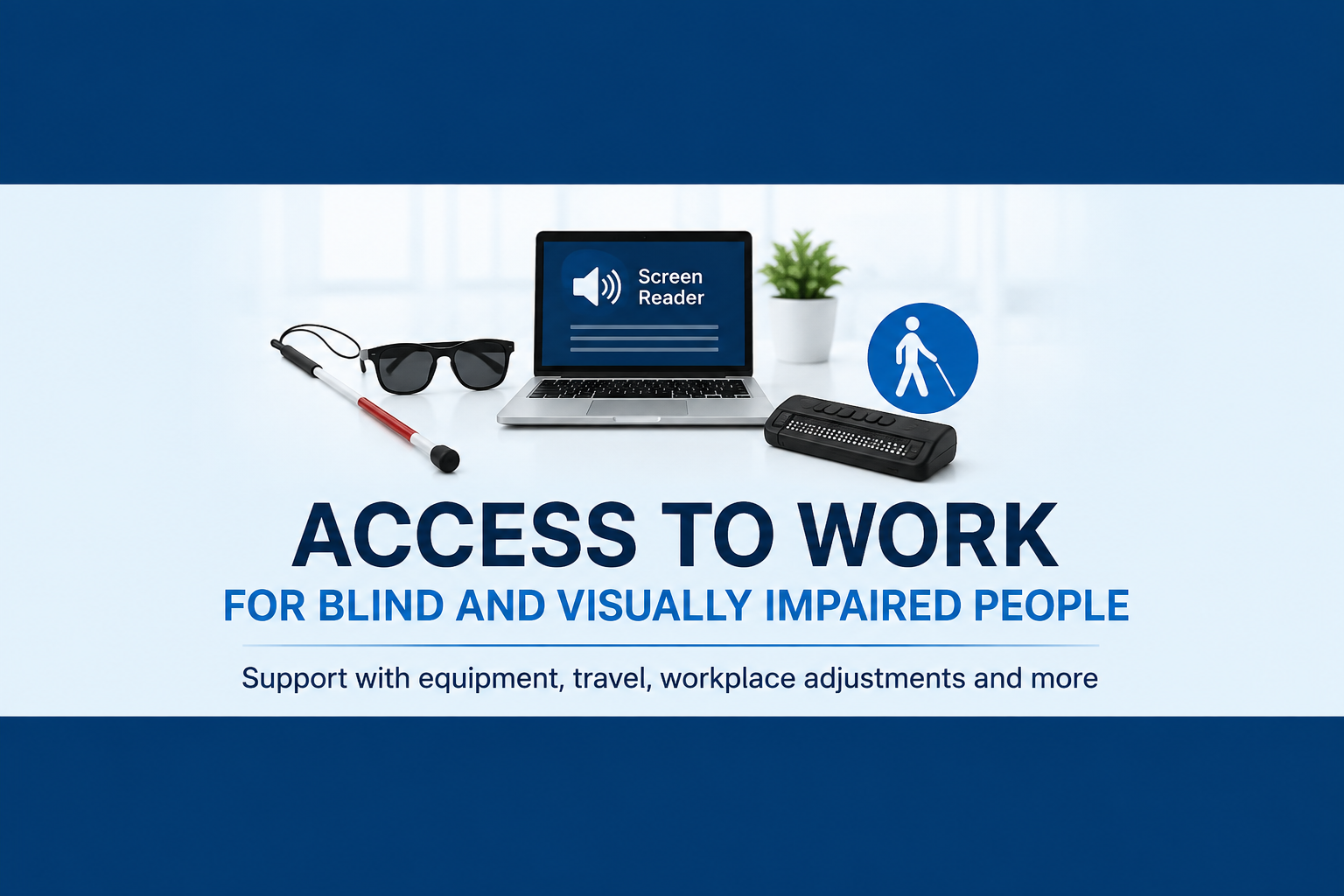
Living with sight loss should never prevent someone from building a successful career. If you are blind or visually impaired and work in the United Kingdom, or are about to start work, the Access to Work scheme may provide practical and financial support that helps remove barriers in the workplace.
Access to Work is designed to help disabled people succeed in employment by paying towards specialist equipment, workplace adaptations, support workers, travel costs and many other forms of assistance that employers may not be expected to fund themselves.
This guide explains everything you need to know about Access to Work for Blind and Visually Impaired People, including who qualifies, what support is available, how much could be awarded, how to apply and what to expect after submitting an application.
Access to Work for Blind and Visually Impaired People is a Government funded scheme that helps disabled people overcome practical barriers in work. If you have a visual impairment that affects your ability to do your job, you may receive funding for specialist technology, support workers, travel assistance, workplace adjustments and communication support. The amount awarded depends on your individual needs rather than your income or savings.
Access to Work is a Government grant that helps disabled people start work, remain in employment or become self employed.
Unlike benefits that provide income, Access to Work pays towards extra costs that arise because of a disability.
For someone with sight loss, this could include specialist software, adapted computer equipment, workplace support or assistance travelling to work where public transport cannot reasonably be used.
The grant is available across England, Scotland and Wales.
Northern Ireland operates different employment support arrangements.
The funding is intended to help create equal opportunities in the workplace by removing barriers rather than replacing an income.
Support may include:
Every application is assessed individually.
You may qualify if you:
The scheme is available whether you work full time or part time.
Many people with the following conditions successfully receive Access to Work support:
Having a Certificate of Vision Impairment may support your application but is not always essential.
No.
You do not need to receive Personal Independence Payment, Attendance Allowance or any other disability benefit.
Eligibility is based on how your disability affects your ability to work.
No.
Applications are normally made by the individual, although employers are involved when workplace adjustments are discussed.
Yes.
Self employed people can receive Access to Work support if they meet the eligibility conditions.
Yes.
If you have a confirmed job offer, you can usually apply before your employment begins.
No.
Access to Work is not means tested.
Your:
do not usually affect whether you qualify.
The award is based on workplace needs rather than financial circumstances.
No.
Unlike many means tested benefits, there is no savings limit.
Whether you have savings or not does not normally affect eligibility.
There is no standard payment.
The amount depends entirely on the support needed.
Funding may cover:
| Workplace Need | Possible Support |
|---|---|
| Reading computer screens | Screen reader software |
| Enlarging documents | Magnification software |
| Reading printed documents | Support worker |
| Moving safely around the workplace | Workplace adaptations |
| Travelling to work | Taxi funding where appropriate |
| Meetings | Reader or communication support |
| Reading handwritten documents | Digital scanning equipment |
| Using computers | Braille display or accessible technology |
The scheme can fund many thousands of pounds worth of specialist equipment where justified.
In some cases employers may contribute towards certain costs depending on the size of the business and the nature of the support required.
Applications are made directly through the Department for Work and Pensions.
The process usually includes:
Many applicants receive an assessment from an independent specialist who considers what adjustments would help them perform their role effectively.
You may be asked for:
Not every applicant will need every document.
An assessor will usually discuss:
The assessor will recommend practical solutions tailored to your individual circumstances.
Many visually impaired workers receive specialist technology.
Examples include:
| Equipment | Purpose |
|---|---|
| Screen reader software | Reads text aloud |
| Screen magnifier | Enlarges text |
| Refreshable Braille display | Converts screen text into Braille |
| CCTV magnifier | Magnifies printed documents |
| OCR scanners | Converts printed text into speech |
| Voice recognition software | Controls computers by voice |
| Accessible keyboards | Easier keyboard navigation |
| High contrast monitors | Improved visibility |
Technology changes regularly, so recommendations are based on current workplace needs.
Yes.
Some blind and visually impaired people cannot safely use public transport for every journey.
Support may include:
Funding depends on individual circumstances and evidence that the extra travel costs arise because of the disability.
Yes.
Some people benefit from:
Support workers may help with tasks that cannot reasonably be completed independently because of sight loss.
Many applications are delayed because important information is missing.
Common mistakes include:
Providing detailed examples often helps assessors understand your needs more clearly.
Sarah works in an office and has severe sight impairment.
She receives funding for:
These adjustments allow her to complete administrative work independently.
Michael is self employed.
His visual impairment makes reading printed contracts difficult.
Access to Work helps fund:
Amira starts a new job in customer services.
She receives:
This helps her work confidently from her first day.
If your job changes, your employer changes or your disability changes, you should inform Access to Work.
A review may consider whether:
Keeping your information up to date helps ensure your support remains suitable.
Access to Work is only one form of support.
Depending on your circumstances, you may also qualify for:
| Benefit or Support | Purpose |
|---|---|
| Personal Independence Payment | Helps with extra disability related living costs |
| Universal Credit | Income related financial support |
| Employment and Support Allowance | Support for people with limited capability for work |
| Carers Allowance | Support for eligible carers |
| Blue Badge Scheme | Parking concessions |
| Motability Scheme | Accessible transport for eligible people |
| Disabled Persons Railcard | Discounted rail travel |
| Local authority social care support | Independent living assistance |
Receiving one form of support does not automatically guarantee eligibility for another.
This article has been reviewed against current UK Government guidance relating to:
Government guidance may change over time. Individual awards are always based on personal circumstances and the evidence provided during the assessment process.
Yes. Blind people can receive Access to Work if their visual impairment creates barriers in the workplace and they meet the eligibility criteria.
No. Access to Work does not require you to receive Personal Independence Payment or any other disability benefit.
No. Income and savings do not normally affect eligibility.
Yes. If you have accepted a job offer, you can usually apply before your employment begins.
Yes. Self employed people may qualify if they meet the eligibility conditions.
Yes. It can fund specialist equipment where an assessment shows it is necessary for work.
Yes. Where a visual impairment creates additional travel barriers, funding for travel may be available.
Processing times vary depending on demand, assessments and the complexity of the support required.
Employers are normally involved where workplace adjustments or funding arrangements need to be discussed.
Yes. Access to Work support can be reviewed if your work or disability related needs change.
Access to Work for Blind and Visually Impaired People is one of the most valuable employment support schemes available in the United Kingdom. By helping to fund specialist equipment, workplace adjustments, travel assistance and support workers, it enables thousands of people with sight loss to access, remain in and progress within employment.
Every person’s circumstances are different, which is why applications are assessed individually. Providing clear information about how your visual impairment affects your work can improve the chances of receiving the most appropriate support.
Whether you are starting your first job, changing careers, becoming self employed or simply need additional workplace assistance, Access to Work could provide practical solutions that make employment more accessible and sustainable.
Benefits Advice UK provides free information to help people better understand the UK benefits system. Always check the latest Government guidance before making financial decisions.

Information on this site is based on official UK guidance.
About our information and sources


Sign up for our newsletter to receive updates when there are changes to Universal Credit.