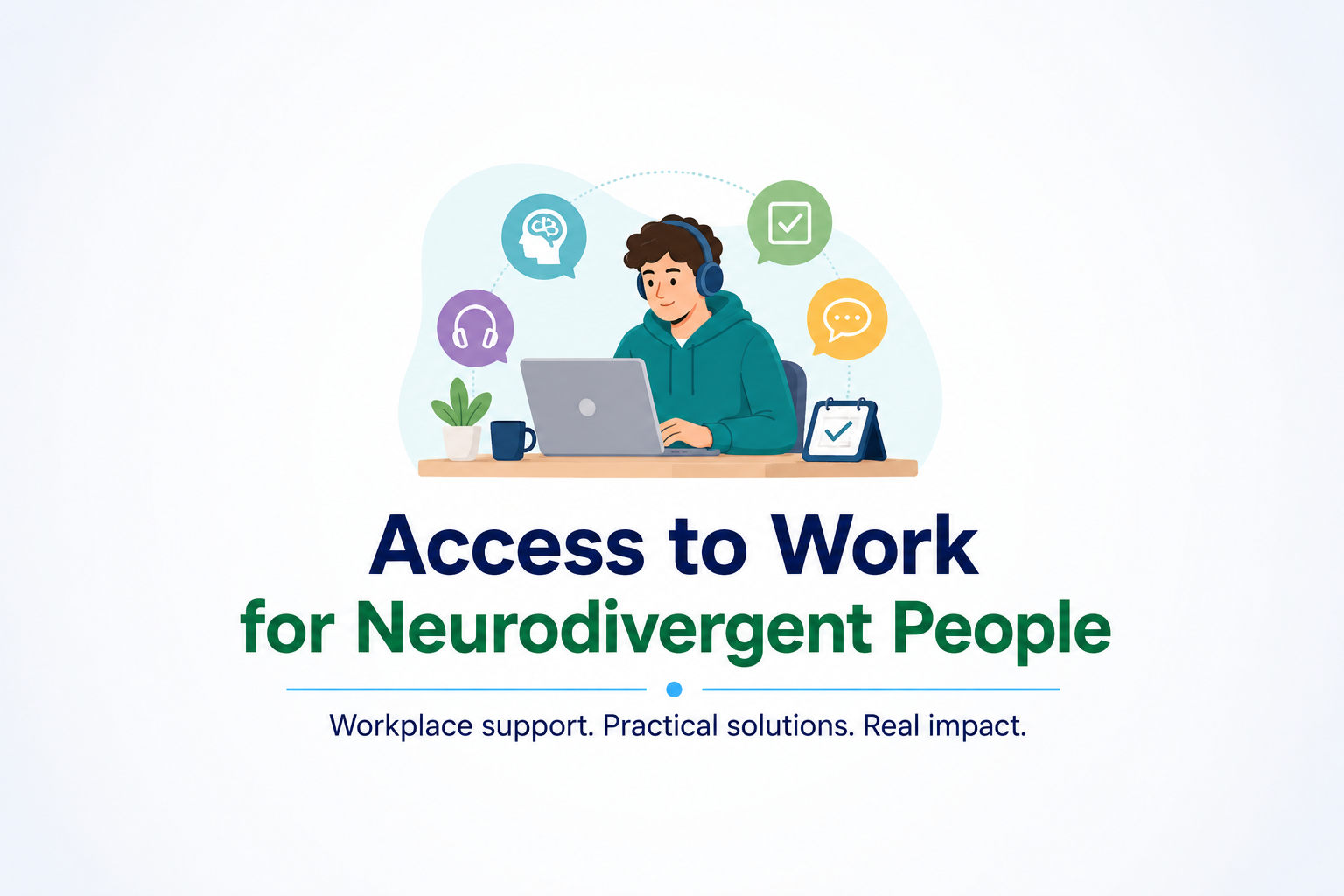
Finding and keeping a job can present different challenges for neurodivergent people. Many employers are committed to creating inclusive workplaces, but practical adjustments often require specialist equipment, coaching or workplace support.
The UK Government’s Access to Work scheme can help remove many of these barriers by providing grants towards the extra costs associated with working with a disability or health condition, including many neurodevelopmental conditions.
This guide explains who can apply, what support is available, how the application process works and what to expect once your application has been assessed.
Can neurodivergent people get Access to Work?
Yes. Many neurodivergent people may qualify for Access to Work if their condition affects their ability to do their job or travel to work and they meet the scheme’s eligibility rules. Support can include workplace coaching, specialist software, equipment, communication support, travel assistance and funding for reasonable workplace adjustments that go beyond what an employer would normally be expected to provide.
Access to Work is a Government grant that helps pay for practical workplace support that enables disabled people, including many neurodivergent people, to start work, stay in work or move into self employment.
It is not a benefit paid directly as income. Instead, it is financial support designed to remove workplace barriers.
The scheme recognises that neurodivergent people often have unique strengths while also experiencing workplace challenges that may require specialist support.
Neurodivergence is an umbrella term that includes conditions such as:
Every application is assessed individually. Having a diagnosis alone does not automatically guarantee an award, but many people receive support where their condition has a substantial impact on work.
| Type of Support | Examples |
|---|---|
| Workplace coaching | Executive function coaching, organisation skills, confidence building |
| Specialist equipment | Noise cancelling headphones, ergonomic equipment, adapted technology |
| Software | Speech to text, mind mapping software, reading software |
| Communication support | Specialist support workers where appropriate |
| Travel support | Help where public transport cannot reasonably be used |
| Mental wellbeing support | Workplace strategies linked to employment needs |
You may qualify if you:
You generally need to have a disability or long term health condition that affects your ability to perform aspects of your work.
Access to Work considers how your condition affects your job rather than focusing only on the medical diagnosis.
To qualify, you normally need to meet several conditions.
| Requirement | Explanation |
|---|---|
| Age | Usually 16 or over |
| Employment | Paid work or confirmed job offer |
| Health condition | Disability or health condition affecting work |
| Residence | Usually living and working in Great Britain |
| Workplace impact | Condition creates practical barriers to work |
Your application may be stronger if you can clearly explain:
No.
Access to Work is not means tested.
Your salary does not normally affect whether you qualify.
Whether you earn a modest wage or have a professional career, eligibility is based on your disability related work needs rather than your income.
No.
Savings and investments are not normally taken into account.
Unlike some means tested benefits, your personal savings will not usually affect your eligibility.
There is no single fixed payment.
Instead, the grant covers the agreed cost of approved support following an assessment.
The amount depends on:
Examples of funded support may include:
| Workplace Need | Possible Funding |
|---|---|
| ADHD coaching | Workplace strategy sessions |
| Autism support | Specialist workplace coaching |
| Dyslexia support | Reading and writing software |
| Noise sensitivity | Specialist headphones or quiet workspace solutions |
| Memory support | Digital planning tools |
| Organisation | Productivity software and coaching |
Funding may cover:
The exact amount varies considerably between applicants.
Applications can usually be made online or by telephone.
The typical process is:
Complete an application.
Explain how your condition affects your work.
Provide employment details.
An adviser reviews your application.
You may have a workplace assessment.
Recommendations are made.
Funding is agreed where appropriate.
Support begins.
Applying as early as possible can help reduce delays, particularly if you are about to begin a new job.
Having information ready can speed up the process.
You may need:
You may also wish to prepare examples of situations where your condition affects work.
Specific examples often help explain your needs more effectively than general descriptions.
Support varies according to individual circumstances.
Examples include:
| Challenge | Possible Support |
|---|---|
| Difficulty concentrating | Noise reducing equipment |
| Organisation | Executive functioning coaching |
| Reading documents | Specialist software |
| Writing reports | Speech recognition technology |
| Time management | Digital planning tools |
| Anxiety in busy offices | Alternative workspace arrangements |
| Processing information | Workplace mentoring |
| Communication | Specialist coaching |
Support focuses on enabling people to perform their role effectively rather than changing the essential duties of the job.
Avoid these common problems.
Explain exactly how your condition affects your work.
Describe workplace challenges rather than only naming your condition.
Apply as soon as possible if you are starting work.
Think about practical solutions that could help.
Provide information that clearly explains your work related needs where requested.
A graphic designer with ADHD struggles with planning multiple deadlines.
Following an assessment, they receive workplace coaching and productivity software that helps organise projects and improve time management.
An autistic software developer experiences sensory overload in an open plan office.
Access to Work funds specialist noise reducing equipment and recommends adjustments to the working environment, allowing them to remain productive.
An employee with dyslexia finds lengthy written reports difficult.
Specialist reading and speech technology helps improve speed and accuracy.
A self employed consultant with autism receives coaching to improve client communication strategies and business organisation.
Yes.
You should notify Access to Work if:
A review may be required to ensure your support continues to meet your needs.
Yes. Many people with ADHD receive workplace support where their condition creates substantial barriers at work.
Yes. Autism is one of the conditions commonly supported through the scheme where workplace adjustments are needed.
Not always. The assessment focuses on how your condition affects your work, although evidence may sometimes be requested depending on your circumstances.
The scheme is designed for employment. Different support arrangements may apply while studying.
Yes, if they meet the eligibility requirements.
No. It is a Government grant for workplace support rather than taxable income.
Access to Work itself does not normally reduce benefits because it is intended to fund workplace support rather than replace income. If you receive means tested benefits and have questions about your specific circumstances, seek personalised advice.
Processing times vary depending on demand and the complexity of the assessment.
Employers remain responsible for making reasonable adjustments under equality law. Access to Work may fund additional support beyond those responsibilities, and in some cases employers may be asked to contribute depending on the circumstances.
In many cases, yes, but you should inform Access to Work as soon as your circumstances change so your support can be reviewed.
Depending on your circumstances, you may also be entitled to:
| Support | Purpose |
|---|---|
| Personal Independence Payment | Help with extra costs of living with a disability |
| Universal Credit | Financial support for people on a low income or out of work |
| Employment and Support Allowance | Support for some people whose health affects their ability to work |
| Disabled Students Allowance | Support for eligible higher education students |
| Reasonable workplace adjustments | Employer provided changes under equality law |
| Local authority employment services | Specialist employment support |
This article has been reviewed against current UK Government guidance and official information relating to Access to Work.
While every effort has been made to ensure accuracy, Government policies, eligibility rules and application processes can change. Always check the latest official guidance before applying or making financial decisions.
Useful official resources include information on:
Using official Government information alongside independent guidance can help ensure you understand your rights and the support available.
Access to Work for Neurodivergent People is one of the UK’s most valuable employment support schemes. It recognises that many neurodivergent people have exceptional skills and talents but may need practical adjustments to thrive in the workplace.
Whether you are employed, self employed or preparing to start a new role, the scheme can help fund specialist equipment, coaching, workplace technology and other tailored support that removes barriers to employment. Because every application is assessed individually, it is important to clearly explain how your condition affects your work and the adjustments that would make the biggest difference.
Applying early, providing clear information and keeping your details up to date can help make the process smoother and improve the chances of receiving appropriate support.
Benefits Advice UK provides free information to help people better understand the UK benefits system. Always check the latest Government guidance before making financial decisions.
Information on this site is based on official UK guidance.
About our information and sources

Sign up for our newsletter to receive updates when there are changes to Universal Credit.