
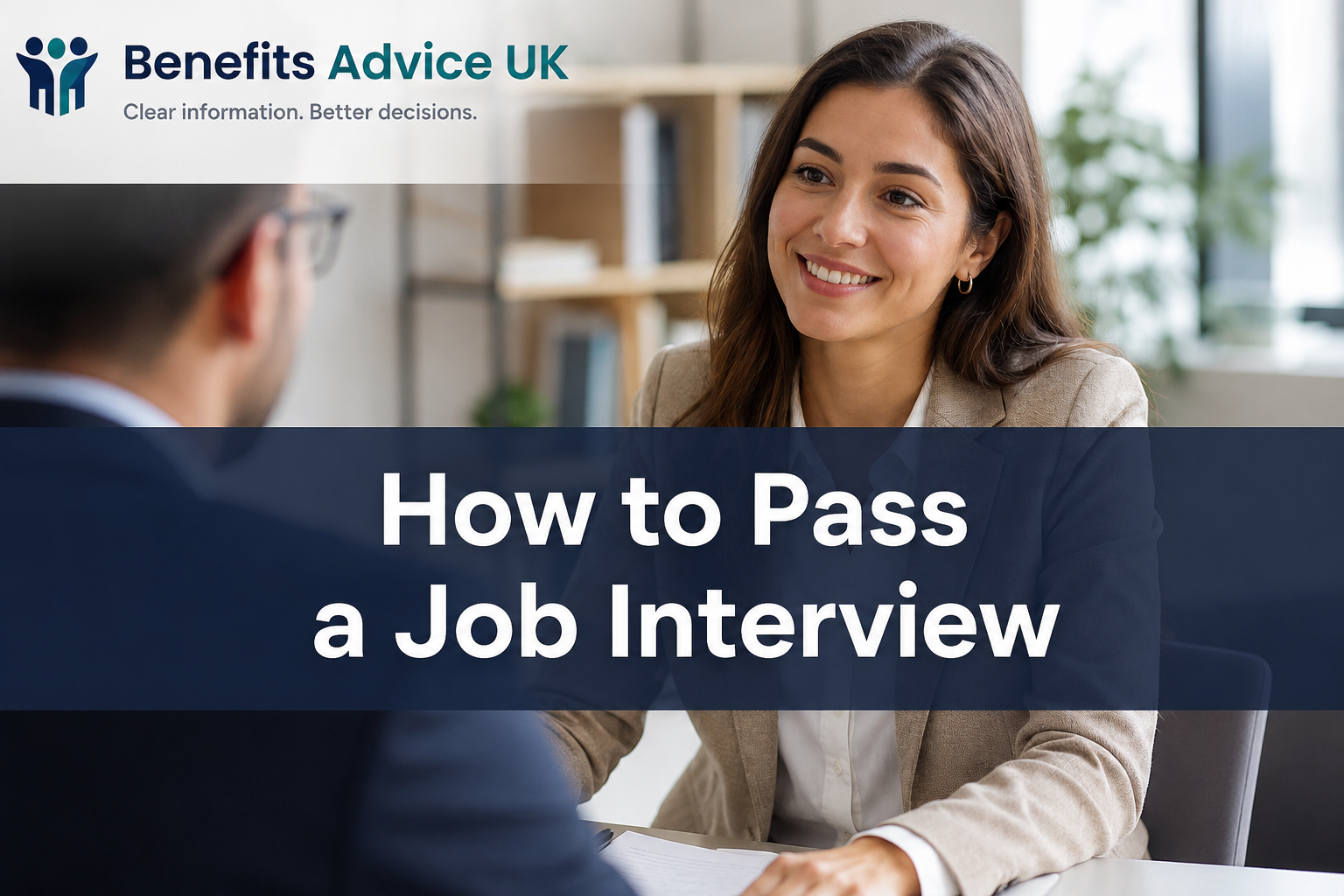
If you are wondering how to pass a job interview, the answer is simple. Prepare well, research the employer, practise your answers, arrive on time, communicate confidently and show genuine enthusiasm for the role.
Most employers do not expect perfection. They want someone who is reliable, willing to learn and genuinely interested in joining their organisation. With the right preparation, anyone can improve their interview skills, whether you are leaving school, changing careers, returning to work or claiming Universal Credit.
This guide explains exactly how to prepare, what employers look for, how to answer difficult questions and where to find free support across the UK.
| Question | Answer |
|---|---|
| How do I pass a job interview? | Research the employer, prepare examples of your skills, practise common interview questions, dress appropriately, arrive early, ask thoughtful questions and follow up professionally afterwards. |
Preparing for an interview helps you answer questions clearly, feel more confident and demonstrate why you are the right person for the job.
Employers often interview several candidates with similar qualifications. Preparation is what usually separates successful applicants from everyone else.
Preparation allows you to:
Most employers recruit people who demonstrate the right attitude as well as the right skills.
Many employers score interviews against set criteria.
Typical areas include:
| What Employers Assess | Why It Matters |
|---|---|
| Communication | Can you explain yourself clearly? |
| Teamwork | Can you work well with others? |
| Reliability | Will you turn up and complete your work? |
| Problem solving | Can you deal with challenges? |
| Motivation | Do you genuinely want the role? |
| Customer service | Can you work professionally with people? |
| Organisation | Can you manage your workload? |
Remember that interviewers are looking for evidence rather than guesses.
Start preparing as soon as you receive the interview invitation.
Visit the employer’s website.
Find out:
Knowing this information shows genuine interest.
Highlight:
Think of examples that prove you can do each one.
Prepare examples from:
Every experience counts.
Know:
Aim to arrive around 10 to 15 minutes early.
Wear clean, tidy clothes that match the workplace.
For most interviews:
If interviewing online:
Most interviews include questions about your experience, skills and motivation.
Examples include:
Keep your answer focused on:
Mention:
Choose strengths supported by real examples.
Examples:
Choose something genuine but improving.
For example:
“I used to struggle with public speaking. I joined presentations at work and now feel much more confident.”
Use the STAR method.
| STAR | Meaning |
|---|---|
| Situation | Explain the background |
| Task | Describe your responsibility |
| Action | Explain what you did |
| Result | Share the outcome |
This structure keeps answers organised.
Pause before answering and focus on giving clear, structured responses.
Good interview answers are:
Do not memorise every sentence.
Instead, remember key points.
Before leaving home, check:
☐ Interview time
☐ Address
☐ Interviewer’s name
☐ Job description
☐ CV
☐ Notebook
☐ Pen
☐ Water
☐ Phone fully charged
☐ Smart clothing
☐ Travel arrangements
Small mistakes can create a poor first impression.
Avoid:
Asking thoughtful questions demonstrates genuine interest.
Examples include:
Applicant Tracking Systems help employers organise applications before interviews take place.
ATS software often searches CVs for relevant skills and keywords.
To improve your chances:
Passing ATS screening increases your chance of receiving an interview invitation.
Yes. Universal Credit provides employment support through Jobcentre Plus and specialist work coaches.
Your work coach may help with:
You may also be able to receive help with interview travel costs in some circumstances. Speak to your work coach before attending.
Access to Work provides practical support for disabled people and people with health conditions entering or staying in employment.
Support may include:
Applying before starting work can help ensure support is ready when needed.
Several trusted organisations provide free employment advice.
| Organisation | Support Available |
|---|---|
| National Careers Service | Careers advice, CV guidance, interview preparation |
| Jobcentre Plus | Job search support and work coaches |
| Access to Work | Workplace adjustments |
| Local councils | Employment programmes |
| Prince’s Trust | Support for young people |
| Shaw Trust | Disability employment support |
| Scope | Employment advice for disabled people |
| Remploy services where available | Specialist employment support |
Confidence comes from preparation, not luck.
Try to:
Everyone feels nervous.
Interviewers understand this.
Leave professionally and remain positive.
Afterwards:
If unsuccessful, politely ask for feedback.
Many successful people receive several rejections before finding the right opportunity.
Research the employer, understand the job description, prepare examples of your experience, practise common questions, dress appropriately, arrive early, communicate confidently and show enthusiasm throughout the interview.
Yes. Universal Credit claimants can receive interview preparation, CV support, job search guidance and training through their Jobcentre Plus work coach. Additional help may also be available for interview expenses in certain circumstances.
Behavioural questions help employers understand how you have handled real situations in the past. They often use these answers to predict how you may perform in the role.
Research the employer, practise common questions and arrive early.
Yes. A small notebook with key points is acceptable.
Stay calm, explain your thinking and answer honestly.
Yes, if appropriate. It shows professionalism.
Bring your CV, identification if requested, a notebook and a pen.
Aim for 10 to 15 minutes before your interview.
Only if they are appropriate for the workplace. Smart shoes are usually the safer choice.
Everyone experiences nerves. Preparation and practice make a significant difference.
Many interviews last between 30 and 60 minutes, although this varies.
Yes. It is usually best to wait until the employer raises the subject or after receiving a job offer unless the interviewer asks about your expectations.
Request feedback, improve your interview skills and keep applying. Rejection is a normal part of finding the right job.
Before your interview, make sure you have:
Learning how to pass a job interview is one of the most valuable skills you can develop during your job search. Every interview gives you more experience, improves your confidence and brings you one step closer to finding the right opportunity.
Preparation, honesty and enthusiasm consistently make the biggest difference. Employers are looking for people who are dependable, willing to learn and genuinely interested in contributing to their organisation.
If you are currently looking for work, claiming Universal Credit or returning to employment after a break, remember that free support is available through Jobcentre Plus, the National Careers Service and Access to Work where eligible.
Continue building your skills, keep applying for suitable vacancies and learn from every interview you attend.
For more practical employment guidance, explore the Work & Job Support section on Benefits Advice UK, and bookmark the website so you always have trusted advice available throughout your job search.

Information on this site is based on official UK guidance.
About our information and sources



Sign up for our newsletter to receive updates when there are changes to Universal Credit.