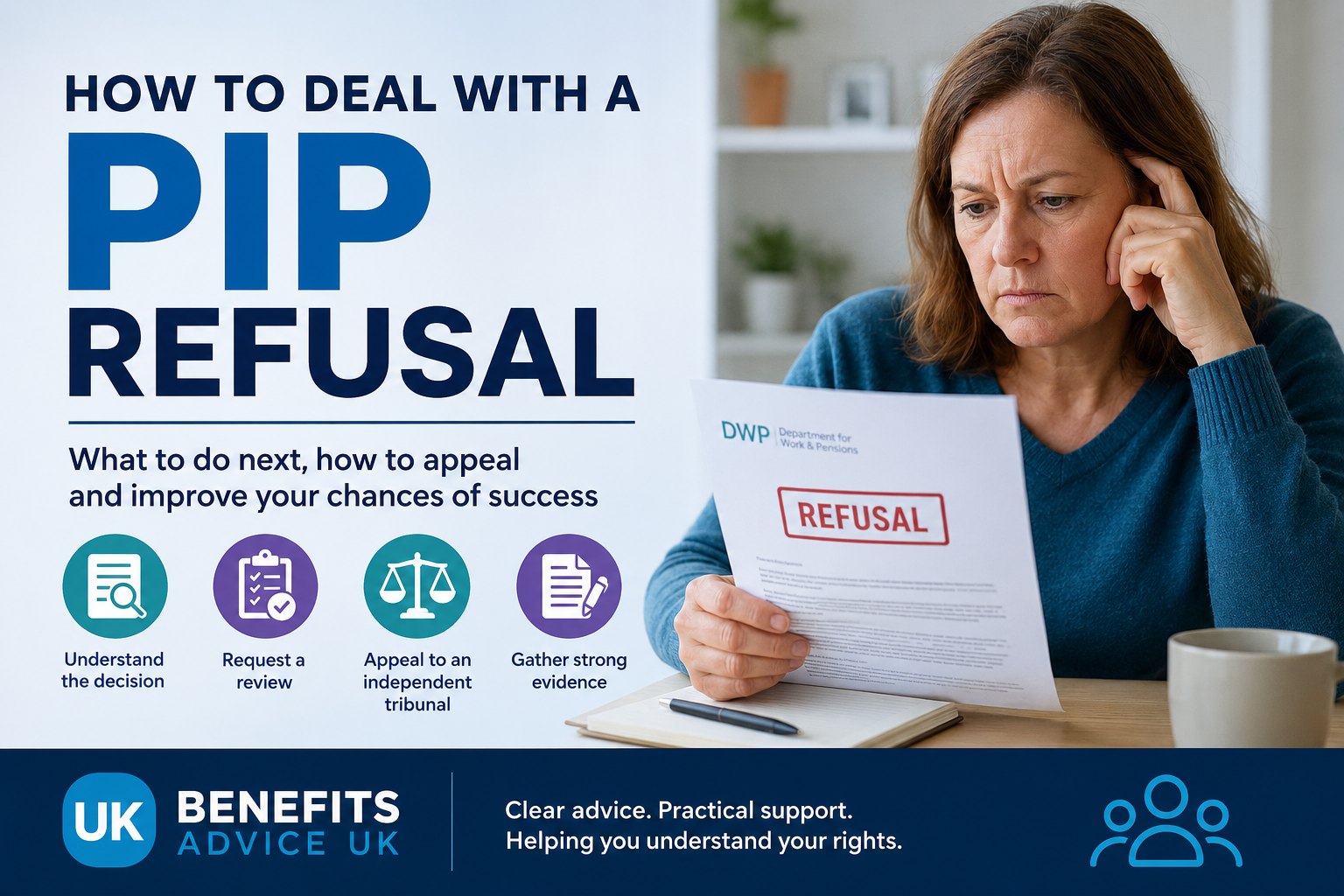
Receiving a Personal Independence Payment (PIP) refusal can be upsetting and frustrating, particularly if you believe your health condition or disability affects your daily life. However, a refusal does not necessarily mean you are not entitled to support.
Thousands of PIP decisions are successfully changed each year after a Mandatory Reconsideration or appeal. Understanding why your claim was refused, gathering stronger evidence and following the correct appeal process can significantly improve your chances of success.
This guide explains exactly how to deal with a PIP refusal, what steps to take next, the time limits involved and where to find additional support.
If your PIP claim is refused, you should first read your decision letter carefully to understand why. If you believe the decision is wrong, you normally have one month to request a Mandatory Reconsideration. If the decision is not changed, you can appeal to an independent tribunal. Many people are awarded PIP after appealing, particularly when they provide additional medical evidence and explain clearly how their condition affects their daily living and mobility.
A PIP refusal means the Department for Work and Pensions (DWP) has decided that you do not qualify for Personal Independence Payment based on the evidence available at the time of the decision.
A refusal may happen because:
A refusal does not automatically mean the decision is correct.
Many decisions are later changed.
Anyone who has received a PIP decision they disagree with can usually ask for the decision to be reconsidered.
This includes people who:
If someone cannot manage the process themselves, an appointee, representative or adviser may be able to help.
The most common reasons include:
| Reason | Explanation |
|---|---|
| Not enough points | The evidence did not meet the required scoring criteria. |
| Limited medical evidence | Supporting documents were missing or incomplete. |
| Assessment report | The assessor reached different conclusions from the claimant. |
| Inconsistent information | Different answers appeared to contradict each other. |
| Condition not fully explained | The application focused on diagnosis rather than daily difficulties. |
| Temporary condition | The condition did not meet the required duration rules. |
Remember that PIP is awarded because of how your condition affects you, not simply because you have a diagnosis.
You may qualify if:
Eligibility depends on how your condition affects everyday activities and mobility.
PIP uses a points based system.
Two components are assessed.
Examples include:
Examples include:
Each activity carries points.
The total determines whether you qualify.
No.
PIP is not means tested.
You can usually receive PIP whether you:
Income does not affect entitlement.
No.
There is no savings limit for PIP.
You can have:
These do not usually affect eligibility.
Only your health needs and functional difficulties are assessed.
PIP is made up of two components.
| Component | Weekly Rate |
|---|---|
| Daily Living Standard | Standard Government rate |
| Daily Living Enhanced | Enhanced Government rate |
| Mobility Standard | Standard Government rate |
| Mobility Enhanced | Enhanced Government rate |
The amount you receive depends entirely on the points awarded.
Government rates are reviewed regularly, usually every April.
Take the following steps.
Read your decision letter carefully.
Check:
Highlight anything that appears incorrect.
Request a copy of the assessment report if you do not already have it.
This can help identify:
Gather stronger evidence.
Useful evidence includes:
Evidence should explain what happens on your worst days and how often difficulties occur.
Request a Mandatory Reconsideration.
This is usually the first stage before appealing.
Explain:
Include any additional evidence.
Appeal if necessary.
If the Mandatory Reconsideration does not change the decision, you can normally appeal to an independent tribunal.
Tribunals are independent of the DWP.
Many claimants are successful at this stage.
A Mandatory Reconsideration is when the DWP reviews its original decision.
Another decision maker considers:
The decision may:
| Outcome | What Happens |
|---|---|
| Decision unchanged | You can usually appeal. |
| Higher award | PIP may increase. |
| Lower award | Rare, but possible. |
| Full award | PIP may be granted. |
For many people, yes.
Tribunals are independent and look at all the evidence again.
You can:
Tribunal panels normally include legally qualified members and disability specialists.
They are not employed by the DWP.
The stronger the evidence, the better.
Useful documents include:
A daily diary showing how your condition affects everyday life can be particularly valuable.
Avoid these common mistakes.
| Mistake | Better Approach |
|---|---|
| Focusing only on diagnosis | Explain how daily life is affected. |
| Sending little evidence | Provide detailed supporting documents. |
| Missing deadlines | Act promptly. |
| Assuming the assessor has all records | Submit important evidence yourself. |
| Underplaying symptoms | Describe your difficulties honestly. |
| Forgetting fluctuating conditions | Explain both good and bad days. |
| Giving short answers | Provide practical examples. |
Sarah has rheumatoid arthritis.
She was refused PIP because she scored too few points.
After submitting occupational therapy evidence and a diary showing she could not prepare meals safely, her Mandatory Reconsideration increased her score and she received the Daily Living component.
James has autism and severe anxiety.
The assessment stated he could travel independently.
His family provided evidence explaining he cannot travel unfamiliar routes without support.
An independent tribunal awarded the Enhanced Mobility component.
Amira has multiple sclerosis.
Her condition varies from day to day.
Her original application focused on good days rather than typical days.
After submitting a symptom diary covering several weeks, the tribunal accepted that she met the required descriptors and awarded both components.
Yes. You normally need to request a Mandatory Reconsideration first before appealing to an independent tribunal.
You usually have one month from the date on your decision letter to request a Mandatory Reconsideration. If you need to appeal after that, there are also time limits, although late requests may sometimes be accepted if you have a good reason.
Many PIP appeals are successful, especially where claimants provide additional evidence and attend the hearing.
Yes. New evidence can be submitted during both the Mandatory Reconsideration and appeal stages.
Many GPs and specialists will provide supporting information, although some may charge for letters.
Yes. Employment does not automatically prevent you from receiving PIP.
It can if it significantly affects your daily living or mobility.
It may do if it causes substantial functional difficulties.
Yes, depending on how it affects your ability to complete daily activities and move around.
Yes. If your appeal is successful, payments are usually backdated to the appropriate date of entitlement.
Many people benefit from free advice from welfare rights organisations or charities that specialise in benefits.
If you receive PIP, or are challenging a refusal, you may also qualify for other forms of support depending on your circumstances.
Possible help includes:
Eligibility rules differ for each scheme, so it is worth checking what additional help may be available.
The following official resources provide the most up to date guidance on PIP, Mandatory Reconsiderations and appeals:
| Resource | What It Covers |
|---|---|
| GOV.UK Personal Independence Payment guidance | Eligibility, claims and payments |
| GOV.UK Mandatory Reconsideration guidance | Challenging benefit decisions |
| HM Courts and Tribunals Service | Appeals process |
| Department for Work and Pensions | PIP policy and decision making |
This article has been reviewed against current UK Government guidance relating to:
Benefit rules and payment rates can change. Always check the latest official guidance before making decisions about your claim.
A PIP refusal can feel discouraging, but it is not always the final outcome. Many people successfully challenge decisions by understanding the reasons for the refusal, obtaining stronger supporting evidence and following the correct review and appeal process.
Take time to read your decision carefully, gather detailed evidence that explains how your condition affects your everyday life and meet all relevant deadlines. If necessary, seek advice from a welfare rights adviser or other trusted support organisation to help present the strongest possible case.
If your condition genuinely limits your daily living or mobility, challenging a refusal may lead to the outcome you deserve.
Benefits Advice UK provides free information to help people better understand the UK benefits system. Always check the latest Government guidance before making financial decisions.
Information on this site is based on official UK guidance.
About our information and sources

Sign up for our newsletter to receive updates when there are changes to Universal Credit.