
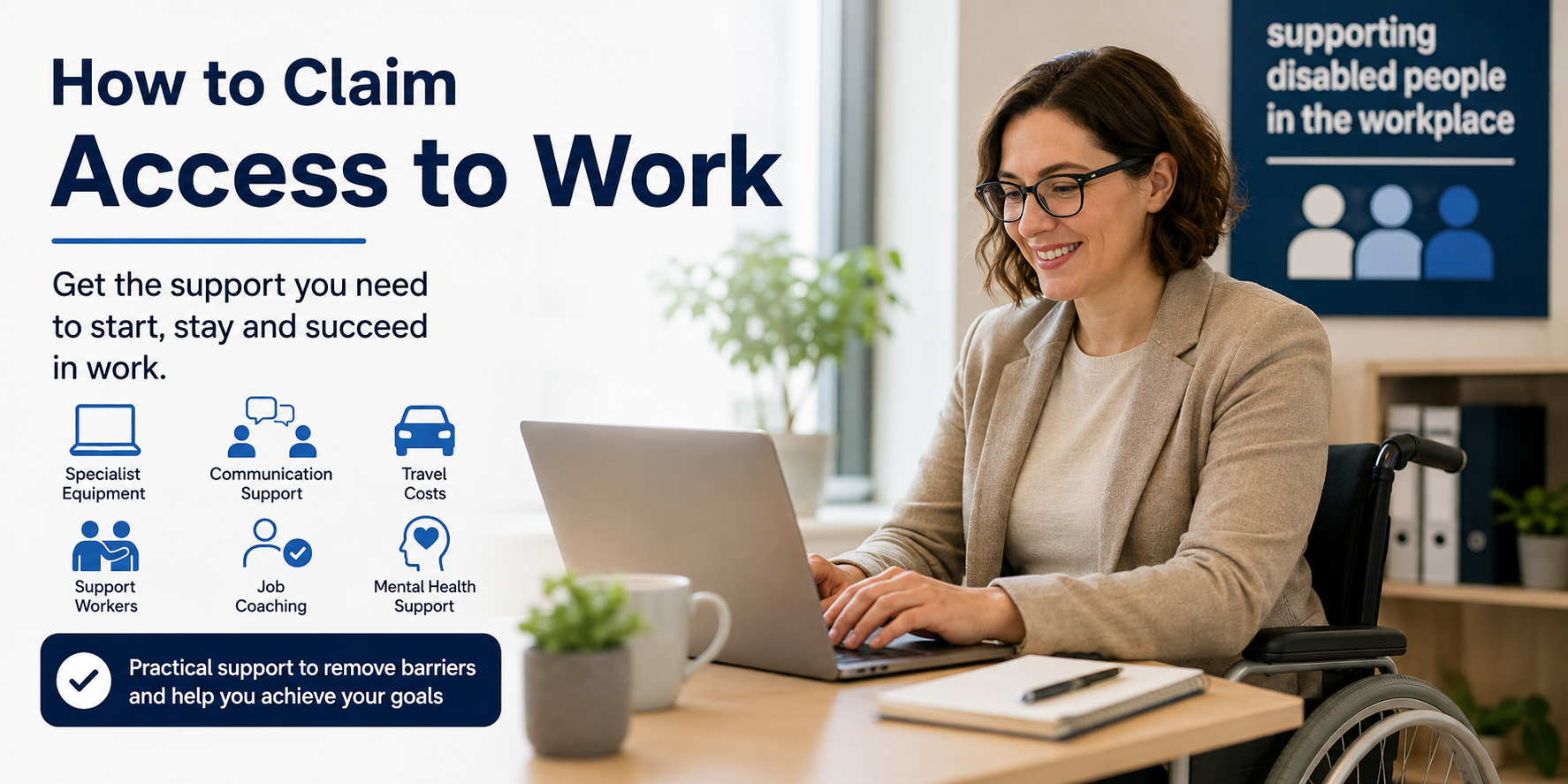
Finding and keeping a job can be more challenging if you have a disability, long term health condition or mental health condition. The good news is that the UK Government’s Access to Work scheme is designed to remove many of these barriers by helping to pay for practical support that enables people to work.
If you are wondering how to claim Access to Work, understanding the eligibility rules, application process and available support can make the process much easier. Unlike many benefits, Access to Work is not a payment for everyday living costs. Instead, it provides grants that help cover extra work related costs which arise because of a disability or health condition.
This guide explains everything you need to know about how to claim Access to Work, including who can apply, how much support may be available, what evidence you may need and what happens after you submit your application.
You can claim Access to Work by applying online or by telephone through the Department for Work and Pensions if you have a disability, physical or mental health condition or learning difficulty that affects your ability to work. If eligible, you may receive funding towards specialist equipment, workplace adaptations, travel costs, support workers or communication support. The amount awarded depends on your individual circumstances and workplace needs.
Access to Work is a Government funded grant scheme that helps disabled people and those with health conditions start work, stay in work or become self employed.
Rather than paying money directly as an income replacement benefit, Access to Work helps pay for practical workplace support that goes beyond what employers are legally expected to provide under equality legislation.
Support can include:
The scheme aims to reduce barriers to employment and improve workplace accessibility.
You may qualify if all of the following apply.
You:
People commonly claiming include those with:
The scheme is available whether you work full time or part time.
The main eligibility requirements are shown below.
| Requirement | Details |
|---|---|
| Minimum age | 16 years old |
| Residence | England, Scotland or Wales |
| Employment | Paid work, self employment or eligible job offer |
| Health | Disability or health condition affecting work |
| Support need | Extra workplace support required because of disability |
You may not qualify if you are unemployed and not about to start work.
No.
Access to Work is not means tested.
Your:
do not normally affect eligibility.
Applications are assessed according to your workplace support needs rather than your financial circumstances.
No.
Unlike many welfare benefits, Access to Work has no savings limit.
Whether you have:
will not normally affect your application.
There is no standard payment amount.
Instead, funding is based on the reasonable cost of the support you need.
Examples include:
| Support | Example |
|---|---|
| Specialist chair | Full or partial funding |
| Screen reading software | Funding where appropriate |
| Hearing equipment | Funding where required |
| Taxi travel | Contribution towards travel costs |
| Support worker | Funding for agreed hours |
| Job coach | Funding where recommended |
| Mental health support | Tailored support package |
The grant is paid towards approved workplace support rather than as a weekly cash benefit.
The maximum annual award is reviewed periodically by the Government and applies to the total value of approved support.
Applying is straightforward.
Check you meet the eligibility requirements.
Gather the information needed before applying.
This may include:
Complete your application online or apply by telephone.
You will be asked questions about:
An Access to Work adviser may contact you.
They may discuss:
Sometimes an assessment is arranged.
A decision is made.
If approved you will receive details of:
Not everyone will need the same evidence.
Examples include:
| Document | Why it may be needed |
|---|---|
| National Insurance number | Identity verification |
| Employer details | Employment confirmation |
| Job offer | New employment |
| Self employment information | Business verification |
| Medical evidence | Understanding support needs |
| Occupational health report | Workplace recommendations |
| Workplace assessment | Identifying suitable adjustments |
Providing clear information can help avoid delays.
Many applications take longer than necessary because important information is missing.
Common mistakes include:
Being clear and detailed usually helps your application progress more smoothly.
Sarah has severe arthritis.
She struggles using a standard office chair and desk.
Access to Work approves specialist seating and an adjustable workstation.
She remains in full time employment comfortably.
David has hearing loss.
He regularly attends meetings with clients.
Access to Work funds communication support and specialist hearing equipment, making meetings far more accessible.
Aisha experiences anxiety and depression.
She receives workplace mental health support through the scheme and regular sessions with a specialist support provider.
This enables her to continue working while managing her condition.
Tom is self employed.
Because of a mobility condition he cannot safely use standard office equipment.
Access to Work contributes towards specialist equipment that allows him to continue running his business.
Yes.
You should notify Access to Work if:
Your support package may need reviewing.
Yes. Receiving Personal Independence Payment does not prevent you applying for Access to Work.
Yes. Access to Work is separate from Universal Credit.
No. It is not treated as taxable income because it funds workplace support.
Yes. Many self employed people qualify if they meet the eligibility conditions.
Yes. If you have a confirmed job offer you can apply before your employment begins.
Usually you apply yourself, although your employer may provide supporting information.
Processing times vary depending on demand, the complexity of your support needs and whether an assessment is required.
Yes. It may contribute towards travel costs if you cannot reasonably use public transport because of your disability.
No. Awards are based on an individual assessment of your workplace needs.
Yes. Support can be reviewed if your circumstances or workplace requirements change.
Depending on your circumstances, you may also qualify for:
| Support | Purpose |
|---|---|
| Personal Independence Payment | Help with extra disability related costs |
| Universal Credit | Help with living costs |
| Employment and Support Allowance | Financial support for some people with limited capability for work |
| Carer’s Allowance | Support for eligible carers |
| Disabled Students’ Allowance | Educational support for disabled students |
| Motability Scheme | Vehicle access for eligible people receiving qualifying mobility benefits |
Each scheme has separate eligibility criteria.
Information reviewed against current UK Government guidance and official sources.
Useful official resources include:
Always refer to the latest official guidance before submitting an application, as eligibility criteria and administrative processes can change.
Knowing how to claim Access to Work can make a significant difference if a disability or health condition affects your ability to work. The scheme provides practical, personalised support that helps people enter employment, remain in work and progress in their careers without unnecessary barriers.
Unlike income related benefits, Access to Work is based on the workplace support you need rather than your earnings or savings. Whether you require specialist equipment, help with travel, communication support or workplace adjustments, the scheme is designed to help you work more confidently and independently.
Applying early, providing clear information about how your condition affects your work and responding promptly to requests for additional evidence can improve the application process and help you receive the support that is right for your situation.
Benefits Advice UK provides free information to help people better understand the UK benefits system. Always check the latest Government guidance before making financial decisions.

Information on this site is based on official UK guidance.
About our information and sources


Sign up for our newsletter to receive updates when there are changes to Universal Credit.