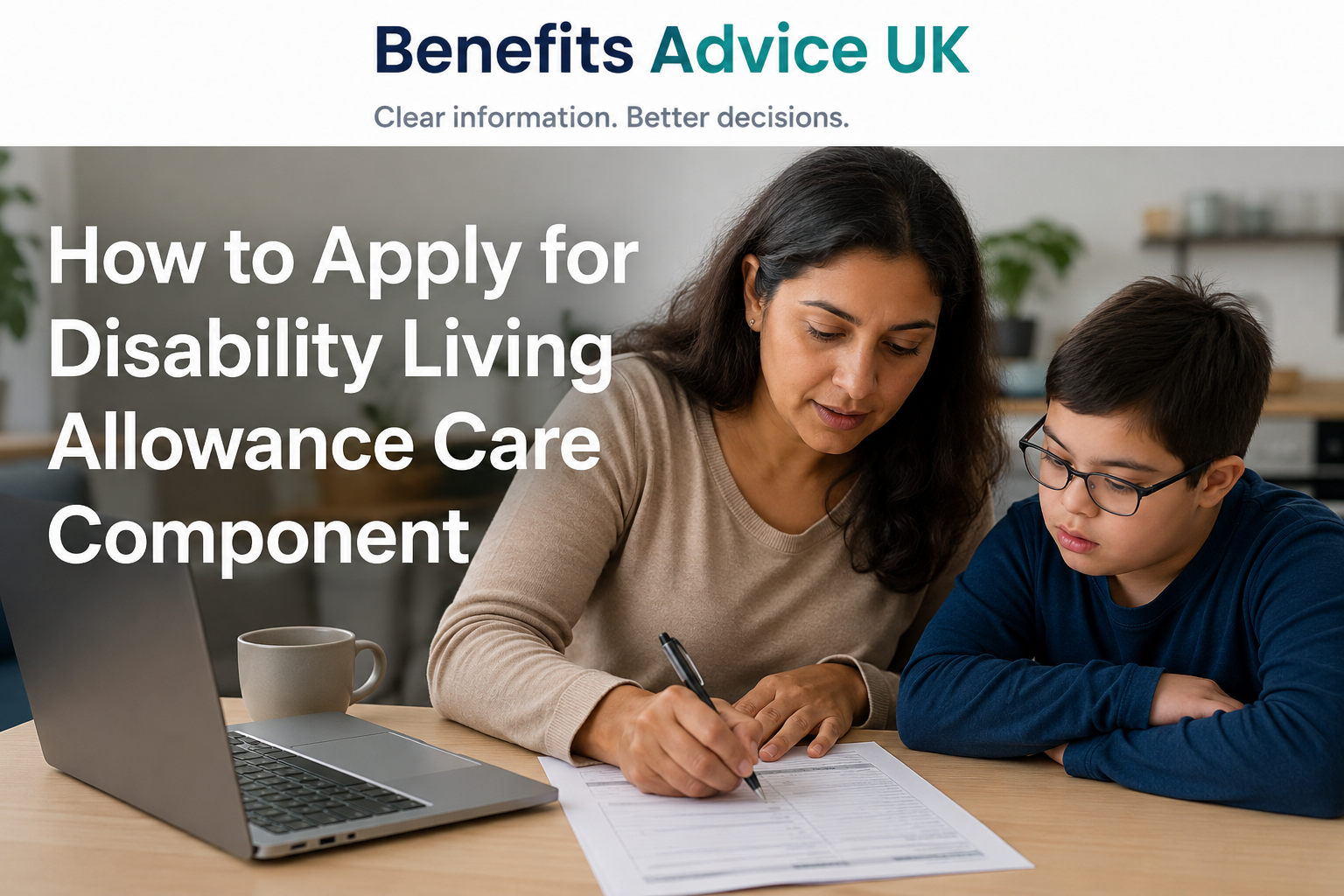
If you or your child needs extra help with personal care because of a disability or long term health condition, understanding how to apply for Disability Living Allowance Care Component can make a significant difference. Although Disability Living Allowance (DLA) has largely been replaced by Personal Independence Payment (PIP) for adults, many children still receive DLA and some adults continue to receive it if they have not yet transferred or remain entitled under existing rules.
This guide explains everything you need to know about the Disability Living Allowance Care Component, including who can claim it, eligibility requirements, payment rates, how to apply, what evidence you need and common mistakes to avoid.
The information has been written in plain English to help you understand the process with confidence.
You apply for the Disability Living Allowance Care Component by completing a Disability Living Allowance claim form where eligible. Most new claims are for children under 16. Adults generally claim Personal Independence Payment instead. You will need to provide detailed information about the care required because of a disability or health condition, along with supporting medical evidence where available. Decisions are based on the level of care needed rather than the medical diagnosis alone.
The Disability Living Allowance Care Component is a non means tested benefit designed to help people who need additional care or supervision because of a physical disability, learning disability, developmental condition or long term illness.
The benefit recognises that some people require significantly more assistance with everyday activities than others.
The Care Component can help with support such as:
Unlike many benefits, the money does not have to be spent on care services. It is intended to help meet the extra costs associated with disability.
Today, most new Disability Living Allowance claims are made for children under the age of 16.
Adults usually claim Personal Independence Payment instead.
You may qualify if:
Some adults remain on Disability Living Allowance if they have not transferred to Personal Independence Payment or fall within limited transitional arrangements.
| Person | Can Make a New DLA Care Claim? |
|---|---|
| Child under 16 | Yes |
| Adult aged 16 or over | Usually No |
| Existing adult DLA claimant | May continue depending on circumstances |
Eligibility depends on how much additional care is required rather than the name of the medical condition.
The Department for Work and Pensions considers:
Conditions commonly associated with successful claims include:
However, having one of these conditions does not automatically mean someone qualifies.
The decision is based on care needs.
The Care Component has three payment levels.
| Rate | Who May Qualify |
|---|---|
| Lowest Rate | Help needed for part of the day or inability to prepare a cooked meal under legacy adult rules |
| Middle Rate | Frequent care during the day or prolonged care during the night |
| Highest Rate | Frequent care during both the day and the night or terminal illness rules |
Payment rates are reviewed regularly by the Government, so always check the latest annual benefit rates before budgeting.
The award level depends entirely on the level of care required.
No.
Disability Living Allowance Care Component is not means tested.
This means your income does not usually affect your entitlement.
It does not matter whether you are:
Your eligibility depends on your care needs rather than your earnings.
No.
There is no savings limit for Disability Living Allowance Care Component.
Whether you have:
your entitlement is not affected because DLA is not a means tested benefit.
The application process varies depending on who is claiming.
For most people making a new claim today, the application is for a child under 16.
The process generally involves:
Obtain the Disability Living Allowance claim form.
Complete every section carefully.
Explain:
Provide supporting evidence where available.
Examples include:
Return the completed form promptly.
Keep copies of everything you send.
Await the decision.
The Department for Work and Pensions may:
Providing good evidence often strengthens an application.
Useful documents include:
| Evidence | Why It Helps |
|---|---|
| GP letter | Explains ongoing condition |
| Consultant report | Confirms diagnosis and treatment |
| Occupational therapy assessment | Details practical difficulties |
| School reports | Shows additional support required |
| Care plans | Demonstrates daily assistance |
| Hospital letters | Confirms medical history |
| Prescription list | Supports long term treatment |
Remember that evidence should describe how the disability affects everyday life rather than simply naming the condition.
Decision makers examine:
They compare the care required with that expected for someone of the same age.
For children, this comparison is particularly important because all children need some level of care.
Many applications fail because applicants underestimate their care needs.
Avoid these common mistakes.
Be honest and explain what happens on difficult days as well as better days.
A seven year old with autism requires constant supervision because they have no awareness of danger, struggle with communication and require assistance throughout the day.
Outcome:
The child may qualify because they require substantially more care than another child of the same age.
A twelve year old with epilepsy requires supervision during bathing, medication support and overnight monitoring following seizures.
Outcome:
The care required both during the day and overnight could support entitlement to a higher level of the Care Component depending on the individual circumstances.
A child with severe physical disabilities requires assistance dressing, eating, washing and moving around every day.
Outcome:
The extensive daily care needs may satisfy the qualifying conditions for a higher rate award.
| Situation | Possible Outcome |
|---|---|
| Extra supervision because of autism | May qualify |
| Frequent overnight care | Higher award may apply |
| Help with washing and dressing daily | Care Component may be awarded |
| Occasional assistance only | May not qualify |
Yes.
You should report significant changes, including:
Reporting changes promptly helps avoid overpayments or underpayments.
If you disagree with the decision, you can ask for it to be looked at again.
The process generally involves:
Many decisions are changed after additional evidence is supplied.
Receiving Disability Living Allowance may increase entitlement to other financial support.
These may include:
Each benefit has its own eligibility rules.
Information reviewed against current UK Government guidance and official sources.
Useful official resources include:
Always use official Government information when completing benefit applications.
Generally, no. Most adults making a new disability benefit claim will need to apply for Personal Independence Payment instead.
Yes. Disability Living Allowance remains available for eligible children under the age of 16.
No. Disability Living Allowance is tax free.
No. Employment alone does not prevent entitlement because DLA is not based on earnings.
Yes. Savings do not affect entitlement.
Processing times vary depending on the complexity of the claim and whether further evidence is required.
Yes. It is possible to receive both if you meet the qualifying conditions for each benefit.
No. Decisions are based on the care required, not simply the medical condition.
Yes. Organisations such as Citizens Advice and other welfare advice services can help complete the claim form.
Most young people receiving Disability Living Allowance are invited to claim Personal Independence Payment when they reach the appropriate age, subject to the current transfer arrangements.
| Question | Answer |
|---|---|
| Is DLA Care Component means tested? | No |
| Does income matter? | No |
| Do savings matter? | No |
| Who can usually make a new claim? | Children under 16 |
| Is medical evidence useful? | Yes |
| Are awards based on diagnosis? | No |
| Can decisions be challenged? | Yes |
Understanding How to Apply for Disability Living Allowance Care Component is essential if your child requires significantly more care than other children of the same age because of a disability or long term health condition. Although most adults now claim Personal Independence Payment instead, Disability Living Allowance remains an important source of financial support for eligible children and some existing adult claimants.
The strongest applications clearly explain the practical help and supervision needed every day and every night, supported by relevant evidence where possible. Remember that entitlement is based on the impact of a disability on daily life rather than the diagnosis itself. Taking time to complete the application carefully, providing detailed examples and reporting any changes in circumstances promptly can improve the accuracy of your claim and help ensure you receive the support to which you are entitled.
Benefits Advice UK provides free information to help people better understand the UK benefits system. Always check the latest Government guidance before making financial decisions.
Information on this site is based on official UK guidance.
About our information and sources
Sign up for our newsletter to receive updates when there are changes to Universal Credit.