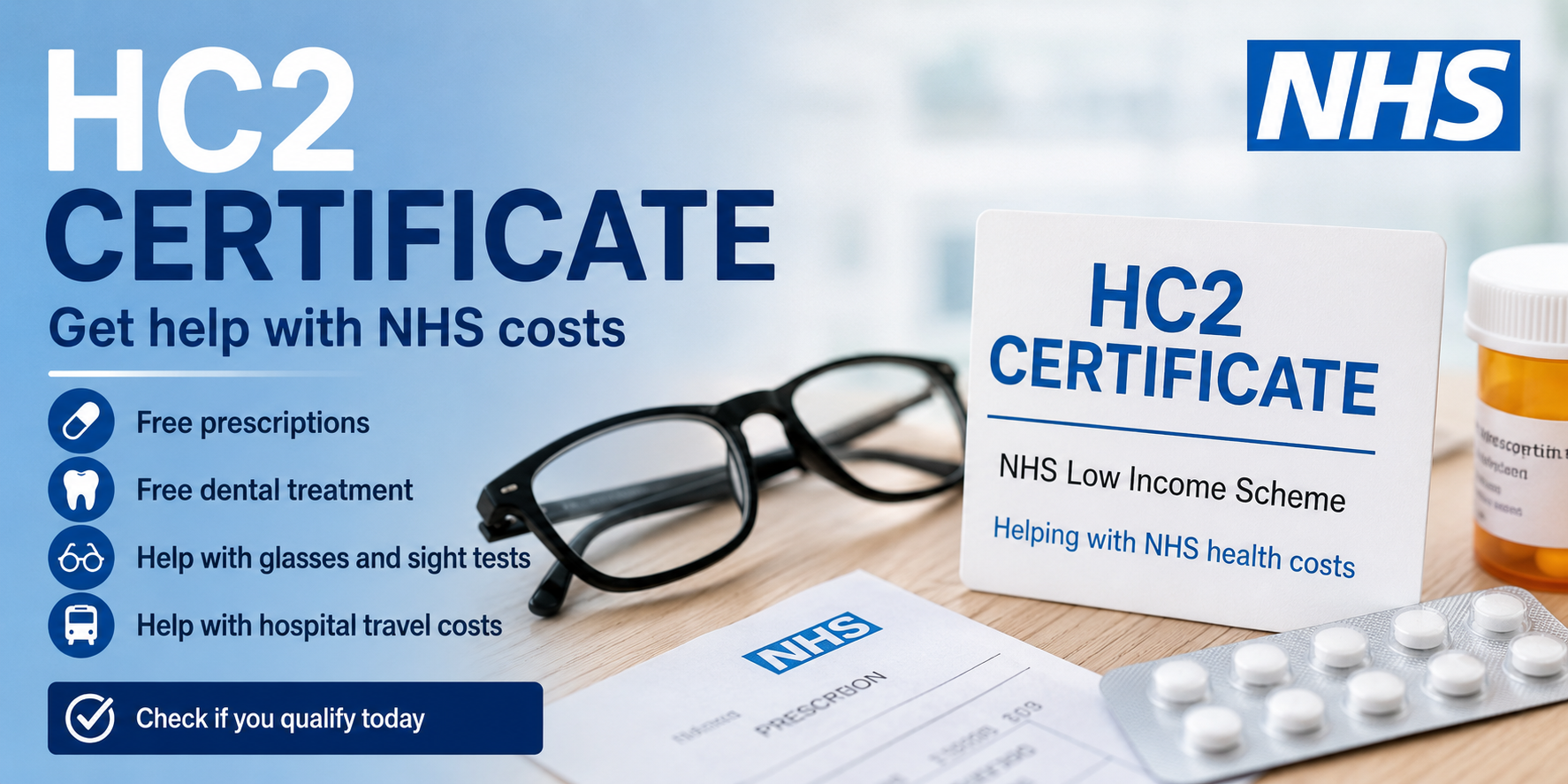
Many people pay NHS charges without realising they could receive help through the NHS Low Income Scheme. If you have a low income, an HC2 certificate could save you hundreds of pounds each year by covering costs such as NHS prescriptions, dental treatment, eye tests, glasses, contact lenses and travel to hospital appointments.
Understanding who qualifies, how to apply and what support is available can make a significant difference to your household finances. This guide explains everything you need to know in clear, simple language.
An HC2 certificate is issued under the NHS Low Income Scheme. It gives eligible people full help with NHS health costs if they have a low income and meet the qualifying rules. It can cover the full cost of NHS prescriptions, dental treatment, sight tests, glasses or contact lenses, travel to NHS appointments and NHS wigs or fabric supports where appropriate.
The certificate is usually awarded for a limited period and must be renewed if you still need help.
An HC2 certificate confirms that you qualify for full help with NHS health costs through the NHS Low Income Scheme.
Unlike benefits that provide regular payments into your bank account, an HC2 certificate reduces or removes the cost of essential healthcare.
Depending on your circumstances, it may cover:
The certificate is recognised throughout England.
People living in Scotland, Wales and Northern Ireland have different NHS charging systems, so entitlement may differ.
You may qualify if your income is low and you do not have enough savings or investments to pay NHS charges yourself.
Many different people apply successfully, including:
Receiving a benefit does not automatically prevent you from applying.
Many people who are employed also qualify.
The NHS Business Services Authority looks at your overall financial circumstances.
They normally consider:
Each application is assessed individually.
There is no single income figure that guarantees entitlement because household circumstances vary considerably.
Some people already receive full NHS help because they receive qualifying benefits.
If you already qualify automatically, you may not need an HC2 certificate.
Examples can include people receiving certain means tested benefits that already include full NHS health cost entitlement.
If you are unsure, applying to the NHS Low Income Scheme can confirm your entitlement.
There is no fixed earnings limit that applies to everyone.
Instead, the NHS Low Income Scheme compares:
| Household Circumstances | Considered |
|---|---|
| Earnings | Yes |
| Benefits received | Yes |
| Pension income | Yes |
| Maintenance payments | Yes |
| Other income | Yes |
| Household size | Yes |
| Housing costs | May be considered |
The amount of disposable income left after essential living costs is an important factor.
Even if you work full time, you could still qualify if your income remains relatively low.
Savings are considered as part of your application.
This can include:
Different rules can apply depending on your age and where you normally live.
People living permanently in residential care may have different capital limits.
Always declare your savings honestly when applying.
An HC2 certificate provides full help with eligible NHS charges.
| NHS Service | HC2 Support |
|---|---|
| NHS prescriptions | Full cost covered |
| NHS dental treatment | Full cost covered |
| NHS eye test | Covered where eligible |
| Glasses or contact lenses | Voucher or full help depending on entitlement |
| Hospital travel | Eligible travel costs covered |
| NHS wigs | Covered where eligible |
| Fabric supports | Covered where eligible |
This support can save many people hundreds of pounds each year.
Many people confuse these certificates.
| Certificate | Support Available |
|---|---|
| HC2 | Full help with NHS health costs |
| HC3 | Partial help towards NHS health costs |
If your income is slightly above the full help threshold, you may receive an HC3 certificate instead.
An HC3 certificate tells you the maximum amount you need to contribute towards NHS costs.
Applications are made through the NHS Low Income Scheme.
Most people can apply online.
Paper application forms are also available for people who cannot apply digitally.
The general application process is:
If approved, your certificate will show the dates it is valid.
Keep it safe in case you need to show proof of entitlement.
Having documents ready can make your application much quicker.
Examples include:
Only provide accurate and up to date information.
Processing times can vary depending on:
If further information is needed, the NHS Business Services Authority will normally contact you.
If successful, you will receive your certificate showing the period of entitlement.
Yes.
Changes to your circumstances could affect your entitlement.
Examples include:
Providing accurate information helps avoid incorrect awards.
Many applications are delayed because important information is missing.
Avoid these common mistakes:
Taking time to complete the form carefully can improve the application process.
| Situation | Possible Outcome |
|---|---|
| Single worker on minimum wage | May qualify for full NHS help |
| Student with low income | May qualify depending on finances |
| Pensioner with limited income | May qualify |
| Couple with children and low earnings | May qualify |
| Self employed worker with fluctuating income | May qualify following assessment |
Every application is considered individually.
Yes. There is no charge to apply.
Yes, if your certificate is valid and covers full NHS costs.
It normally lasts for a fixed period shown on the certificate before renewal is required.
Yes. Many people who work still qualify because entitlement depends on overall financial circumstances rather than employment status alone.
Yes. The NHS Low Income Scheme assesses income, savings and household circumstances.
Yes, if they meet the qualifying rules.
Yes. Students with low income may qualify.
Yes. Online applications are available for most people.
You may receive an HC3 certificate instead if you qualify for partial help, or you can seek further advice if you believe the decision is incorrect.
In some situations, reimbursement may be possible if you were entitled at the time and meet the relevant conditions. Keep all receipts and follow the NHS claims process.
Depending on your circumstances, you may also qualify for:
| Benefit or Scheme | Purpose |
|---|---|
| Universal Credit | Help with living costs |
| Pension Credit | Extra income for older people |
| Personal Independence Payment | Help with disability related costs |
| Attendance Allowance | Support for older disabled people |
| Carer’s Allowance | Support for unpaid carers |
| Healthy Start | Help with food and vitamins |
| Free School Meals | Support for eligible children |
| Council Tax Reduction | Help with council tax bills |
| Household Support Fund | Emergency financial assistance from local councils |
Checking all available support could improve your overall financial position.
Information reviewed against current UK Government guidance and official sources.
Useful official resources include:
These official sources provide the most up to date information on eligibility, applications and NHS charges.
An HC2 certificate can provide valuable financial support by removing many NHS healthcare costs for people on low incomes. Whether you are working, retired, studying or temporarily out of work, it is worth checking your entitlement if paying for prescriptions, dental care or eye care is becoming difficult.
Applying is free, and even if you do not qualify for full help, you could still receive partial assistance through an HC3 certificate. Always provide accurate information, keep your financial evidence up to date and renew your certificate before it expires if you remain eligible.
Benefits Advice UK provides free information to help people better understand the UK benefits system. Always check the latest Government guidance before making financial decisions.
Information on this site is based on official UK guidance.
About our information and sources
Sign up for our newsletter to receive updates when there are changes to Universal Credit.