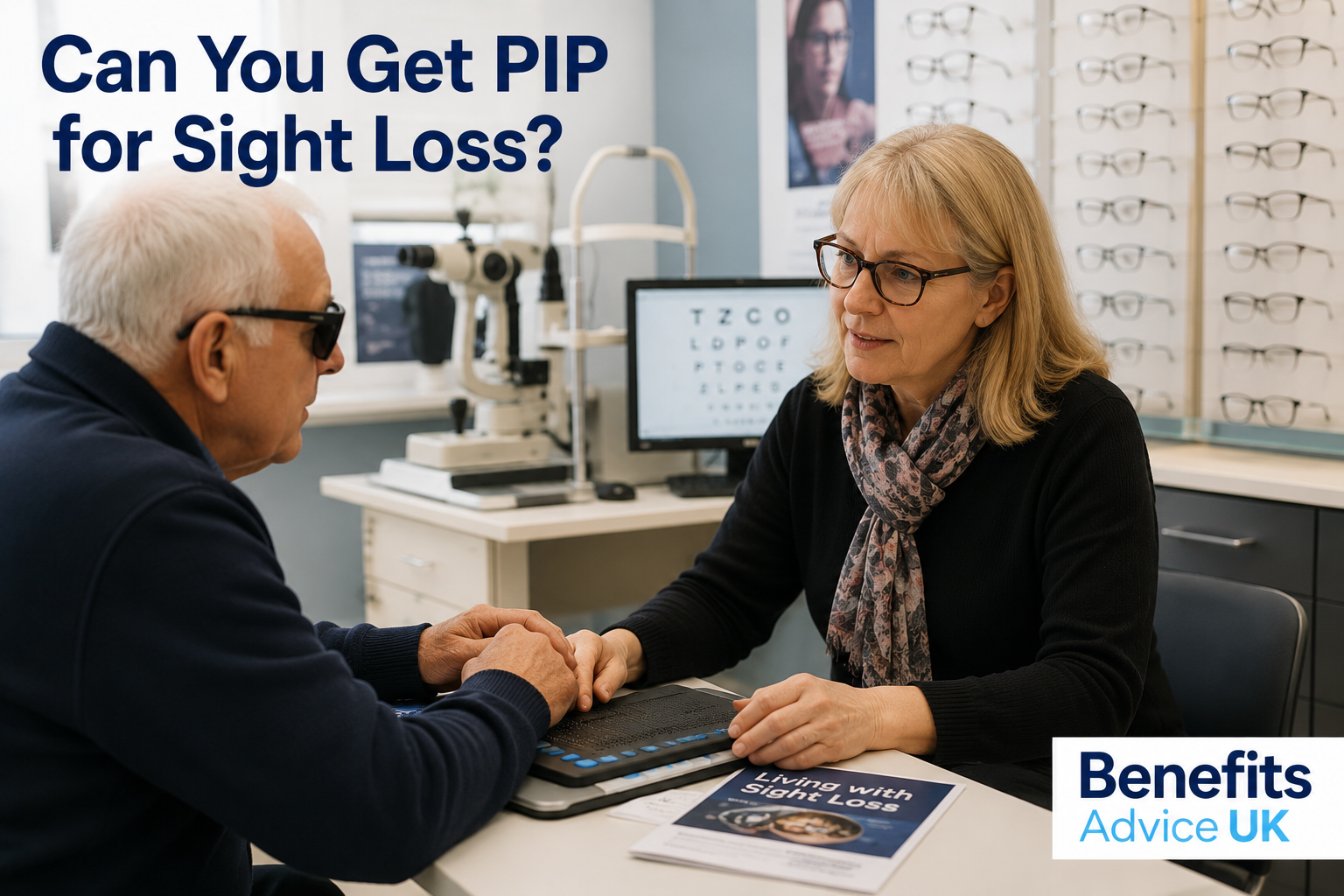
Losing your sight or living with a serious visual impairment can make many everyday activities more difficult. From preparing meals and reading important letters to travelling safely and managing medication, sight loss often affects independence in ways that are not immediately obvious to others.
If you are wondering, can you get PIP for sight loss, the answer is yes. Many people with visual impairments successfully receive Personal Independence Payment (PIP). However, entitlement is based on how your condition affects your daily living and mobility rather than on your diagnosis alone.
This guide explains who may qualify, how the assessment works, how much you could receive, what evidence strengthens a claim and the common mistakes that can reduce your chances of success.
Yes. You can receive Personal Independence Payment if your sight loss makes everyday activities or getting around difficult and these difficulties are expected to last at least 12 months.
PIP is not awarded simply because you are registered blind or partially sighted. Instead, the Department for Work and Pensions assesses how your visual impairment affects specific daily activities and mobility tasks.
Many people with:
may qualify for either the Daily Living component, the Mobility component or both.
Personal Independence Payment is a benefit designed to help people aged 16 to State Pension age who have long term health conditions or disabilities.
It is intended to help with the extra costs associated with living with a disability.
The money is not means tested and can be spent however you choose.
Unlike income related benefits, PIP is based entirely on how your condition affects everyday life.
No.
Being registered blind or partially sighted does not automatically guarantee an award.
Instead, the assessment considers whether you can safely, repeatedly, to an acceptable standard and within a reasonable time complete specific activities.
For example, someone with limited vision who can safely cook, travel independently and manage paperwork may score fewer points than someone with more significant daily difficulties.
You may qualify if you:
Common eye conditions include:
The diagnosis itself does not determine entitlement.
PIP uses a points based system.
The assessment looks at how your condition affects everyday activities.
These include:
For someone with sight loss, reading printed information, preparing food safely and managing medication often become particularly important.
Mobility looks at:
Someone unable to navigate unfamiliar places because of severe visual impairment may score points under the mobility component.
| Activity | How Sight Loss May Affect It |
|---|---|
| Reading | Unable to read letters or instructions without assistance |
| Preparing food | Difficulty identifying ingredients or using sharp knives safely |
| Medication | Unable to distinguish medicines correctly |
| Budgeting | Difficulty reading bills or banking information |
| Planning journeys | Unable to travel independently |
| Following routes | Requires another person or specialist support |
No.
Your:
do not affect your entitlement.
Someone earning a high salary can still receive PIP if they meet the assessment criteria.
No.
There is no savings limit.
Whether you have:
your savings do not affect your entitlement.
PIP has two components.
Each can be paid at either a standard or enhanced rate depending on your assessment score.
| Component | Standard Rate | Enhanced Rate |
|---|---|---|
| Daily Living | Lower payment | Higher payment |
| Mobility | Lower payment | Higher payment |
The exact rates are updated annually by the Government.
If awarded both enhanced components, your total weekly payment can be significant and is paid every four weeks.
Because payment rates change each April, always check the latest Government figures before budgeting.
The process usually follows these stages.
Start your claim by contacting the Department for Work and Pensions.
Complete the “How your disability affects you” form.
Describe:
Be specific.
Instead of writing:
“I struggle to cook.”
Explain:
“I cannot safely identify food packaging or see whether meat has cooked properly without assistance.”
Provide supporting evidence.
Attend an assessment if required.
Many assessments are completed by telephone, video or face to face depending on individual circumstances.
Receive the decision.
If successful, payments are normally backdated to the start of your claim.
Strong evidence can significantly improve your claim.
Useful documents include:
Keeping a diary of daily difficulties can also help demonstrate how your condition affects real life.
Many claims fail because people underestimate how much their condition affects them.
Avoid these common mistakes.
Many people naturally cope well and avoid asking for help.
Describe what actually happens on your worst typical days.
The assessment focuses on daily impact rather than medical labels.
Explain:
Sight loss can cause anxiety when travelling independently.
This can also affect mobility.
Medical reports strengthen your application.
Take time to answer every question fully.
Sarah has advanced glaucoma.
Although she can see shapes and movement, she cannot safely prepare meals without assistance because she struggles to distinguish ingredients and judge cooking temperatures.
She receives the Daily Living component.
David has severe retinitis pigmentosa.
He cannot safely travel unfamiliar routes because of tunnel vision and requires assistance outside familiar areas.
He receives the enhanced Mobility component.
Maria has diabetic retinopathy.
She struggles with medication management, reading correspondence and identifying household hazards.
She receives both Daily Living and Mobility components.
| Situation | Possible Outcome |
|---|---|
| Mild vision problems with little daily impact | May not qualify |
| Significant difficulty preparing food | Daily Living points awarded |
| Unable to travel independently | Mobility points awarded |
| Requires help managing medication | Daily Living points may increase |
| Needs assistance on unfamiliar journeys | Mobility entitlement may apply |
Yes. Registration supports your claim but does not automatically guarantee an award.
Yes. Partial sight may qualify if it significantly affects daily activities or mobility.
Usually medical evidence is helpful, although entitlement depends on functional difficulties rather than diagnosis alone.
Yes. Employment does not prevent you claiming PIP.
No. Children usually claim Disability Living Allowance instead. PIP generally begins from age 16.
Yes. PIP can usually be claimed alongside Universal Credit if you satisfy both sets of rules.
No. PIP is not means tested.
Yes. You can request a Mandatory Reconsideration and, if necessary, appeal to an independent tribunal.
Many people do. Depending on your circumstances, assessments may take place by telephone, video or in person.
Yes. Most awards are reviewed periodically to ensure your entitlement remains correct.
Depending on your circumstances, you may also qualify for:
Receiving PIP may also increase entitlement to other benefits or additional support.
Information reviewed against current UK Government guidance and official sources.
Useful resources include:
Always refer to official Government guidance for the latest payment rates, application procedures and eligibility rules.
| Question | Answer |
|---|---|
| Can you get PIP for sight loss? | Yes, if your condition affects daily living or mobility |
| Is PIP means tested? | No |
| Do savings matter? | No |
| Does employment affect entitlement? | Usually no |
| Is being registered blind enough on its own? | No, daily impact is assessed |
| Can you receive both Daily Living and Mobility? | Yes, if you score enough points |
| Is medical evidence important? | Yes |
| Can you appeal a refusal? | Yes |
If you have been asking can you get PIP for sight loss, the answer is yes, but success depends on demonstrating how your visual impairment affects your ability to carry out everyday tasks and move around safely rather than simply proving you have an eye condition.
A well prepared claim should clearly explain the practical challenges you face, include strong supporting medical evidence and describe the help you need on a day to day basis. Taking the time to provide detailed and accurate information can make a significant difference to the outcome of your application.
Many people with sight loss successfully receive PIP because the benefit recognises the additional challenges that visual impairment can create, whether that involves preparing food safely, managing medication, reading information or travelling independently.
Benefits Advice UK provides free information to help people better understand the UK benefits system. Always check the latest Government guidance before making financial decisions.
Information on this site is based on official UK guidance.
About our information and sources
Sign up for our newsletter to receive updates when there are changes to Universal Credit.