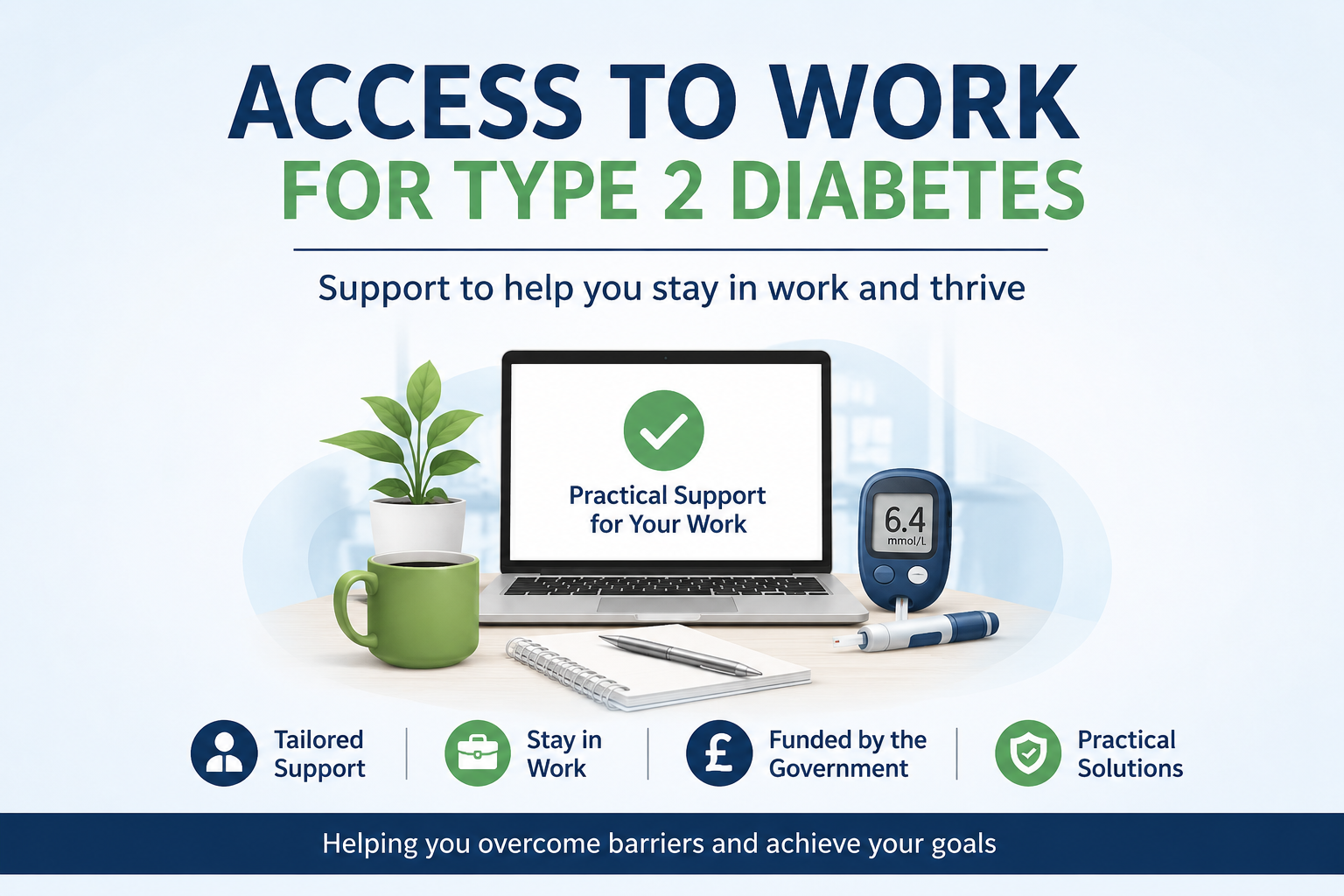
Access to Work for Type 2 Diabetes

Access to Work for Type 2 Diabetes

Living with Type 2 diabetes can present challenges at work, especially if you need regular blood sugar monitoring, medication, medical appointments or adjustments to your working environment. The good news is that the UK Government’s Access to Work scheme may be able to provide practical and financial support that helps you stay in work or start a new job.

Many people assume Access to Work is only available for people with severe physical disabilities, but this is not the case. Long term health conditions, including Type 2 diabetes, may qualify if they create substantial difficulties in the workplace.

This guide explains everything you need to know about Access to Work for Type 2 Diabetes, including who can qualify, what support may be available, how applications are assessed and how to maximise your chances of receiving assistance.

Quick Answer

Can you get Access to Work for Type 2 Diabetes?

Yes. You may be eligible for Access to Work for Type 2 Diabetes if your condition creates practical difficulties that make it harder to do your job and reasonable adjustments from your employer alone are not enough. Support is based on your individual needs rather than simply having a diagnosis.

What Is Access to Work for Type 2 Diabetes?

What does Access to Work provide?

Access to Work is a Government funded programme designed to remove barriers that disabled people and those with long term health conditions face in employment.

For someone living with Type 2 diabetes, the scheme can provide funding towards practical workplace support that helps you perform your job safely and effectively.

Unlike benefits such as Universal Credit or Personal Independence Payment, Access to Work is not a regular cash payment. Instead, it helps pay for support that allows you to work.

Support is individually assessed and tailored to your circumstances.

Who Can Claim Access to Work for Type 2 Diabetes?

Who is eligible?

You may qualify if you:

  • Live in England, Scotland or Wales
  • Are aged 16 or over
  • Have a disability or long term health condition that affects your ability to work
  • Have a paid job
  • Are about to start employment
  • Are self employed
  • Have a work placement
  • Are starting an apprenticeship
  • Are attending a job interview requiring support

Having Type 2 diabetes alone does not automatically qualify you.

The important question is whether your diabetes creates practical workplace difficulties.

Eligibility Requirements

How is eligibility assessed?

The Department for Work and Pensions considers how your diabetes affects your ability to carry out your job.

Examples include:

  • Frequent blood glucose monitoring
  • Insulin injections during working hours
  • Fatigue caused by unstable blood sugar
  • Risk of hypoglycaemia
  • Neuropathy affecting mobility
  • Diabetic retinopathy affecting vision
  • Medical appointments impacting working arrangements
  • Difficulties travelling safely to work
  • Need for specialist equipment
  • Requirement for flexible working arrangements

Every application is assessed individually.

Examples of workplace barriers

Workplace Challenge Possible Access to Work Support
Vision problems Specialist screen equipment
Mobility issues Taxi support or travel assistance
Fatday fatigue Flexible workplace recommendations
Frequent glucose monitoring Adapted working arrangements
Neuropathy Ergonomic furniture
Reduced dexterity Adaptive equipment

Income Rules

Does income affect Access to Work?

No.

There is no means test.

Your:

  • Salary
  • Household income
  • Partner’s earnings
  • Savings
  • Investments

do not normally affect whether you qualify.

Access to Work focuses entirely on how your health condition affects your ability to work.

Savings Rules

Do savings affect Access to Work?

No.

Unlike many means tested benefits, Access to Work does not have savings limits.

Whether you have no savings or substantial savings generally makes no difference to your eligibility.

How Much Could You Receive?

How much support is available?

There is no standard payment because Access to Work funds practical support rather than paying benefit income.

Support may include funding towards:

Support Example
Specialist equipment Adjustable workstation
Travel costs Taxi fares where public transport is unsuitable
Support workers Practical workplace assistance
Mental health support Workplace mental health service
Communication support Specialist assistance if required
Workplace adaptations Equipment tailored to individual needs

The amount awarded depends entirely on your assessed needs.

Some awards may be worth a few hundred pounds while others can be worth many thousands of pounds where specialist support is required.

How To Apply

How do you apply for Access to Work?

Applications are made directly to the Department for Work and Pensions.

The process usually involves:

  1. Completing an application.
  2. Providing details about your job.
  3. Explaining how Type 2 diabetes affects your work.
  4. Describing the support you believe would help.
  5. Taking part in an assessment if required.
  6. Receiving a decision.
  7. Arranging approved support.

Many applicants are contacted by an Access to Work adviser to discuss their circumstances.

The adviser may recommend additional support you had not considered.

What Documents Will You Need?

What evidence should you prepare?

Having good evidence can help demonstrate your workplace needs.

Useful documents include:

  • National Insurance number
  • Employer details
  • Job description
  • Medical evidence where relevant
  • Details of medication
  • Occupational health reports
  • Workplace risk assessments
  • Evidence of previous adjustments
  • Quotes for specialist equipment if available

Not every applicant will need every document.

What Support Can Someone With Type 2 Diabetes Receive?

What practical help could be funded?

Every case is different, but examples include:

Workplace equipment

This could include:

  • Ergonomic seating
  • Height adjustable desks
  • Specialist computer equipment
  • Voice recognition software where vision is affected

Travel support

If complications make public transport difficult, Access to Work may contribute towards:

  • Taxi journeys
  • Alternative travel arrangements

Workplace assessments

An assessor may recommend changes that make working easier and safer.

Flexible adjustments

Recommendations may include:

  • Scheduled breaks
  • Safe areas for glucose testing
  • Time for insulin administration
  • Flexible working arrangements

Does Your Employer Have Responsibilities?

Can your employer simply refuse adjustments?

No.

Employers have legal duties under equality legislation to consider reasonable workplace adjustments.

Access to Work is designed to complement these responsibilities rather than replace them.

In many cases:

  • Employers provide reasonable adjustments.
  • Access to Work funds additional specialist support.

What Happens After You Apply?

What is the assessment process?

Most applicants experience several stages.

Stage What Happens
Application Initial information submitted
Review Eligibility checked
Assessment Needs discussed
Recommendation Suitable support identified
Decision Funding approved where appropriate
Implementation Support arranged

Processing times vary depending on demand and the complexity of each case.

What Happens If Your Circumstances Change?

Should you report changes?

Yes.

You should tell Access to Work if:

  • You change jobs.
  • Your employer changes.
  • Your condition improves.
  • Your condition worsens.
  • Your workplace changes.
  • Your working hours change.
  • You become self employed.

Your support package may need reviewing.

Common Mistakes To Avoid

What mistakes delay applications?

Many applicants make avoidable errors.

These include:

  • Assuming diabetes automatically qualifies.
  • Not explaining how work is affected.
  • Providing very little evidence.
  • Forgetting to mention travel difficulties.
  • Underestimating fatigue.
  • Focusing only on the diagnosis rather than workplace impact.
  • Waiting until problems become severe.
  • Not discussing adjustments with their employer.

The strongest applications clearly explain how diabetes creates barriers in the workplace and exactly what support would remove those barriers.

Examples And Real Life Scenarios

Office administrator

Sarah has diabetic retinopathy that makes reading multiple computer screens difficult.

Outcome:

Following assessment, specialist screen technology and workplace adaptations help reduce eye strain and improve productivity.

Delivery driver

David experiences occasional episodes of low blood sugar and struggles with long journeys on public transport before work.

Outcome:

Access to Work contributes towards suitable travel support while his employer adjusts shift patterns.

Self employed graphic designer

Emma works from home and develops diabetic neuropathy affecting her posture and mobility.

Outcome:

Funding helps provide ergonomic office equipment that enables her to continue running her business comfortably.

Retail supervisor

Michael requires regular blood glucose monitoring throughout long shifts.

Outcome:

An assessment recommends workplace adjustments allowing scheduled monitoring breaks without affecting customer service.

Comparison Table

Situation Likely Outcome
Type 2 diabetes with no workplace impact Usually unlikely to qualify
Diabetes causing workplace difficulties May qualify after assessment
Employer adjustments solve all problems Access to Work may not be needed
Additional specialist support required Funding may be available

Frequently Asked Questions

Can you get Access to Work for Type 2 diabetes?

Yes, if your diabetes creates practical barriers at work that require additional support.

Is Access to Work means tested?

No. Income and savings are not normally taken into account.

Do I need to receive Personal Independence Payment?

No. Receiving PIP is not a requirement.

Can self employed people apply?

Yes. Eligible self employed workers may qualify.

Can I apply before starting a new job?

Yes. People with a confirmed job offer can apply.

Does my employer have to apply?

No. Applications are usually made by the individual.

Will I receive money directly?

Support is usually arranged to pay for agreed workplace assistance rather than providing regular benefit payments.

Can temporary workers apply?

In many cases, yes, provided they meet the scheme’s eligibility requirements.

Will diabetes automatically qualify?

No. The assessment looks at how your condition affects your ability to work rather than the diagnosis itself.

Can support be reviewed later?

Yes. Awards can be reviewed if your circumstances or workplace needs change.

Related Benefits And Support Available

People with Type 2 diabetes may also wish to explore whether they qualify for other forms of support depending on how their condition affects daily living and work.

Possible support includes:

  • Personal Independence Payment
  • Universal Credit
  • Employment and Support Allowance where applicable
  • Carer’s Allowance for eligible carers
  • Blue Badge Scheme where eligibility criteria are met
  • Disabled Persons Railcard where applicable
  • Council Tax Reduction
  • Healthy Start Scheme for eligible families
  • NHS prescription support where qualifying conditions apply

Each scheme has its own eligibility rules, so qualifying for one does not automatically mean you qualify for another.

Information Reviewed Against Current UK Government Guidance And Official Sources

This article has been reviewed against current UK Government guidance relating to the Access to Work scheme, disability employment support and official Department for Work and Pensions information available at the time of writing.

Eligibility decisions are always made based on individual circumstances, current legislation and the evidence provided during the application process.

As Government guidance may change, applicants should always check the latest official information before applying.

Useful Government Resources

Useful official resources include information on:

  • Access to Work applications
  • Equality Act workplace rights
  • Disability employment support
  • Department for Work and Pensions guidance
  • Advisory, Conciliation and Arbitration Service guidance on workplace adjustments

These official sources provide the most up to date eligibility criteria and application procedures.

Conclusion

Access to Work for Type 2 Diabetes can make a significant difference to people whose condition affects their ability to work. The scheme is designed to remove workplace barriers through practical support rather than providing direct financial benefits.

If your diabetes makes travelling to work difficult, requires specialist equipment, affects your vision, causes fatigue or creates other challenges in your role, it is worth considering whether Access to Work could help. Every application is assessed individually, so taking time to explain your circumstances clearly and provide supporting evidence can improve your chances of receiving appropriate assistance.

Seeking support early can often help you remain in work, maintain your independence and continue developing your career with greater confidence.

Benefits Advice UK provides free information to help people better understand the UK benefits system. Always check the latest Government guidance before making financial decisions.

imporatant_image

Important

Information on this site is based on official UK guidance.

About our information and sources
Inbox Background
Newsletter Image

Get the latest updates to your inbox

Sign up for our newsletter to receive updates when there are changes to Universal Credit.