
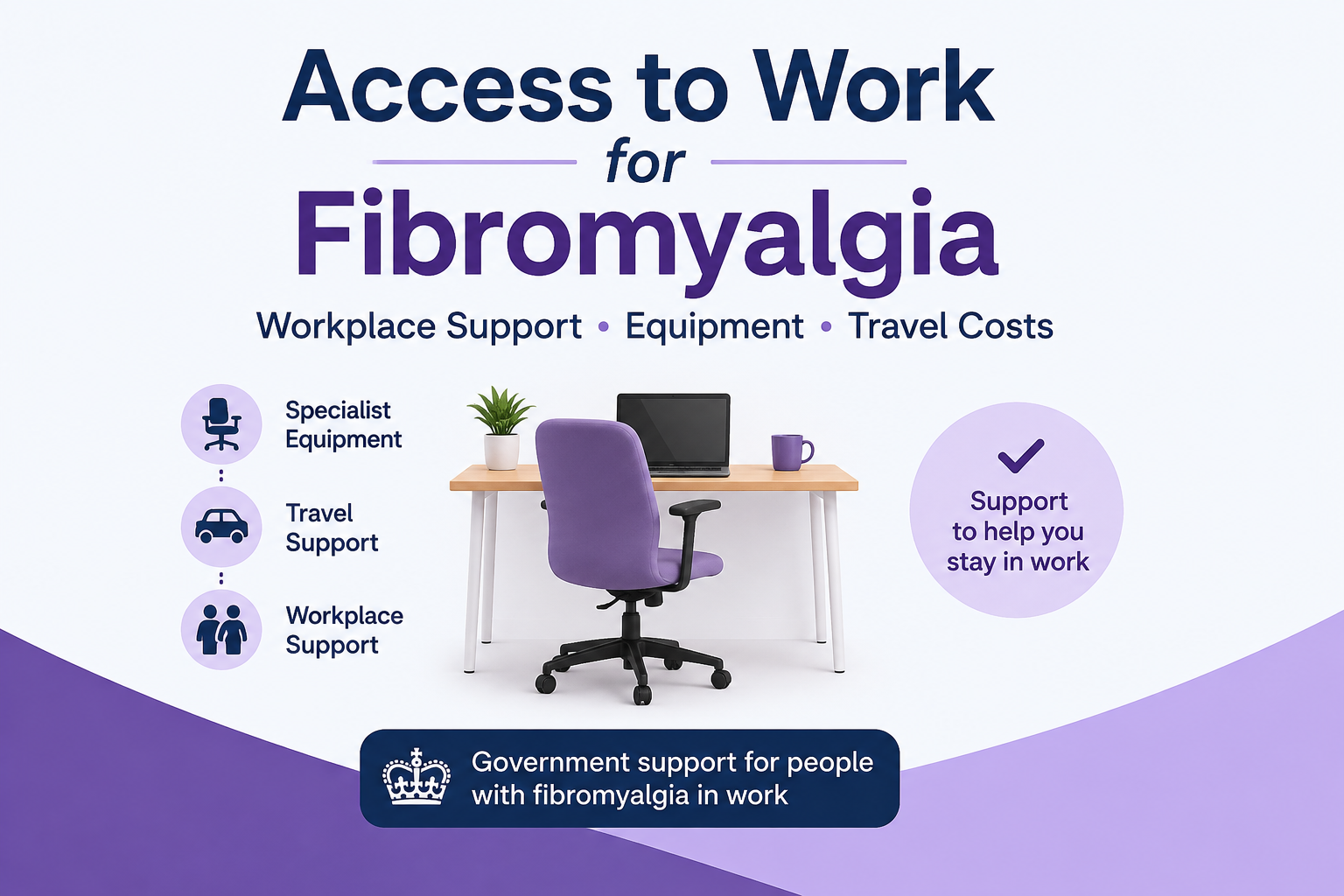
Living with fibromyalgia can make working challenging. Symptoms such as persistent pain, fatigue, poor sleep, stiffness and brain fog can affect your ability to travel to work, complete tasks or maintain a full working day. Fortunately, the UK Government’s Access to Work scheme may be able to provide practical and financial support that helps you stay in work or start a new job.
This guide explains who can apply, what support may be available, how the application process works and common mistakes to avoid. Whether you are employed, self employed or about to begin a new role, understanding Access to Work for Fibromyalgia could make a significant difference to your working life.
Can you get Access to Work for Fibromyalgia?
Yes. People with fibromyalgia may qualify for Access to Work if their condition creates practical difficulties in the workplace and they meet the scheme’s eligibility requirements. Support is based on your individual needs rather than your diagnosis alone. Depending on your circumstances, Access to Work could pay towards specialist equipment, workplace adaptations, travel costs, support workers or mental health support.
Access to Work for Fibromyalgia is Government funded support designed to remove workplace barriers caused by the condition.
Access to Work is a discretionary grant administered by the Department for Work and Pensions. It helps disabled people and people with long term health conditions remain in employment by funding practical support that goes beyond what employers are legally required to provide under the Equality Act 2010.
Fibromyalgia is recognised as a long term health condition. While every person experiences different symptoms, many people find that pain, fatigue, cognitive difficulties and mobility issues affect their working lives.
Rather than paying money directly as an income replacement benefit, Access to Work provides funding for specific workplace support.
The amount awarded depends entirely on individual needs.
You may qualify if your fibromyalgia affects your ability to do your job or travel to work and you meet the eligibility conditions.
Generally, applicants should:
You do not have to receive Personal Independence Payment or any other disability benefit to qualify.
Eligibility depends on how fibromyalgia affects your work rather than simply having the diagnosis.
Decision makers will consider:
| Requirement | Explanation |
|---|---|
| Long term condition | Usually expected to last at least 12 months |
| Workplace impact | Symptoms make working or travelling difficult |
| Paid work | You are employed or self employed, or starting eligible work |
| Additional support needed | Support required goes beyond reasonable employer adjustments |
Examples of workplace difficulties include:
Each application is assessed individually.
No. There are no income limits for Access to Work grants.
Unlike many means tested benefits, Access to Work does not assess:
Your financial circumstances are generally not relevant.
The assessment focuses on the practical support you need to remain in work.
No. Your savings do not normally affect eligibility.
There is no savings threshold similar to those used for Universal Credit or Pension Credit.
Whether you have little savings or substantial savings, the assessment focuses on your disability related workplace needs.
There is no standard payment. Grants are tailored to your individual circumstances and support needs.
The amount depends on:
Examples of funded support include:
| Type of Support | Possible Help |
|---|---|
| Travel | Taxi costs where public transport is unsuitable |
| Equipment | Specialist chairs, desks and keyboards |
| Technology | Voice recognition software and adapted IT |
| Support Worker | Assistance with workplace tasks |
| Coaching | Disability employment support |
| Mental Health | Workplace mental health service |
Support can sometimes continue for several years, with reviews where necessary.
Applications can usually be made online or by telephone before or after starting work.
The process usually involves:
Complete an application.
Provide details about:
An adviser may contact you to discuss your circumstances.
A workplace assessment may be arranged if specialist recommendations are needed.
A decision is made and, if approved, funding arrangements are confirmed.
Applications should be made as early as possible, especially when starting a new job.
Having accurate information ready can speed up your application.
Useful documents include:
Medical evidence is not always requested immediately but can strengthen your application if your symptoms require specialist support.
Many delays occur because people underestimate how their condition affects their work.
Avoid these common mistakes.
Explain your daily difficulties fully.
Describe how fibromyalgia affects specific work tasks.
Fatigue is often one of the biggest workplace barriers.
Brain fog can significantly affect productivity.
Apply as soon as you know support will be needed.
Applications are usually made by the employee.
The following examples illustrate how the scheme may work.
| Situation | Possible Outcome |
|---|---|
| Office worker unable to sit comfortably | Ergonomic chair and adjustable desk funded |
| Employee struggles with commuting | Taxi support approved during flare ups |
| Home worker experiences wrist pain | Adapted keyboard and mouse provided |
| Employee experiences severe fatigue | Flexible equipment and workplace adjustments recommended |
| Self employed graphic designer | Specialist software and adapted workstation funded |
Every application is assessed individually and different outcomes are possible.
Yes. If fibromyalgia creates workplace difficulties and you meet the eligibility criteria, you may qualify.
No. Receiving PIP is not a requirement.
Yes. Self employed workers can qualify if they meet the eligibility rules.
Yes. People with a confirmed job offer can often apply before their employment begins.
No. It funds practical workplace support rather than replacing income.
Yes. Access to Work is separate from Universal Credit.
Yes. Equipment and support may be available where appropriate.
In most cases your employer will become involved because workplace arrangements may need to be discussed.
Not always. However, evidence may be requested if it helps assess your support needs.
Tell Access to Work if your circumstances or workplace needs change. Your support package may be reviewed.
If you disagree with the decision, you can ask for it to be looked at again and provide any additional information that supports your case.
People with fibromyalgia may also qualify for other forms of financial support depending on their circumstances.
| Benefit or Support | Purpose |
|---|---|
| Personal Independence Payment | Helps with extra disability related costs |
| Universal Credit | Support for people on a low income |
| Employment and Support Allowance | Financial support for some people unable to work |
| Carers Allowance | Support for eligible carers |
| Council Tax Reduction | Help with council tax bills |
| Blue Badge | Parking concessions for eligible people |
| Disabled Facilities Grant | Home adaptations in qualifying cases |
| Motability Scheme | Vehicle leasing for eligible disability benefit recipients |
Each benefit has separate eligibility rules.
Information in this guide has been reviewed against current UK Government guidance and official sources.
Useful official resources include:
Always refer to the latest Government guidance before making decisions or submitting an application, as eligibility rules and administrative processes can change.
This article has been prepared using current publicly available UK Government guidance relating to Access to Work, disability employment support and workplace adjustments.
While every effort has been made to ensure accuracy, each application is assessed individually. Having fibromyalgia does not automatically guarantee an award, and the level of support depends on your personal circumstances and workplace needs.
Access to Work for Fibromyalgia can provide valuable practical support that enables many people to remain in employment, start a new career or continue running their own business despite the challenges of a long term health condition.
The scheme is designed to remove workplace barriers rather than replace income, making it an important source of support for people whose symptoms affect travel, mobility, concentration or day to day work activities. Because awards are based on individual needs, it is important to explain clearly how fibromyalgia affects your job and what support would help you perform your role safely and effectively.
Applying early, providing detailed information and keeping records of your workplace difficulties can improve the application process and help ensure the right support is considered.
Benefits Advice UK provides free information to help people better understand the UK benefits system. Always check the latest Government guidance before making financial decisions.

Information on this site is based on official UK guidance.
About our information and sources


Sign up for our newsletter to receive updates when there are changes to Universal Credit.