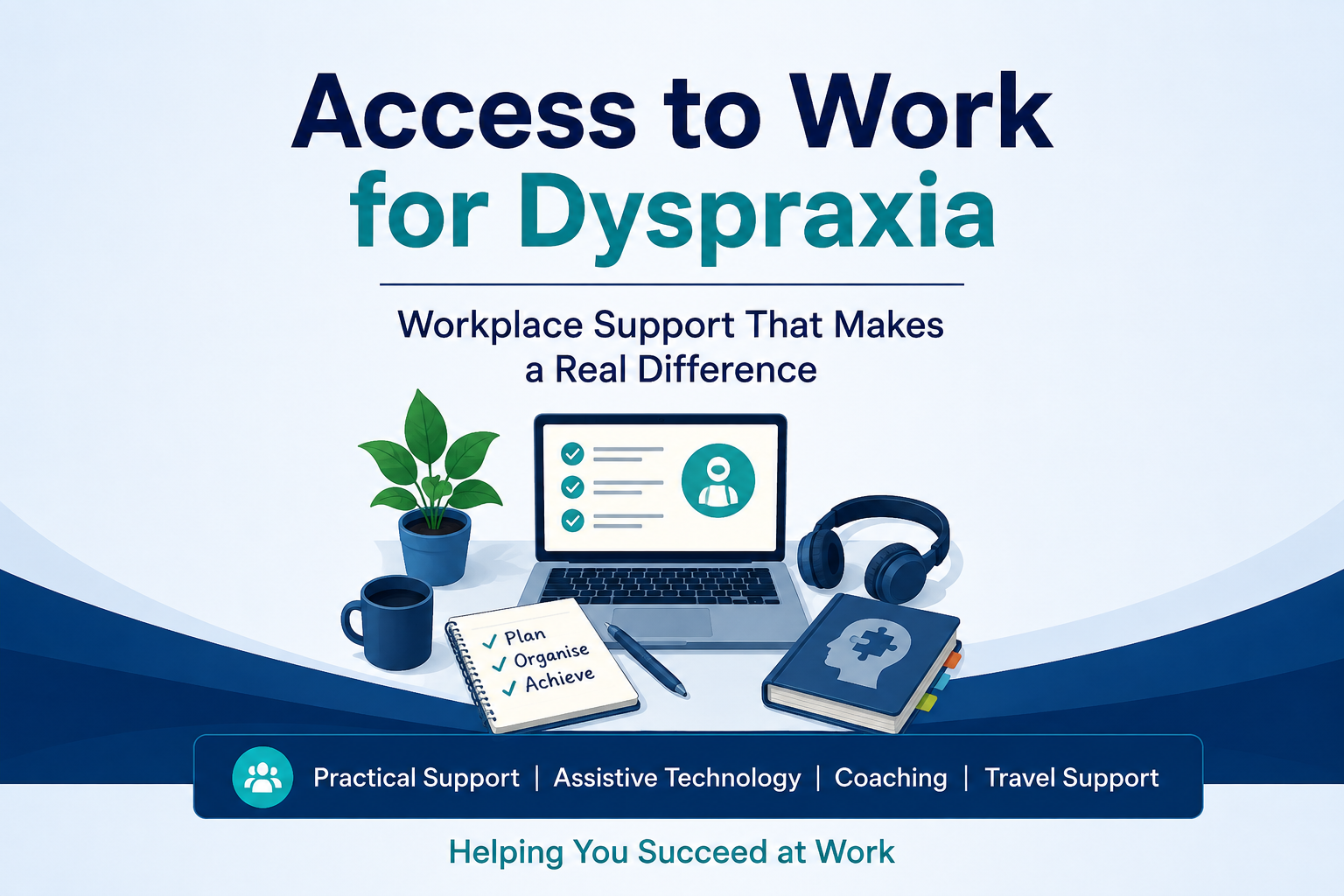
Access to Work for Dyspraxia

Access to Work for Dyspraxia

Living with dyspraxia can make certain aspects of work more challenging, but it should never prevent someone from building a successful career. The UK Government’s Access to Work scheme exists to help disabled people and those with long term health conditions overcome barriers in the workplace through practical and financial support.

If dyspraxia affects your ability to carry out your job, travel to work or communicate effectively in the workplace, you may be able to receive tailored support through Access to Work.

This guide explains everything you need to know about Access to Work for Dyspraxia, including who can apply, what support is available, how much funding may be provided and how to make a successful application.


Quick Answer

Can you get Access to Work for Dyspraxia?

Yes.

If your dyspraxia has a substantial and long term effect on your ability to do your job or travel to work, you may qualify for Access to Work support. The scheme can fund specialist equipment, workplace adjustments, job coaching, travel assistance and other practical support that helps you perform your role more effectively.

Every application is assessed individually, meaning support is tailored to your personal needs rather than your diagnosis alone.


What Is Access to Work for Dyspraxia?

What is Access to Work for Dyspraxia?

Access to Work for Dyspraxia is a Government funded scheme that provides practical support to help people with dyspraxia succeed in employment.

Unlike benefits that provide income, Access to Work focuses on removing workplace barriers.

Support can include:

  • Specialist equipment
  • Assistive technology
  • Workplace assessments
  • Training
  • Job coaching
  • Mental health support where appropriate
  • Support workers
  • Help with travelling to work if public transport is unsuitable

The aim is to help people stay in work, start employment or become self employed.


Who Can Claim Access to Work for Dyspraxia?

Who qualifies for Access to Work for Dyspraxia?

You may qualify if you:

  • Live in England, Scotland or Wales
  • Are aged 16 or over
  • Have dyspraxia that affects your work
  • Have the legal right to work in the UK
  • Are in paid employment, self employed, about to start work, undertaking a work trial or apprenticeship

People can apply whether they work:

  • Full time
  • Part time
  • From home
  • Hybrid
  • Permanently
  • On temporary contracts

You do not have to receive Personal Independence Payment or any other disability benefit before applying.


Eligibility Requirements

What are the eligibility requirements?

To qualify, your dyspraxia must have a significant impact on your ability to carry out your work.

Examples include difficulties with:

  • Organisation
  • Planning tasks
  • Time management
  • Coordination
  • Handwriting
  • Using certain equipment
  • Motor skills
  • Processing information
  • Following complex instructions
  • Workplace fatigue caused by increased concentration

An Access to Work adviser considers:

  • Your individual circumstances
  • Your job role
  • Your working environment
  • What reasonable adjustments your employer already provides
  • What additional support would enable you to work effectively

Having a formal diagnosis can strengthen an application, but decisions are based on workplace needs rather than the label itself.


Income Rules

Does income affect Access to Work?

No.

There are no income limits.

Whether you earn minimum wage or a professional salary does not affect eligibility.

The scheme exists to fund workplace support rather than replace income.

Income Level Effect on Claim
Low income No effect
Average income No effect
High income No effect
Self employed income No effect

Savings Rules

Do savings affect Access to Work?

No.

Savings are not means tested.

Whether you have no savings or substantial savings does not usually affect your entitlement.

Savings Impact
Under £6000 None
£16000 None
Higher savings None

How Much Could You Receive?

How much funding is available?

There is no standard payment amount.

Instead, Access to Work pays for agreed workplace support based on your individual circumstances.

Support may include funding for:

Type of Support Examples
Workplace assessment Specialist assessment of workplace needs
Equipment Ergonomic keyboards, specialist mice, adapted desks
Technology Speech recognition software, planning software, organisational apps
Coaching Executive functioning coaching, workplace mentoring
Training Time management strategies, productivity techniques
Support worker Practical workplace assistance
Travel Taxi costs where appropriate

Funding can amount to several thousand pounds depending on individual needs.

Some employers may be asked to contribute depending on business size and employment circumstances, particularly for existing employees.


How Can Access to Work Help Someone With Dyspraxia?

What workplace support is available?

Support varies according to your role.

Someone working in an office may receive different support from someone working in healthcare or construction.

Common support includes:

Specialist assessments

Experts identify workplace barriers and recommend practical solutions.

Assistive technology

Examples include:

  • Speech to text software
  • Digital planning tools
  • Reminder systems
  • Task management software
  • Mind mapping software

Ergonomic equipment

This may include:

  • Adjustable desks
  • Ergonomic keyboards
  • Alternative computer mice
  • Voice controlled equipment

Workplace coaching

Many people with dyspraxia benefit from coaching covering:

  • Organisation
  • Prioritisation
  • Managing workload
  • Memory techniques
  • Confidence building

Travel support

Where travelling independently is particularly difficult because of disability related needs, Access to Work may contribute towards alternative travel arrangements.


How To Apply

How do you apply for Access to Work for Dyspraxia?

Applications are completed directly through the Government.

The typical process is:

Step 1

Complete an online application or apply by telephone.

Step 2

Provide details about:

  • Your employer
  • Your role
  • Your disability
  • The difficulties you experience

Step 3

An adviser reviews your application.

Step 4

A workplace assessment may be arranged.

Step 5

Recommendations are produced.

Step 6

Funding is agreed where appropriate.

Step 7

Support is put into place.

Applying before starting a new job can often speed up support being available when employment begins.


What Documents Will You Need?

What information should you prepare?

Having information ready helps reduce delays.

You may need:

  • National Insurance number
  • Employer details
  • Job description
  • Contact information
  • Details of your diagnosis if available
  • Evidence explaining how dyspraxia affects your work
  • Quotes for equipment if requested
  • Workplace assessment reports where available

Medical evidence is not always required immediately but can support complex applications.


What Common Mistakes Should You Avoid?

What mistakes delay Access to Work applications?

Many applicants underestimate how much information to provide.

Common mistakes include:

  • Giving only the diagnosis without explaining workplace impact
  • Not describing specific difficulties
  • Waiting until problems become severe
  • Assuming employers will arrange everything
  • Forgetting to mention travel difficulties
  • Providing incomplete contact details
  • Missing requests for additional information

The strongest applications explain exactly how support would improve work performance.


Examples And Real Life Scenarios

What does Access to Work for Dyspraxia look like in practice?

Situation Outcome
Office administrator struggles with organisation Receives productivity software and workplace coaching
Graphic designer experiences coordination difficulties Receives adapted equipment and ergonomic workstation
Self employed consultant struggles with planning Receives executive functioning coaching
Employee finds travelling difficult Taxi support approved for work journeys where eligible
Apprentice needs additional workplace support Specialist assessment recommends software and mentoring

These examples are illustrative. Every application is assessed individually.


Can You Receive Access to Work Alongside Other Benefits?

Can Access to Work be claimed with other support?

Yes.

Access to Work does not usually prevent you receiving other benefits.

You may also receive, if eligible:

  • Personal Independence Payment
  • Universal Credit
  • Employment and Support Allowance
  • New Style Employment and Support Allowance
  • Adult Disability Payment in Scotland
  • Disability Living Allowance in certain circumstances

Each benefit has separate eligibility rules.


What Happens If Your Circumstances Change?

Should you report changes?

Yes.

You should notify Access to Work if:

  • You change employer
  • Your role changes significantly
  • Your working hours change
  • You become self employed
  • Your workplace support needs change
  • Your contact details change

Support may need reviewing to ensure it remains suitable.


Frequently Asked Questions

Can I get Access to Work if I have mild dyspraxia?

Possibly. Eligibility depends on how your condition affects your ability to work rather than how it is described medically.

Do I need a formal diagnosis?

A diagnosis can help, but applications focus on workplace impact and individual needs.

Can students apply?

Only if they meet the employment requirements, such as being in paid work or an apprenticeship.

Can self employed people apply?

Yes. Self employed workers can qualify if they meet the scheme’s conditions.

Does my employer apply for me?

No. Most applications are made by the individual.

Will Access to Work pay my wages?

No. The scheme funds workplace support rather than salary.

Can I receive specialist software?

Yes. Software is commonly funded where it helps overcome workplace barriers.

Is there a waiting period?

Processing times vary depending on demand and the complexity of your application.

Will my employer know?

Your employer will usually become involved where workplace adjustments or funding arrangements are required.

Can my support change in the future?

Yes. Support can be reviewed if your needs or job change.


Related Benefits And Support Available

What other support may help someone with dyspraxia?

Depending on your circumstances, you may also wish to explore:

Benefit or Scheme Purpose
Personal Independence Payment Helps with extra disability related living costs
Universal Credit Financial support for people on low income
Employment and Support Allowance Support for people whose health affects work
Disabled Students Allowance Support for eligible higher education students
Reasonable workplace adjustments Employer provided adjustments under equality legislation
Local authority employment support Help with finding and keeping work

Combining different forms of support can often provide a more complete package that helps someone remain in employment and develop their career.


Information Reviewed Against Current UK Government Guidance And Official Sources

This article has been reviewed against current UK Government guidance and official information available at the time of publication.

The information is intended to provide a clear explanation of how Access to Work operates for people with dyspraxia. Individual decisions are always based on personal circumstances and the evidence available during the assessment process.

As Government guidance and eligibility rules may change, applicants should always check the latest official information before making an application.


Useful Government Resources

Useful official resources include:

  • GOV.UK Access to Work guidance
  • Department for Work and Pensions
  • Jobcentre Plus
  • Equality Advisory and Support Service
  • ACAS guidance on workplace adjustments

These organisations provide the latest information on eligibility, applications and employment rights.


Conclusion

Access to Work for Dyspraxia can make a significant difference to someone’s working life by removing practical barriers that might otherwise limit employment opportunities. Whether you need specialist technology, workplace coaching, ergonomic equipment or support with travelling to work, the scheme is designed to help you perform your job with greater confidence and independence.

The most successful applications clearly explain how dyspraxia affects day to day work tasks and demonstrate how practical support would improve productivity and wellbeing. Remember that Access to Work is tailored to individual needs, so no two support packages are exactly the same.

If you believe dyspraxia is affecting your ability to work, applying as early as possible can help ensure the right adjustments are in place before difficulties become more significant.

Benefits Advice UK provides free information to help people better understand the UK benefits system. Always check the latest Government guidance before making financial decisions.

imporatant_image

Important

Information on this site is based on official UK guidance.

About our information and sources
Inbox Background
Newsletter Image

Get the latest updates to your inbox

Sign up for our newsletter to receive updates when there are changes to Universal Credit.