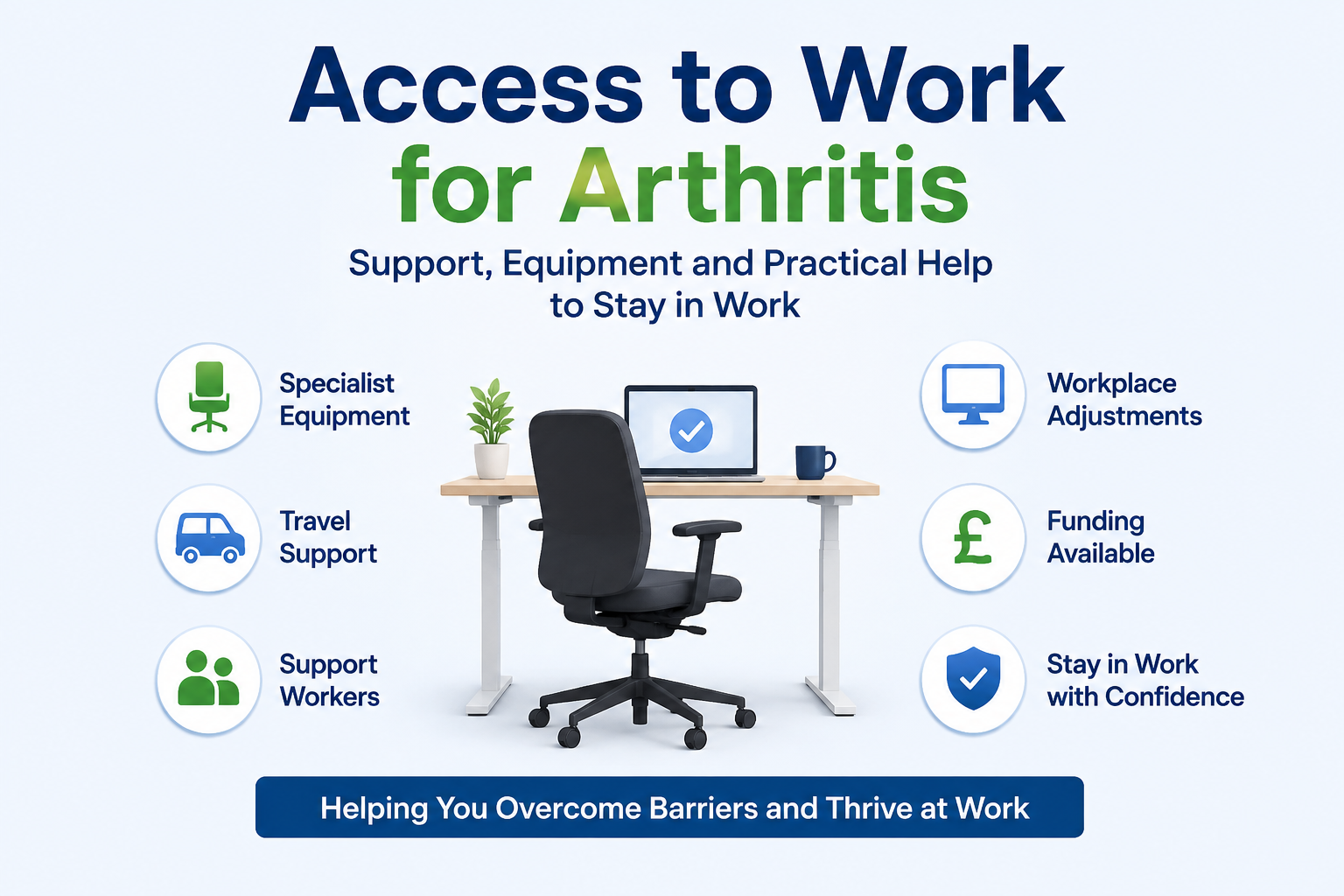
Living with arthritis can make work more challenging, but it does not necessarily mean you have to leave your job. If your condition affects your ability to carry out your role, the UK Government’s Access to Work scheme may be able to provide practical and financial support to help you stay in employment or start a new job.
This guide explains who can apply, what support is available, how much funding may be provided, how to apply and what happens after your application. Whether you have osteoarthritis, rheumatoid arthritis, psoriatic arthritis or another long term joint condition, this guide will help you understand your options.
Yes. If arthritis is affecting your ability to do your job or travel to work because of a disability or long term health condition, you may qualify for Access to Work. The scheme can provide grants towards specialist equipment, workplace adaptations, travel costs, support workers and other practical assistance. The amount awarded depends on your individual needs rather than your income or savings.
Access to Work for Arthritis is a Government funded grant that helps people whose arthritis creates barriers in the workplace.
Unlike most benefits, Access to Work is not a cash payment for everyday living costs. Instead, it helps pay for support that enables you to work more comfortably, safely and independently.
Support is designed around your individual circumstances after an assessment of your workplace needs.
The scheme aims to:
The diagnosis itself is less important than how it affects your daily work.
Examples include:
You may qualify if:
You generally cannot receive Access to Work if you are unemployed and not about to start work.
| Employment Status | May Qualify |
|---|---|
| Full time employee | Yes |
| Part time employee | Yes |
| Self employed | Yes |
| Apprentice | Yes |
| Work trial | Yes |
| Internship | Often |
| Volunteer only | Usually No |
Your arthritis must have a significant impact on your ability to do your job.
Examples include:
An adviser will normally assess:
Each application is assessed individually.
No.
Access to Work is not means tested.
Your:
do not normally affect whether you qualify.
Eligibility is based on disability related workplace needs rather than financial circumstances.
No.
Unlike many welfare benefits, there is no savings limit.
Whether you have no savings or substantial savings, your eligibility is based on how arthritis affects your work.
There is no standard payment because every award is individually assessed.
Funding can help cover:
| Support | May Be Funded |
|---|---|
| Ergonomic office chair | Yes |
| Height adjustable desk | Yes |
| Voice recognition software | Yes |
| Specialist keyboard | Yes |
| Ergonomic mouse | Yes |
| Workplace assessment | Yes |
| Taxi fares to work | Yes where eligible |
| Support worker | Yes |
| Adapted equipment | Yes |
| Disability awareness training | Yes |
The Government sets an annual maximum award, but most people receive funding based solely on the support recommended during their assessment.
Depending on your circumstances, Access to Work may fund:
You can apply online or by telephone.
The application process usually involves:
Complete the application.
Provide details about:
An adviser may contact you.
A workplace assessment may be arranged.
Recommendations are produced.
Funding is agreed where appropriate.
Equipment or services are arranged.
You may need:
Medical evidence is not always required immediately, but providing supporting information can help where requested.
Many people with arthritis benefit from relatively simple workplace changes.
Examples include:
| Workplace Challenge | Possible Support |
|---|---|
| Pain while sitting | Ergonomic chair |
| Joint stiffness | Sit stand desk |
| Poor grip | Specialist keyboard |
| Hand pain | Ergonomic mouse |
| Fatigue | Flexible equipment solutions |
| Difficulty travelling | Taxi funding where eligible |
| Standing all day | Seating adaptations |
| Lifting equipment | Mechanical aids |
The exact support depends on your assessment.
Yes.
Tell Access to Work if:
A review may be carried out to make sure your support remains appropriate.
Common mistakes include:
Providing detailed examples of how arthritis affects your work often leads to a more accurate assessment.
Sarah works in an office and has rheumatoid arthritis.
Typing throughout the day causes severe wrist pain.
Following an assessment, she receives funding for:
She continues working comfortably without reducing her hours.
David is a self employed electrician with osteoarthritis.
Kneeling and carrying equipment causes significant pain.
Access to Work helps fund adapted equipment that reduces strain and improves safety while working.
Louise cannot comfortably use public transport because standing causes severe joint pain.
Following assessment, Access to Work contributes towards taxi journeys so she can continue working.
| Situation | Likely Outcome |
|---|---|
| Mild arthritis with no work impact | Unlikely to qualify |
| Arthritis affecting daily work | May qualify |
| Difficulty travelling to work | Travel support may be available |
| Needs specialist equipment | Equipment may be funded |
| Employer already provides adjustments | Additional support may still be available |
Yes, provided your osteoarthritis creates difficulties at work and you meet the eligibility rules.
Yes. Rheumatoid arthritis is one of many long term conditions that may qualify.
No.
It is a Government grant that funds workplace support rather than everyday living costs.
No.
Access to Work itself does not normally reduce Universal Credit entitlement.
Yes.
Many self employed people with arthritis successfully receive Access to Work support.
Possibly.
Taxi support may be available where arthritis prevents you using public transport safely or reasonably.
Sometimes.
Depending on the type of support, payments may be made directly to your employer, supplier or reimbursed after approved purchases.
Yes.
You can apply if you have a confirmed job offer or are about to begin work.
Times vary depending on demand and whether an assessment is required.
Applying as early as possible is recommended.
No.
Receiving Personal Independence Payment is not a requirement for Access to Work.
People with arthritis may also qualify for other support depending on their circumstances.
Potential benefits include:
| Benefit or Support | Purpose |
|---|---|
| Personal Independence Payment | Daily living and mobility support |
| Attendance Allowance | Support for older people with care needs |
| Universal Credit | Help with living costs |
| Employment and Support Allowance | Income support in certain circumstances |
| Blue Badge | Easier parking for eligible disabled people |
| Disabled Persons Railcard | Reduced rail fares |
| Motability Scheme | Vehicle leasing for eligible benefit recipients |
| Council Tax Reduction | Help with council tax |
| Disabled Facilities Grant | Home adaptations |
Receiving one form of support does not automatically guarantee entitlement to another, as each scheme has different rules.
Information reviewed against current UK Government guidance and official sources.
Useful official resources include:
Always refer to the latest Government guidance, as eligibility rules and funding arrangements can change.
Access to Work for Arthritis can make a significant difference to people who want to remain in work despite the challenges of living with a painful or limiting joint condition. The scheme focuses on removing workplace barriers by funding practical support that helps people perform their jobs safely and effectively.
If arthritis affects your mobility, grip, stamina, comfort or ability to travel to work, it is worth exploring whether Access to Work could help. The support available is tailored to your individual needs rather than being based on your income or savings, making it an important resource for employees, apprentices and self employed workers across the UK.
Applying early, explaining clearly how your condition affects your work and providing accurate information can improve the assessment process and help ensure you receive the most appropriate support.
Benefits Advice UK provides free information to help people better understand the UK benefits system. Always check the latest Government guidance before making financial decisions.
Information on this site is based on official UK guidance.
About our information and sources
Sign up for our newsletter to receive updates when there are changes to Universal Credit.