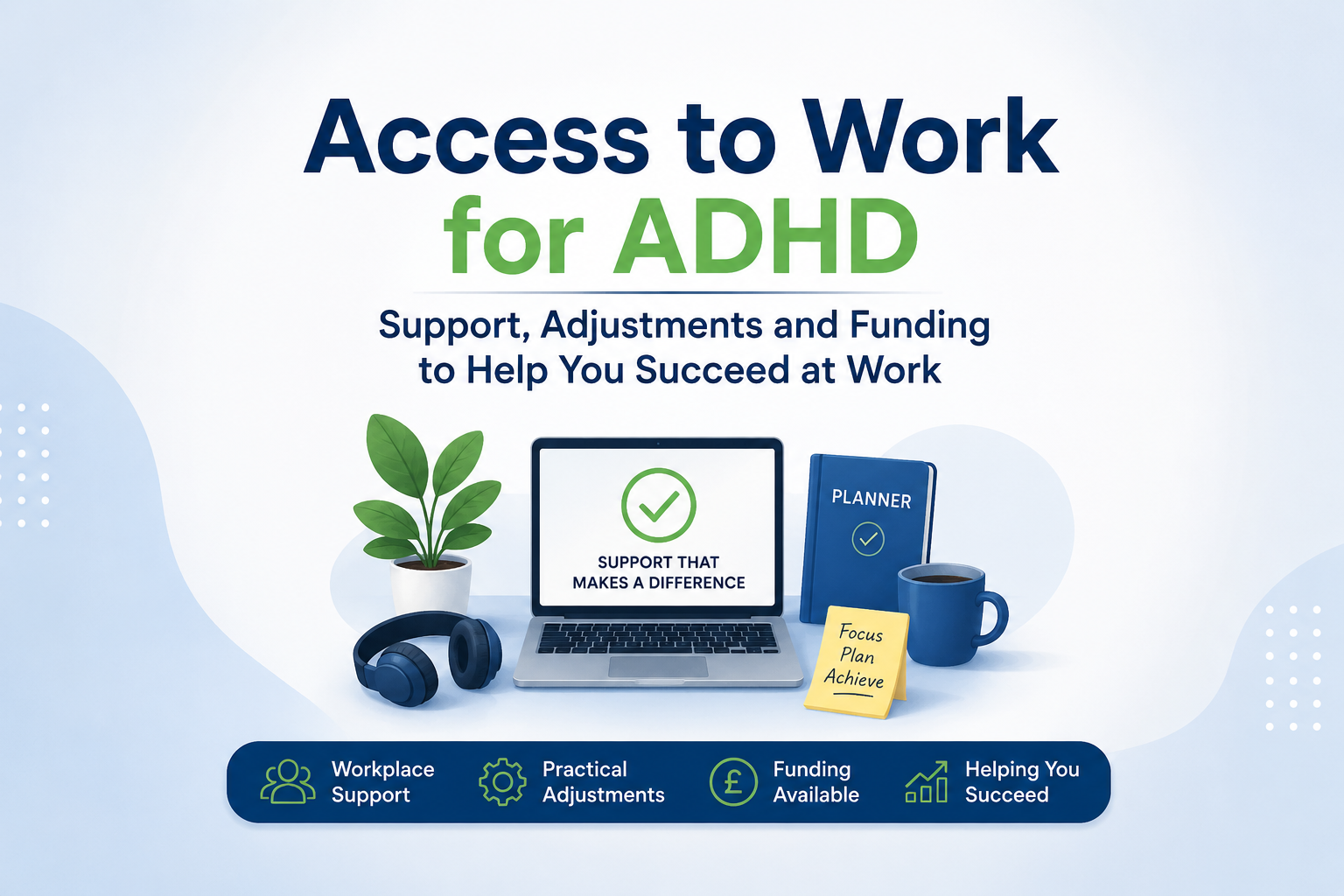
Living and working with Attention Deficit Hyperactivity Disorder, commonly known as ADHD, can present unique challenges in the workplace. Many people find that difficulties with concentration, organisation, time management or sensory distractions can affect their ability to perform at their best. Fortunately, the UK Government offers practical support through the Access to Work scheme.
If you have ADHD and your condition affects your ability to work, Access to Work may be able to fund specialist equipment, workplace coaching, travel support and other reasonable adjustments that help you succeed in employment.
This guide explains exactly how Access to Work for ADHD works, who can apply, what support is available and how to make a successful application.
Yes. If your ADHD has a significant impact on your ability to do your job or travel to work, you may qualify for Access to Work support. The scheme is available whether you have a permanent or temporary job, are self employed, are starting work or are taking part in a work placement. The amount of support depends on your individual needs rather than your income or savings.
Access to Work for ADHD is a Government funded employment support scheme that helps people with ADHD overcome barriers in the workplace.
Rather than paying money directly to you as a benefit, Access to Work provides funding for practical support that enables you to work effectively.
Support is personalised after an assessment of your needs.
The scheme recognises that ADHD affects people differently. Some people may need help with organisation and planning, while others benefit from specialist software, coaching or changes to their working environment.
Its purpose is to help people:
You may qualify if:
You do not need to receive Personal Independence Payment or any other disability benefit to qualify.
Many people with ADHD receive Access to Work even if they have never claimed disability benefits.
To qualify, your ADHD must create practical difficulties at work that go beyond the normal challenges experienced by colleagues.
Examples include:
The support must relate directly to helping you perform your job.
| Workplace Challenge | Possible Support |
|---|---|
| Difficulty focusing | Noise cancelling equipment or quiet workspace |
| Organisation issues | ADHD workplace coaching |
| Memory difficulties | Planning software and reminder systems |
| Time management | Digital productivity tools |
| Sensory distractions | Workplace adjustments |
No.
Access to Work is not means tested.
Your:
do not affect whether you qualify.
Support is based entirely on how your disability affects your work.
No.
Unlike some benefits, there are no savings limits.
Whether you have:
your savings do not normally affect eligibility.
There is no standard payment.
Instead, Access to Work pays for approved support based on your individual assessment.
Funding may include:
| Type of Support | Example |
|---|---|
| Workplace coaching | ADHD coaching sessions |
| Specialist software | Organisation and planning software |
| Equipment | Noise cancelling headphones |
| Travel support | Taxi fares where appropriate |
| Mental health support | Workplace mental health service |
| Support workers | Practical workplace assistance |
The annual maximum award changes periodically in line with Government policy.
Most applicants receive only the support they genuinely require.
Depending on your assessment, support could include:
Many applicants receive specialist coaching designed to improve:
Funding may cover software such as:
Examples include:
If ADHD prevents safe or practical use of public transport, Access to Work may contribute towards travel costs.
Applying is relatively straightforward.
Check you meet the eligibility rules.
Complete an Access to Work application online or by telephone.
Provide details about:
An adviser may arrange a workplace assessment.
Recommendations are produced.
Funding is approved where appropriate.
Support begins.
Having the correct information ready can make your application smoother.
You may need:
Medical evidence is not always requested immediately but can be helpful.
Examples include:
The assessment focuses on understanding your work rather than testing your ADHD.
An assessor may ask:
The aim is to recommend practical solutions.
Many applications are delayed because people focus only on their diagnosis.
Instead, explain how ADHD affects your work.
Avoid:
Remember that Access to Work is based on individual need.
Situation
Emily works in marketing.
She struggles with planning multiple deadlines and loses track of important tasks.
Outcome
Access to Work funds ADHD coaching and specialist planning software, helping her improve organisation and productivity.
Situation
David works in IT.
He becomes overwhelmed by noise in an open plan office.
Outcome
Funding is approved for noise reducing equipment and adjustments to his workspace.
Situation
Sarah is self employed.
She finds it difficult managing administration alongside client work.
Outcome
Access to Work provides coaching and organisational tools that help her run her business more effectively.
Usually not.
Many people receiving benefits such as:
can also receive Access to Work.
Each scheme has different eligibility rules.
| Question | Answer |
|---|---|
| Means tested | No |
| Savings limit | None |
| Income limit | None |
| Available to employed people | Yes |
| Available to self employed people | Yes |
| Available before starting work | Yes in many cases |
| Requires ADHD diagnosis | Usually evidence of disability is needed where requested |
| Provides cash payments | No |
| Funds workplace support | Yes |
Yes, provided your ADHD substantially affects your ability to work.
No.
No. It is a Government employment support scheme.
Yes.
Usually you apply yourself, although your employer may be involved later.
Yes, where coaching is recommended following assessment.
Yes, if specialist equipment is considered necessary.
Times vary depending on demand and the complexity of your case.
Yes.
No.
Yes, where ADHD creates significant barriers to using normal transport.
Yes. If your job changes or your support needs increase, your award can be reviewed.
Depending on your circumstances, you may also qualify for:
| Support | Purpose |
|---|---|
| Personal Independence Payment | Daily living and mobility support |
| Universal Credit | Financial support if on a low income |
| Employment and Support Allowance | Support for some people unable to work due to illness or disability |
| Disabled Students Allowance | Support for eligible students |
| Reasonable workplace adjustments | Employer provided changes under equality legislation |
This article has been reviewed against current UK Government guidance relating to the Access to Work scheme, disability support in employment and workplace adjustments. Eligibility and funding decisions are made on an individual basis, and Government policies can change over time. Applicants should always ensure they are using the most up to date official guidance when making an application.
The following official resources provide further guidance:
Access to Work for ADHD is one of the most valuable forms of employment support available in the UK. Rather than providing a cash benefit, it funds practical adjustments that help people overcome workplace barriers, remain in employment and build successful careers.
Whether you need specialist coaching, assistive technology, travel support or workplace adjustments, the scheme is designed to meet your individual needs rather than applying a one size fits all approach. There are no income or savings limits, and receiving other benefits does not usually prevent you from applying.
Applying as early as possible, providing clear examples of how ADHD affects your work and supplying relevant supporting information can improve the process and help ensure you receive the right level of support.
Benefits Advice UK provides free information to help people better understand the UK benefits system. Always check the latest Government guidance before making financial decisions.
Information on this site is based on official UK guidance.
About our information and sources
Sign up for our newsletter to receive updates when there are changes to Universal Credit.