
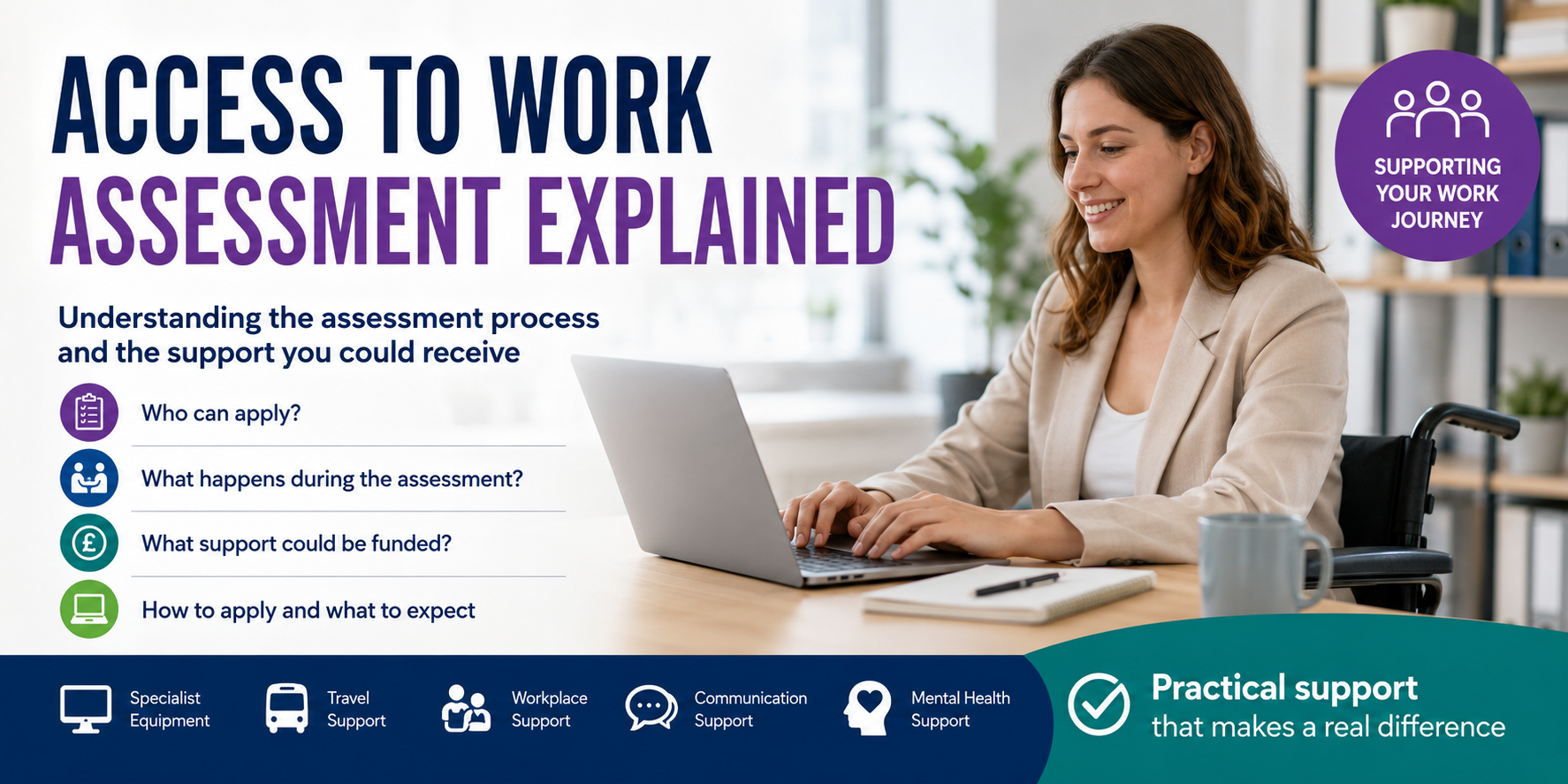
Many disabled people and those with long term physical or mental health conditions worry about what happens after applying for the Access to Work scheme. One of the most common questions is what the assessment involves, who carries it out and whether it is something to be concerned about.
This guide provides a complete Access to Work Assessment Explained resource that answers the most common questions in plain English. It explains what happens before, during and after the assessment, how decisions are made, what evidence may be required and what support could be funded.
Whether you are employed, self employed, starting a new job or returning to work after illness, understanding the assessment process can help you feel more confident and prepared.
An Access to Work assessment is a conversation designed to identify practical support that could help a disabled person or someone with a long term health condition do their job effectively.
It is not a medical examination or a benefits assessment. Instead, an adviser or specialist assessor discusses the difficulties you experience at work and recommends reasonable support, equipment or services that could remove workplace barriers.
An Access to Work assessment looks at how your disability or health condition affects your ability to carry out your job.
The purpose is to understand:
Unlike benefit assessments, the assessment focuses on solutions rather than deciding whether you are disabled enough.
Depending on your circumstances, the assessment may be completed:
The process is usually friendly, practical and centred around helping you succeed in work.
You may qualify if you:
You may also qualify if you are:
You normally cannot receive Access to Work if you:
To qualify you generally need to:
| Requirement | Explanation |
|---|---|
| Live in Great Britain | England, Scotland or Wales |
| Be aged 16 or over | Most applicants are adults entering work |
| Have a disability or health condition | Physical or mental condition lasting or expected to last at least 12 months |
| Be in paid work or about to start work | Includes self employment and apprenticeships |
| Need practical workplace support | Support must relate directly to your work |
The assessment considers how your condition affects your ability to perform your role rather than simply looking at your diagnosis.
No.
Access to Work is not means tested.
Your:
do not normally affect whether you qualify.
The assessment focuses entirely on your work related support needs.
No.
There are no savings limits.
Whether you have:
your eligibility is based on your disability related workplace needs rather than your financial circumstances.
There is no standard payment because every person’s circumstances are different.
Funding can cover a wide range of workplace support.
| Type of Support | May Be Funded |
|---|---|
| Specialist equipment | Yes |
| Adapted computer equipment | Yes |
| Ergonomic furniture | Yes |
| Voice recognition software | Yes |
| British Sign Language interpreter | Yes |
| Job coach | Yes |
| Mental health support | Yes |
| Travel to work | Yes |
| Taxi costs where appropriate | Yes |
| Workplace support worker | Yes |
| Communication support | Yes |
| Disability awareness training | Yes |
Support is tailored to individual needs.
Some employers may be expected to contribute towards certain costs depending on the size of the business and the type of support required.
Applying is straightforward.
Submit an Access to Work application.
You will normally need to provide:
Your application is reviewed.
An adviser contacts you to discuss your circumstances.
If needed, a specialist assessment is arranged.
Recommendations are produced.
Funding is approved where appropriate.
Support can then be arranged.
The discussion is designed to understand your daily working life.
You may be asked:
The assessor wants to understand practical solutions rather than test your condition.
You may be asked for:
Medical evidence is not always required, but providing useful information can help speed up the process.
After considering your circumstances, recommendations are made.
These may include:
If funding is approved, you will receive details explaining what has been agreed.
Timescales vary depending on demand and complexity.
Factors affecting waiting times include:
Straightforward cases are generally processed more quickly than complex applications.
Yes.
An application may not be approved if:
If circumstances change, you may be able to submit a new application or request a review where appropriate.
Avoid these common issues.
| Mistake | Better Approach |
|---|---|
| Giving very little information | Explain exactly how work is affected |
| Focusing only on diagnosis | Describe practical workplace difficulties |
| Forgetting fluctuating symptoms | Explain good and bad days |
| Assuming equipment is the only support | Consider travel, coaching and support workers |
| Waiting until problems become severe | Apply early |
| Not involving your employer | Keep them informed where appropriate |
Providing clear examples usually helps the assessor understand your needs.
Sarah has arthritis and struggles to use a standard keyboard.
Following her assessment she receives:
These adjustments reduce pain and improve productivity.
James experiences severe anxiety.
His assessment recommends:
He remains in employment with improved wellbeing.
Amira has significant hearing loss.
Her assessment identifies the need for:
These adjustments allow her to participate fully in meetings.
David has ADHD.
His assessment recommends:
These adjustments help improve concentration and organisation.
No. It is a workplace focused assessment rather than a medical assessment.
Not usually. Medical evidence may sometimes be requested but many assessments rely on discussions about your work.
Yes. If you have a confirmed job offer, you can usually apply before your first day.
Yes. Self employed people may qualify if they meet the scheme’s eligibility requirements.
Sometimes. Employer involvement can help identify practical workplace solutions, although discussions may initially take place with you alone.
No. Access to Work is separate from benefits such as Personal Independence Payment or Universal Credit.
Yes. Home workers may receive support where their disability creates work related barriers.
No. There is no charge for the assessment itself.
Yes. If your condition, job or workplace changes, support can sometimes be reviewed.
You can ask for further information, discuss the decision with Access to Work and consider submitting a new application if your circumstances change or additional evidence becomes available.
Depending on your circumstances, you may also qualify for:
| Scheme | Purpose |
|---|---|
| Personal Independence Payment | Helps with extra disability related costs |
| Universal Credit | Financial support for people on low incomes |
| Employment and Support Allowance | Support for people whose health affects work |
| Carer’s Allowance | Support for eligible carers |
| Disabled Students’ Allowance | Support for students with disabilities |
| Motability Scheme | Vehicle leasing through qualifying mobility benefits |
| Blue Badge Scheme | Parking concessions for eligible disabled people |
These schemes operate separately from Access to Work and have different eligibility rules.
Information reviewed against current UK Government guidance and official sources.
Useful resources include:
Always refer to official Government guidance before making decisions about your application.
Understanding the Access to Work Assessment Explained process can remove much of the uncertainty many applicants feel.
The assessment is designed to identify practical ways to help you stay in work, start a new role or perform your job more effectively. It is not a medical examination or a test to prove your disability. Instead, it focuses on understanding your individual circumstances and recommending appropriate workplace support.
Preparing clear examples of the difficulties you experience, providing relevant information and engaging openly during the assessment can help ensure that any recommendations accurately reflect your needs.
For many people, Access to Work funding provides life changing support through specialist equipment, travel assistance, workplace coaching, communication support and other adjustments that make employment more accessible and sustainable.
Benefits Advice UK provides free information to help people better understand the UK benefits system. Always check the latest Government guidance before making financial decisions.

Information on this site is based on official UK guidance.
About our information and sources


Sign up for our newsletter to receive updates when there are changes to Universal Credit.