
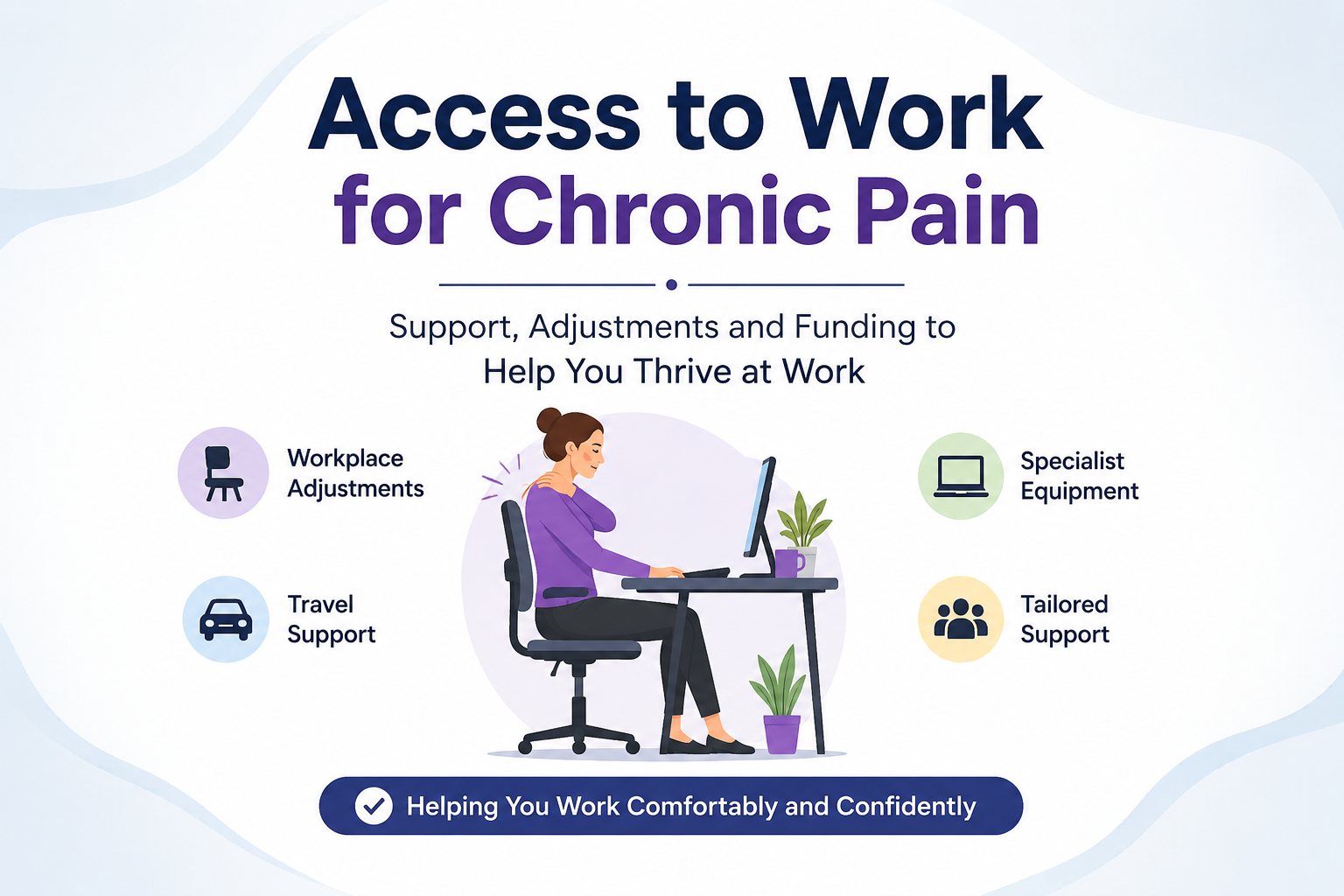
Living with chronic pain can make working extremely challenging, but it does not necessarily mean you have to leave employment or give up your career. Many people in the United Kingdom continue to work successfully with the right adjustments, specialist equipment and practical support.
Access to Work is a Government scheme designed to remove barriers faced by disabled people and those with long term health conditions, including chronic pain. Depending on your circumstances, it can provide funding for equipment, workplace adaptations, travel support and other assistance that enables you to remain in work or start a new job.
This guide explains everything you need to know about Access to Work for Chronic Pain, including who can qualify, what support may be available, how much funding could be provided, how to apply and common mistakes to avoid.
Yes. If chronic pain has a substantial and long term impact on your ability to do your job, you may qualify for Access to Work support. The scheme is not means tested and can provide funding towards specialist equipment, workplace adjustments, support workers, travel costs and communication support depending on your individual needs.
Access to Work for Chronic Pain is Government funded workplace support designed to help people whose long term pain affects their ability to work.
Unlike disability benefits, Access to Work is not paid as regular income. Instead, it provides practical help that allows you to carry out your job safely and effectively.
The support is tailored to each individual after an assessment of how their condition affects them in the workplace.
Chronic pain conditions can include:
The important factor is not the diagnosis itself but how the condition affects your ability to perform your work.
You may qualify if you:
You may also qualify if you are:
You do not need to receive Personal Independence Payment to qualify.
To qualify, the Department for Work and Pensions considers whether your chronic pain creates additional barriers in the workplace that would not normally be experienced by someone without your condition.
Examples include:
Each application is assessed individually.
| Workplace difficulty | Possible Access to Work support |
|---|---|
| Sitting causes severe pain | Ergonomic chair |
| Standing is difficult | Sit stand workstation |
| Keyboard use increases pain | Ergonomic keyboard and mouse |
| Travelling by bus is impossible | Taxi funding where appropriate |
| Pain limits lifting | Manual handling equipment |
| Fatigue affects productivity | Workplace assessment and adjustments |
No.
Access to Work is not means tested.
Your salary does not affect whether you qualify.
Whether you earn minimum wage or a professional salary, your application is assessed on your workplace needs rather than your income.
No.
There is no savings limit.
Unlike some means tested benefits, your personal savings, investments or property are not considered when deciding whether you qualify.
There is no standard payment because Access to Work pays for support rather than providing cash directly to applicants.
The amount depends entirely on your individual circumstances.
Support may include:
| Type of support | Examples |
|---|---|
| Specialist equipment | Ergonomic desks, specialist keyboards, supportive chairs |
| Workplace adaptations | Adjustable workstations, adapted furniture |
| Travel support | Taxi costs where public transport is unsuitable |
| Mental health support | Workplace coping strategies where relevant |
| Support workers | Practical workplace assistance where appropriate |
| Communication support | If additional communication needs exist |
Funding can sometimes cover ongoing support as well as one off purchases.
Applications are usually straightforward.
Check you meet the eligibility requirements.
Gather information about:
Complete an Access to Work application.
You may be contacted for further information.
A workplace assessment may be arranged.
A decision is made outlining what support will be provided.
Although every application differs, useful documents include:
Providing clear evidence of how chronic pain affects your work can help speed up the process.
Many delays happen because applicants do not explain how their condition affects work.
Avoid these common mistakes.
The more specific your examples, the easier it is for assessors to understand your needs.
The following examples are illustrative and show how workplace support may be used.
| Situation | Outcome |
|---|---|
| Office worker with fibromyalgia struggles sitting all day | Receives ergonomic chair and adjustable desk |
| Teacher with arthritis experiences painful standing | Workplace adjustments reduce time spent standing continuously |
| Graphic designer with chronic neck pain | Specialist monitor arm and ergonomic equipment improve comfort |
| Self employed consultant with persistent back pain | Funding helps purchase ergonomic office equipment |
| Employee unable to use buses because of severe pain flare ups | Travel support assists with journeys where eligible |
Every award is based on individual needs rather than diagnosis alone.
Yes. Receiving Personal Independence Payment does not prevent you from receiving Access to Work if you meet the eligibility criteria.
Yes. Self employed people may qualify if their chronic pain affects their work.
Yes. If you have a confirmed job offer, you can usually apply before your employment begins.
Your employer is usually involved because workplace adjustments may need to be arranged.
Sometimes you may initially pay for approved items and reclaim the cost, while in other cases suppliers are paid directly. The process depends on the agreed support.
Yes. If a workplace assessment recommends specialist seating, funding may be available.
It may help with travel costs if your disability or health condition means you cannot reasonably use public transport and other eligibility conditions are met.
It can be if it has a substantial and long term adverse effect on your ability to carry out normal daily activities.
Yes. Explain how your symptoms fluctuate and how this affects your work.
Yes. Support may be available where your home working environment requires adjustments because of your disability or long term health condition.
Depending on your circumstances, you may also be entitled to:
| Benefit or support | Purpose |
|---|---|
| Personal Independence Payment | Helps with extra disability related costs |
| Universal Credit | Financial support for people on a low income |
| Employment and Support Allowance | Support for eligible people whose ability to work is limited |
| Carers Allowance | Support for eligible carers |
| Blue Badge | Parking concessions for eligible disabled people |
| Disabled Persons Railcard | Discounted rail travel for eligible people |
| Motability Scheme | Vehicle leasing for eligible recipients of the enhanced mobility component of certain disability benefits |
Access to Work can often complement these forms of support because it focuses specifically on removing workplace barriers rather than replacing income.
Information reviewed against current UK Government guidance and official sources.
Useful resources include:
These official sources are updated periodically, so always refer to the latest guidance when making decisions about your application.
Access to Work for Chronic Pain can make a significant difference for people who want to remain in employment, start a new role or continue running their own business despite living with persistent pain.
The scheme recognises that barriers at work are often created by the working environment rather than by a person’s condition alone. By funding practical support such as specialist equipment, workplace adaptations, travel assistance and tailored assessments, Access to Work helps many people continue working safely, comfortably and confidently.
If chronic pain is affecting your ability to perform your job, it is worth exploring whether this Government scheme could provide the additional support you need. Every application is considered individually, and awards are based on the practical impact your condition has on your work rather than your income or savings.
Benefits Advice UK provides free information to help people better understand the UK benefits system. Always check the latest Government guidance before making financial decisions.

Information on this site is based on official UK guidance.
About our information and sources


Sign up for our newsletter to receive updates when there are changes to Universal Credit.