
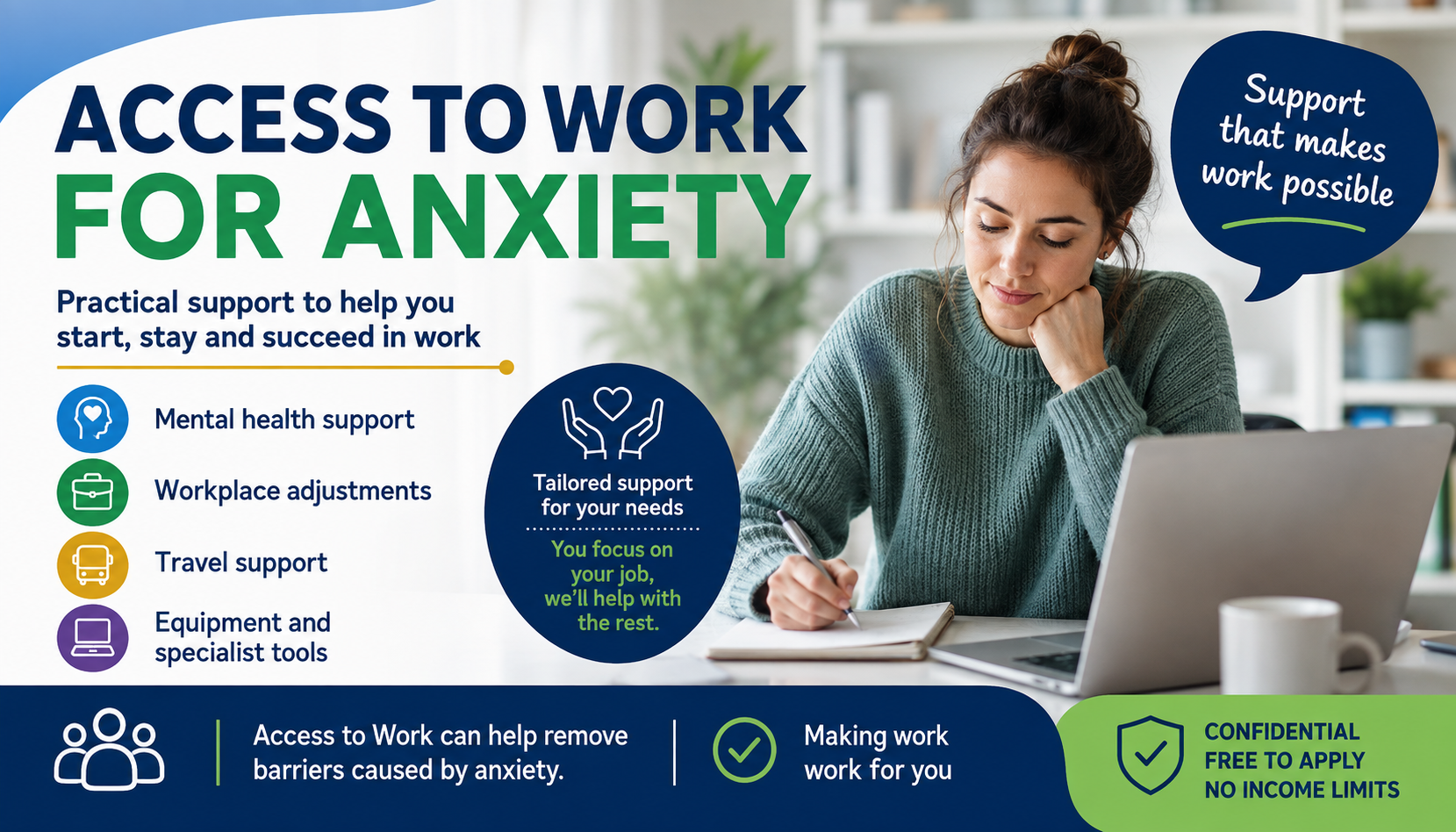
Living with anxiety can make work feel overwhelming, even when you have the skills and experience to succeed. The good news is that the UK’s Access to Work scheme may be able to help by funding practical support that enables people with disabilities and long term health conditions, including many anxiety related conditions, to stay in work or start a new job.
Whether you experience generalised anxiety disorder, panic disorder, social anxiety, health anxiety or another recognised mental health condition, Access to Work could help remove barriers that affect your ability to work.
This guide explains who qualifies, what support is available, how much funding you could receive and how to make a successful application.
Yes. If your anxiety has a substantial and long term impact on your ability to do your job or travel to work, you may qualify for Access to Work. The scheme can pay for practical workplace support such as specialist equipment, job coaching, mental health support services, travel assistance and other reasonable adjustments that go beyond what an employer is legally required to provide.
Access to Work for Anxiety is Government funded support that helps people whose anxiety creates practical barriers in the workplace.
Unlike benefits that provide income, Access to Work provides funding for practical support that helps you perform your job more effectively.
The support is personalised and depends on your individual circumstances rather than your diagnosis alone.
The scheme can help people who:
The aim is to remove workplace barriers and help people remain economically active.
You may qualify if all of the following apply.
| Requirement | Details |
|---|---|
| Age | You are aged 16 or over |
| Employment | You have a job, are about to start work or are self employed |
| Residence | You normally live and work in England, Scotland or Wales |
| Health condition | Your anxiety has a substantial and long term effect on your ability to work |
Anxiety conditions may include:
You do not automatically qualify because of your diagnosis. The assessment focuses on how your condition affects your work.
The main test is whether your condition creates significant workplace difficulties.
Examples include:
Your condition usually needs to have lasted, or be expected to last, at least 12 months.
Evidence from a GP, psychologist, psychiatrist or other healthcare professional can strengthen your application.
No.
There are no personal income limits for Access to Work.
Your salary does not affect whether you qualify.
Unlike means tested benefits, Access to Work is based on your disability related needs rather than your earnings.
| Income Level | Effect on Access to Work |
|---|---|
| Low income | No effect |
| Average income | No effect |
| High income | No effect |
No.
Your personal savings are not taken into account.
Whether you have no savings or significant savings, eligibility depends on your work related needs.
| Savings | Effect |
|---|---|
| Under £6000 | No effect |
| £16000 | No effect |
| Higher savings | No effect |
There is no standard payment.
The amount depends entirely on the support you require.
Examples of funded support include:
| Type of Support | Possible Funding |
|---|---|
| Mental health support service | Fully funded where approved |
| Specialist coaching | Based on assessed need |
| Taxi fares when public transport is unsuitable | May be funded |
| Noise cancelling equipment | May be funded |
| Specialist software | May be funded |
| Workplace adaptations | May be funded |
| Support worker | May be funded |
Funding is paid towards approved support rather than directly as cash to spend freely.
The Government sets an annual maximum award which is reviewed periodically.
Support varies depending on your circumstances.
Examples include:
Professional workplace mental health support to help you remain in employment.
A coach can help you develop coping strategies and workplace confidence.
If anxiety prevents you from safely using public transport, funding may help with alternative travel arrangements.
Examples include:
Recommendations may include:
Some adjustments are the employer’s responsibility under equality legislation, while Access to Work may fund additional support beyond those legal duties.
Applications can usually be made online or by telephone.
The process normally includes:
Complete the application.
You will provide:
An adviser reviews your application.
An assessment may be arranged.
This could involve discussing:
Recommendations are made.
Funding is agreed where appropriate.
Useful documents include:
You do not always need extensive medical evidence, but providing clear information usually helps.
The assessment focuses on practical barriers rather than judging your condition.
The assessor may ask:
Being open and honest usually leads to better recommendations.
Many applications are delayed because important information is missing.
Avoid these common errors.
| Mistake | Better Approach |
|---|---|
| Saying only “I have anxiety” | Explain how anxiety affects your work |
| Providing little evidence | Include medical and workplace information |
| Applying after leaving work | Apply as early as possible |
| Not explaining travel difficulties | Describe specific problems |
| Assuming employers pay for everything | Understand what Access to Work may fund |
Sarah works in a busy office.
Crowded environments trigger panic attacks.
Following an assessment, she receives funding for workplace coaching and recommendations for a quieter workspace.
Result:
She remains in employment and her attendance improves.
David is self employed.
His social anxiety makes client meetings extremely stressful.
Access to Work funds specialist coaching and communication support.
Result:
He builds confidence and continues growing his business.
Emma experiences severe anxiety when travelling during rush hour.
Alternative travel support is approved because public transport causes overwhelming panic attacks.
Result:
She can travel safely and reliably to work.
| Scheme | Main Purpose |
|---|---|
| Access to Work | Practical workplace support |
| Personal Independence Payment | Help with extra living costs |
| Universal Credit | Income related financial support |
| Employment and Support Allowance | Financial support for limited capability for work |
| Statutory Sick Pay | Temporary sick pay from an employer |
Yes, if your anxiety substantially affects your ability to work and you meet the eligibility criteria.
Not always, but medical evidence can strengthen your application.
Yes. You can apply once you have a job offer.
Yes.
No. Access to Work funding is separate from Universal Credit.
No. It funds practical workplace support rather than replacing your income.
Yes, where support is necessary because of your condition.
Times vary depending on demand and individual circumstances.
The application is normally made by you, although employers may assist with information.
Tell Access to Work if your needs change. Your support package may be reviewed.
If you disagree with the outcome, you can ask for the decision to be looked at again and provide additional evidence where appropriate.
Depending on your circumstances, you may also qualify for:
Access to Work can often be received alongside other benefits because it is designed to support employment rather than replace income.
This article has been reviewed against current UK Government guidance and official information relating to:
Government policies and funding arrangements can change. Always check the latest official guidance before making financial decisions or submitting an application.
Useful official sources include:
Access to Work for Anxiety can make a significant difference for people whose mental health creates barriers in the workplace. Rather than providing financial benefits directly, the scheme funds practical support that helps individuals start work, remain employed and progress in their careers.
The support available is tailored to each person’s needs and can include specialist coaching, workplace adjustments, travel assistance, assistive technology and mental health support services. Importantly, there are no income or savings limits, making the scheme accessible to people across a wide range of financial circumstances.
If anxiety is affecting your ability to work, applying early and providing clear information about how your condition impacts your daily job duties can improve your chances of receiving the right support.
Benefits Advice UK provides free information to help people better understand the UK benefits system. Always check the latest Government guidance before making financial decisions.

Information on this site is based on official UK guidance.
About our information and sources


Sign up for our newsletter to receive updates when there are changes to Universal Credit.