Living with a disability, long term health condition or mental health condition should not prevent you from finding or keeping a job. Many people need practical support at work, but worry about the cost of specialist equipment, travel or workplace adjustments.
The UK Government’s Access to Work scheme helps remove these barriers by providing grants towards the extra costs that arise because of a disability or health condition. The support is personalised and can cover a wide range of practical assistance that helps people start work, remain in employment or become self employed.
If you have ever wondered What Can Access to Work Pay For?, this guide explains everything you need to know, including who qualifies, what support is available, how much could be funded and how to apply.
Access to Work can pay for practical workplace support that goes beyond the reasonable adjustments an employer is legally expected to provide.
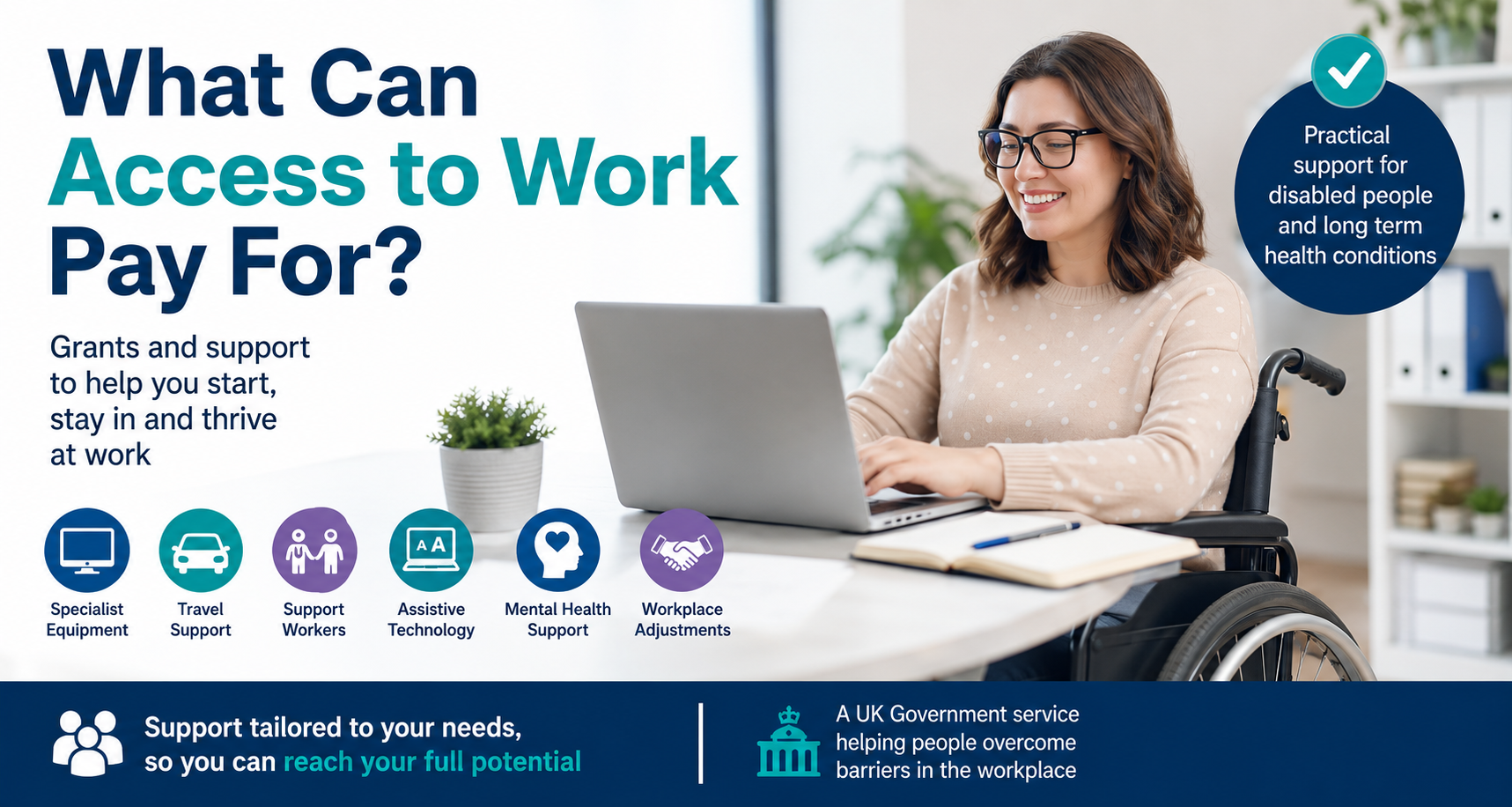
Depending on your circumstances, funding may cover:
The grant is based on individual needs rather than a fixed list of items.
Access to Work is a Government funded grant designed to help disabled people overcome barriers in the workplace.
Unlike benefits that provide income, Access to Work pays towards practical support that enables someone to work successfully.
The funding is available whether you are:
The support is tailored after an assessment of your individual needs.
You may qualify if you:
You must also:
| Situation | Could qualify |
|---|---|
| Office worker with hearing loss | Yes |
| Teacher with multiple sclerosis | Yes |
| Delivery driver with mobility impairment | Yes |
| Freelancer with visual impairment | Yes |
| Apprentice with autism | Yes |
| Employee with anxiety disorder | Yes |
Eligibility always depends on individual circumstances rather than diagnosis alone.
The scheme considers:
Access to Work does not replace an employer’s legal duty to make reasonable adjustments under equality legislation.
Instead, it provides additional help where adjustments involve significant costs or specialist support.
No.
There is no income test.
Your salary does not normally affect whether you qualify.
Whether you earn minimum wage or have a professional career, support is based on your workplace needs rather than your earnings.
No.
Unlike many means tested benefits, there are no savings limits.
The amount you have in your bank account does not usually affect eligibility.
This makes Access to Work different from many other forms of financial support.
There is no standard payment because every award is individually assessed.
The grant can range from a few hundred pounds for equipment to many thousands of pounds where ongoing specialist support is required.
Support depends on:
Some people receive a one off payment for equipment.
Others receive ongoing funding throughout employment.
| Support | Possible funding |
|---|---|
| Specialist computer equipment | Yes |
| Ergonomic furniture | Yes |
| Screen readers | Yes |
| Speech recognition software | Yes |
| Sign language interpreter | Yes |
| Support worker | Yes |
| Taxi fares | Yes |
| Job coach | Yes |
| Mental health support | Yes |
| Workplace adaptations | Yes |
The amount approved depends on an individual assessment.
Yes.
One of the most common grants covers specialist equipment that enables someone to perform their job safely and effectively.
Examples include:
Access to Work usually does not pay for a standard computer that any employee would require.
However, it may contribute towards:
Yes.
Assistive technology is one of the largest areas of Access to Work support.
Examples include:
Yes.
If your disability means you cannot reasonably use public transport, Access to Work may help with additional travel costs.
Examples include:
This support helps people travel safely to and from work.
Yes.
Support workers are available where practical assistance is needed during work.
Examples include:
Yes.
Funding may include:
This helps employees communicate effectively in meetings, training sessions and everyday work.
Yes.
People experiencing mental health conditions may receive practical workplace support.
This can include:
Yes.
Funding may contribute towards workplace changes such as:
Yes.
Where appropriate, the scheme may fund disability awareness training that helps colleagues better understand an employee’s needs.
This can improve communication and workplace inclusion.
Applications can usually be made online or by telephone.
The process normally includes:
Many applicants receive an assessment that identifies the most appropriate support.
Applicants should be prepared to provide:
Medical evidence is not always required immediately but may sometimes be requested.
Common errors include:
Many invisible disabilities also qualify.
Applying early often allows problems to be resolved before they become more serious.
Access to Work exists to help with additional disability related costs beyond normal employer responsibilities.
The assessment focuses on how your condition affects work rather than your medical diagnosis alone.
Changes in employment or support needs should be reported promptly.
Sarah has severe arthritis.
Access to Work funds:
She continues working comfortably from the office and home.
James is profoundly deaf.
Funding provides:
This enables him to fully participate in his role.
Emma has severe anxiety.
She receives:
This helps her remain in employment and build confidence.
| Workplace challenge | Access to Work support |
|---|---|
| Cannot use public transport | Taxi funding |
| Hearing impairment | Interpreter support |
| Visual impairment | Screen reading software |
| Physical disability | Specialist equipment |
| Mental health condition | Workplace mental health support |
| Learning disability | Job coach |
Usually no, unless they are specialist disability related equipment that goes beyond ordinary prescription glasses required for work.
It may contribute towards specialist adaptations rather than a standard laptop.
Yes, where public transport is unsuitable because of your disability and the additional travel costs are approved.
Yes. Eligible self employed people can apply if they meet the scheme’s conditions.
No. Receiving Access to Work funding does not normally reduce Universal Credit.
No. It is separate from Personal Independence Payment and does not replace disability benefits.
Yes. If ADHD creates workplace barriers that require additional support, funding may be available.
Yes. Many autistic employees receive workplace support through the scheme.
Yes. If you have accepted a job offer, you can usually apply before your employment begins.
If your circumstances change significantly, your Access to Work support may need to be reviewed to ensure it still meets your needs.
Depending on your circumstances, you may also qualify for:
Each scheme has separate eligibility criteria and should be considered independently.
Information reviewed against current UK Government guidance and official sources.
Useful resources include:
These organisations provide the latest eligibility rules, application guidance and workplace rights information.
Access to Work is one of the UK’s most valuable employment support schemes for disabled people and those with long term health conditions. Rather than providing income, it funds practical solutions that make work more accessible and sustainable.
Support can include specialist equipment, assistive technology, travel costs, support workers, communication assistance, workplace adaptations and mental health support. Awards are based on individual needs, and there are no income or savings limits for eligibility.
If your disability or health condition creates extra barriers at work, it is worth exploring whether Access to Work could provide the support you need. Applying early and providing clear information about how your condition affects your job can help ensure your application is assessed effectively.
Benefits Advice UK provides free information to help people better understand the UK benefits system. Always check the latest Government guidance before making financial decisions.
Information on this site is based on official UK guidance.
About our information and sources
Sign up for our newsletter to receive updates when there are changes to Universal Credit.