
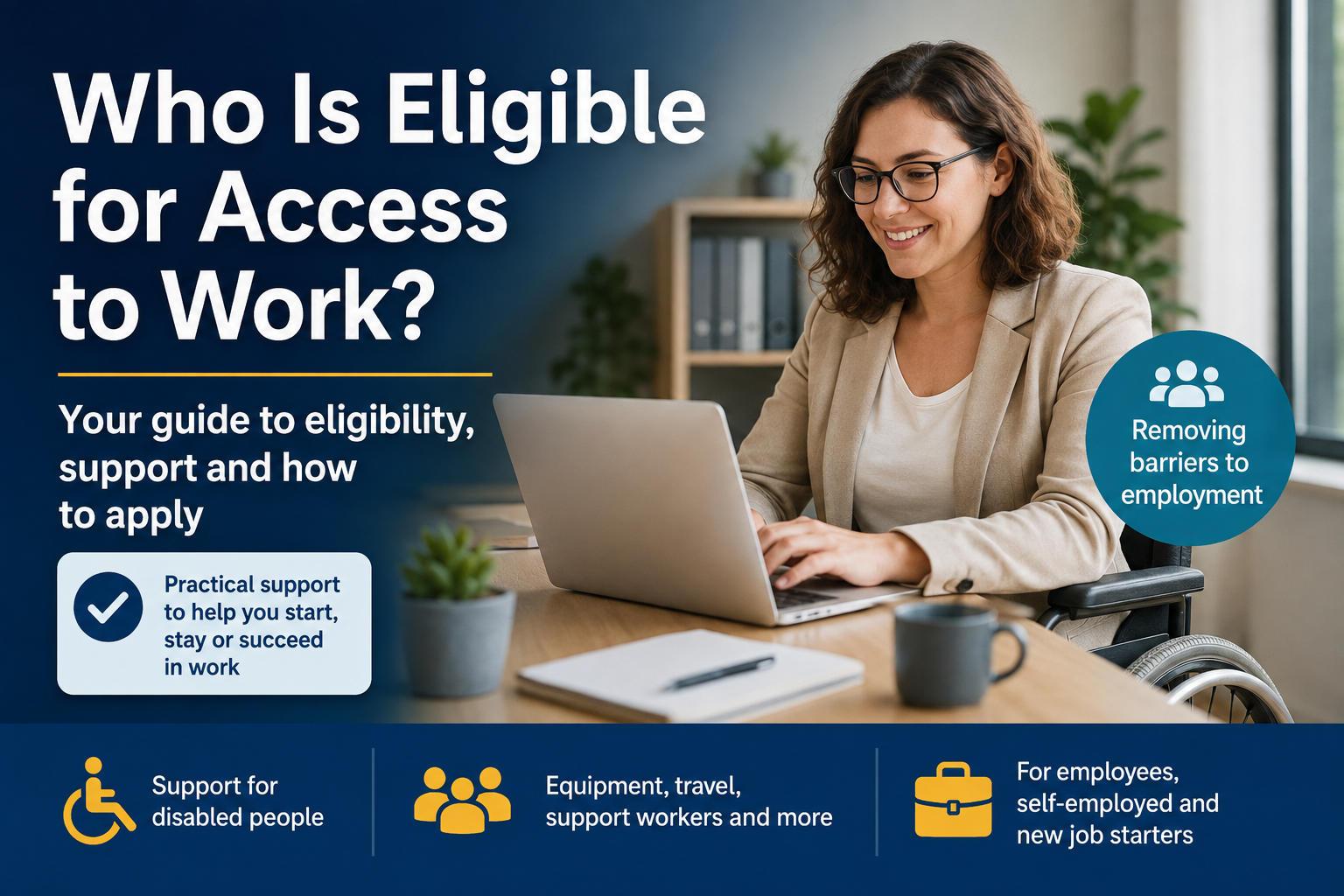
If you have a disability, long term health condition or mental health condition and want to work or stay in work, you may be able to receive practical support through the UK’s Access to Work scheme.
Many people wrongly assume that Access to Work is only available to people who receive disability benefits. In reality, the scheme is much broader and is designed to remove barriers that make working more difficult.
Understanding who is eligible for Access to Work can help you access specialist equipment, workplace adjustments, travel support, communication assistance and many other forms of practical help.
This guide explains exactly who qualifies, the eligibility rules, what support is available, how much could be funded and how to make an application.
Access to Work is available to people aged 16 or over who have a disability, physical or mental health condition or long term health condition that affects their ability to do a job or travel to work. You must live and work in England, Scotland or Wales and have paid work, be about to start work, be self employed or be taking part in an eligible work placement.
Your income, savings and whether you receive benefits do not normally affect eligibility.
Access to Work eligibility means meeting the Government’s conditions for receiving practical workplace support rather than cash benefits.
The scheme is intended to help disabled people start employment, remain employed or become self employed by funding adjustments that are beyond what employers would normally be expected to provide.
Unlike many benefits, Access to Work does not replace income. Instead, it pays towards additional support that enables someone to work effectively.
Examples include:
You may qualify if you satisfy all the main conditions below.
| Requirement | Eligible |
|---|---|
| Aged 16 or over | Yes |
| Live in England Scotland or Wales | Yes |
| Have a disability or health condition affecting work | Yes |
| Starting a new job | Yes |
| Already employed | Yes |
| Self employed | Yes |
| Apprentices | Usually yes |
| Work trial participants | Often yes |
| Volunteers only | Normally no |
| Northern Ireland residents | No under this scheme |
The main eligibility requirements are relatively straightforward.
Applicants must normally be at least 16 years old.
You must have:
Conditions do not need to be visible.
Examples include:
Having a diagnosis alone does not automatically guarantee support. The condition must create practical barriers in carrying out work.
You may qualify if you are:
You normally need to live and work in:
Northern Ireland operates separate employment support arrangements.
Yes.
You can apply if you already have a confirmed job offer and need support before starting work.
Support may also be available for certain interviews where adjustments are required.
No.
Many successful applicants receive:
Receiving benefits is not a requirement.
No.
There is no income limit for Access to Work.
Whether you earn:
your income does not normally determine whether you qualify.
Eligibility is based on your work related support needs rather than your salary.
No.
Unlike many means tested benefits, Access to Work does not assess:
There is no capital limit.
Access to Work does not pay a standard weekly amount.
Instead, funding depends entirely on the reasonable costs of meeting your workplace needs.
Support can include funding for:
| Type of Support | Example |
|---|---|
| Equipment | Specialist keyboards adapted desks voice recognition software |
| Travel | Taxi costs where public transport is unsuitable |
| Communication | Sign language interpreters lip speakers |
| Mental health | Workplace coping strategies coaching |
| Support workers | Readers note takers job aides |
| Workplace adaptations | Specialist furniture or equipment |
| Training | Disability specific workplace training |
The value of awards varies significantly depending on individual circumstances.
Some awards cover relatively small equipment costs while others provide substantial long term support where this is justified.
Applications are made directly to the Department for Work and Pensions.
The process generally involves:
Applications should ideally be made as early as possible, particularly before starting a new job.
Although requirements differ between applicants, it helps to have:
Medical evidence is not always required at the start of an application.
Avoid these common errors.
Apply before problems become serious whenever possible.
Many people delay applying because they wrongly believe they need Personal Independence Payment first.
Describe exactly how your condition affects daily work.
Mental health conditions can qualify in exactly the same way as physical conditions where work is affected.
Employers have legal responsibilities, but Access to Work can fund additional support beyond reasonable workplace adjustments.
Sarah develops mobility problems that make travelling by public transport difficult.
Outcome:
Access to Work helps fund suitable travel support, allowing her to remain in employment.
James struggles with reading large amounts of written material.
Outcome:
Funding is provided for specialist software and workplace coaching.
Ahmed finds team meetings difficult because he cannot clearly hear discussions.
Outcome:
Communication support and appropriate equipment help him participate fully.
Rachel experiences severe anxiety when managing client meetings.
Outcome:
Access to Work funds tailored mental health support to help her continue running her business.
Yes.
You should inform the Department for Work and Pensions if:
A review may be carried out to ensure your support remains appropriate.
Yes. If you have a confirmed job offer, you can usually apply before your employment begins.
No. Income and savings are not normally assessed.
Yes. Eligible self employed people can receive support.
Some students may qualify if they are undertaking eligible paid work or certain work placements. Separate support may apply for study related needs.
No. Receiving Personal Independence Payment is not required.
Yes. Many people receive both.
No. It funds practical workplace support rather than replacing income.
Yes. Mental health conditions are covered where they create workplace barriers.
Depending on the circumstances, funding arrangements may involve reimbursement to employers or direct payment for approved support.
Yes. Your support can be reviewed if your circumstances or workplace needs change.
Times vary depending on demand, the complexity of your support needs and whether an assessment is required.
Depending on your circumstances, you may also qualify for:
| Benefit or Scheme | Purpose |
|---|---|
| Universal Credit | Help with living costs |
| Personal Independence Payment | Extra costs of disability |
| Employment and Support Allowance | Support if illness limits work |
| Adult Disability Payment | Disability benefit in Scotland |
| Disability Living Allowance for children | Support for disabled children |
| Blue Badge | Disabled parking concessions |
| Motability Scheme | Accessible vehicle leasing for eligible recipients of qualifying mobility benefits |
| Council Tax Reduction | Help with council tax bills |
| Carer’s Allowance | Support for eligible carers |
This article has been reviewed against current UK Government guidance relating to Access to Work eligibility and workplace support.
The information reflects the general eligibility framework used by the Department for Work and Pensions at the time of writing. Individual circumstances may vary, and applications are assessed on their own merits.
Applicants should always refer to the latest official Government guidance before making an application, as eligibility criteria, funding arrangements and application processes may change.
The following official resources provide further information about Access to Work:
Understanding Who Is Eligible for Access to Work can make a significant difference if a disability, long term health condition or mental health condition is affecting your ability to work.
The scheme is designed to remove practical barriers rather than provide income. Eligibility is based mainly on whether your condition affects your work and whether you meet the residency and employment requirements. Your income, savings and most other financial circumstances do not usually affect your entitlement.
If you believe you could benefit from workplace adjustments or practical support, applying early can help you start or remain in employment with greater confidence and independence.
Benefits Advice UK provides free information to help people better understand the UK benefits system. Always check the latest Government guidance before making financial decisions.

Information on this site is based on official UK guidance.
About our information and sources


Sign up for our newsletter to receive updates when there are changes to Universal Credit.