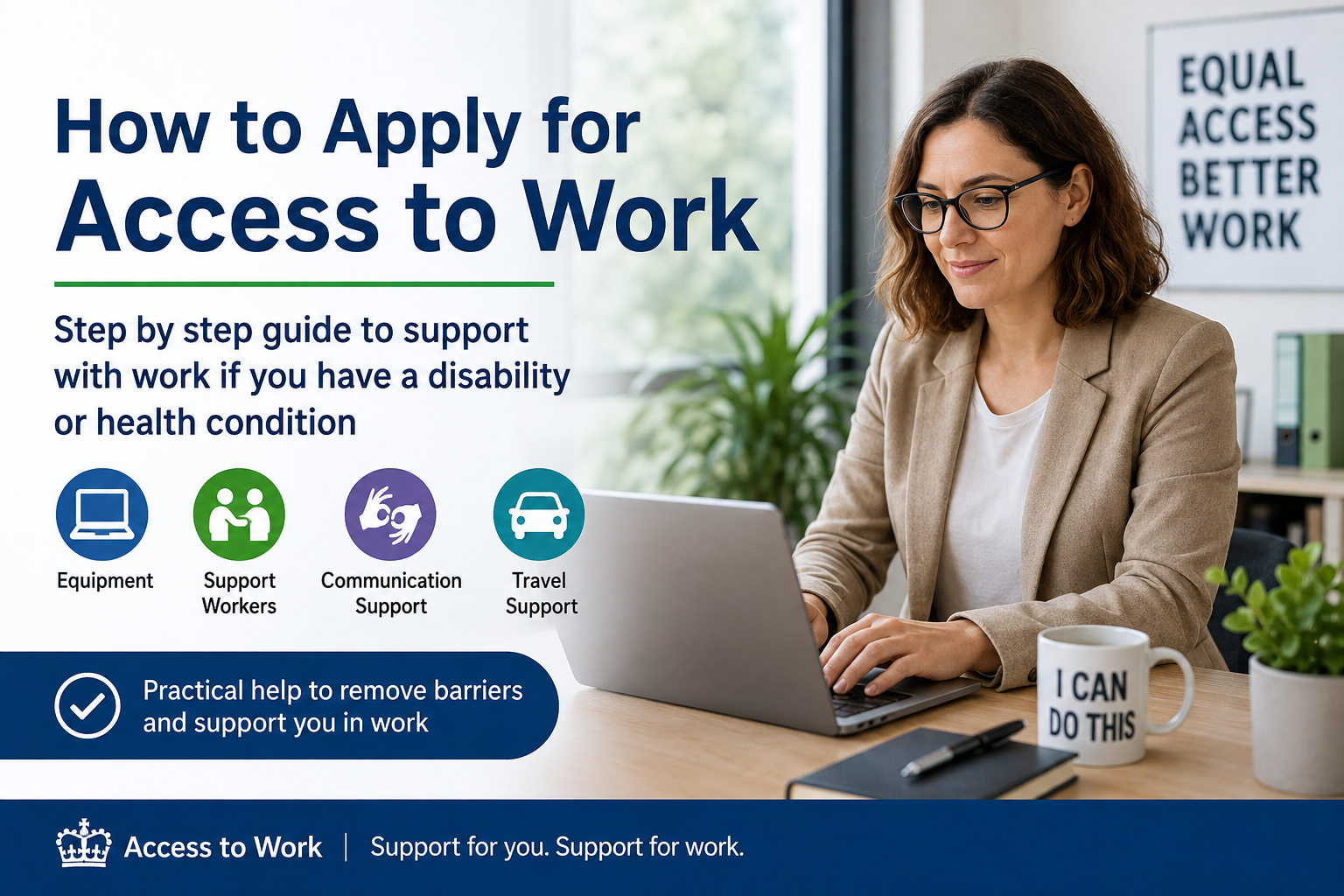
How to Apply for Access to Work

How to Apply for Access to Work

Starting or staying in work can be more challenging if you have a disability, long term health condition or mental health condition. Fortunately, the UK Government’s Access to Work scheme is designed to remove many of these barriers by providing practical and financial support that helps people succeed in employment.

If you are wondering how to apply for Access to Work, this guide explains every stage of the process in plain English. Whether you are employed, self employed, about to start a new job or attending a work placement, understanding how the scheme works can help you receive valuable support that allows you to work more independently and confidently.

This guide explains eligibility, how much support may be available, what evidence you may need, how the application process works and what happens after you apply.


Quick Answer

How do you apply for Access to Work?

You can apply for Access to Work online or by telephone through the Department for Work and Pensions. You must normally have a disability, health condition or mental health condition that affects your ability to work and be aged 16 or over. After applying, an adviser may contact you to discuss your needs before deciding what support can be provided.


What Is How to Apply for Access to Work

What does applying for Access to Work mean?

Applying for Access to Work means asking the Government to assess whether you qualify for financial support to help overcome workplace barriers caused by a disability or health condition.

Unlike many benefits, Access to Work is not a regular payment into your bank account. Instead, it provides funding towards practical support that helps you do your job effectively.

Support may include:

  • Specialist equipment
  • Adapted computer technology
  • Support workers
  • British Sign Language interpreters
  • Job coaching
  • Mental health support
  • Taxi fares where public transport is unsuitable
  • Travel support
  • Workplace adaptations

The amount awarded depends entirely on your individual circumstances rather than your income.


Who Can Claim How to Apply for Access to Work

Who qualifies for Access to Work?

You may qualify if you:

  • Are aged 16 or over
  • Live in England, Scotland or Wales
  • Have a disability or health condition that affects your work
  • Are in paid employment
  • Are self employed
  • Are starting a job soon
  • Are attending a work trial
  • Are undertaking an apprenticeship
  • Are on certain internships

You do not need to receive Personal Independence Payment or any other disability benefit to qualify.

Typical qualifying health conditions include

Health Condition May Qualify
Physical disability Yes
Visual impairment Yes
Hearing impairment Yes
Learning disability Yes
Autism Yes
ADHD Yes
Mental health condition Yes
Long term illness Yes
Neurological condition Yes

Every application is assessed individually.


Eligibility Requirements

What are the eligibility rules?

To qualify you generally need to satisfy several conditions.

You must have a disability or health condition

Your condition must create practical difficulties in carrying out your work.

Examples include:

  • Difficulty travelling independently
  • Problems using standard equipment
  • Communication barriers
  • Physical workplace limitations
  • Fatigue caused by medical conditions
  • Anxiety affecting workplace performance

You must be working or about to start work

Access to Work supports employment rather than unemployment.

You can usually apply if you are:

  • Employed
  • Self employed
  • Starting employment
  • Apprentices
  • Certain trainees
  • Work trial participants

Your work must be genuine

Your employment should normally involve real paid work.


Income Rules

Does your income affect Access to Work?

No.

There is no income limit for Access to Work.

Your earnings do not normally affect your eligibility.

Unlike means tested benefits, your salary is not used to decide whether you qualify.

Income Effect on Access to Work
Low income No effect
Average income No effect
High income No effect

The decision focuses on your workplace support needs.


Savings Rules

Do savings affect Access to Work?

No.

There are no savings limits for Access to Work.

Whether you have:

  • No savings
  • £500 savings
  • £10,000 savings
  • More than £50,000 savings

your savings alone will not usually affect your application.


How Much Could You Receive

How much funding is available?

There is no standard payment because every award is tailored to your individual needs.

Funding can cover a wide range of support.

Examples include

Type of Support Examples
Equipment Specialist keyboards, adapted desks, screen readers
Communication BSL interpreters, speech to text support
Travel Taxi journeys where appropriate
Support workers Readers, job coaches, personal assistants
Mental health Workplace mental health support
Adaptations Changes to working environment

The level of funding depends on the assessment carried out by Access to Work advisers.

In some cases employers may be expected to contribute towards certain costs depending on the circumstances and the size of the organisation, while many types of support remain fully funded.


How To Apply

How do you apply for Access to Work?

Applying is usually straightforward if you prepare the necessary information beforehand.

Step One

Check that you are eligible.

Confirm that:

  • You are aged 16 or over.
  • You live in Great Britain.
  • Your condition affects your ability to work.
  • You are in work or about to start work.

Step Two

Gather your information.

You may need:

  • National Insurance number
  • Employer details
  • Workplace address
  • Job title
  • Start date
  • Contact information

Step Three

Submit your application.

Applications can usually be made online or by telephone.

You will be asked about:

  • Your health condition
  • Your work
  • Difficulties you experience
  • The support you think would help

Step Four

Speak with an adviser.

An Access to Work adviser may arrange a discussion about:

  • Your role
  • Your workplace
  • Equipment already available
  • Adjustments already made
  • Additional support required

Sometimes a workplace assessment may be recommended.

Step Five

Receive a decision.

If approved, you will receive details explaining:

  • What support has been agreed
  • Funding arrangements
  • Any employer contribution
  • Next steps

What Documents Will You Need

What information should you prepare?

Having the correct information ready can make your application much quicker.

Useful documents include:

Document Why It Helps
National Insurance number Confirms identity
Employer details Identifies workplace
Job description Explains your role
Medical evidence if requested Supports your needs
Workplace contact Allows communication with employer

Not every applicant will need medical evidence.

If additional information is required, Access to Work will usually explain what is needed.


Common Mistakes To Avoid

What mistakes delay applications?

Many applications are delayed because important information is missing.

Avoid these common errors.

Waiting until work becomes impossible

Apply as early as possible.

Underestimating your difficulties

Be honest about the challenges you experience.

Forgetting to explain daily tasks

Describe how your condition affects specific parts of your job.

Not updating your circumstances

Tell Access to Work if:

  • You change employer
  • Your hours change
  • Your health changes
  • Your workplace changes

Assuming you must receive disability benefits

Receiving Personal Independence Payment or other disability benefits is not a requirement.


Examples And Real Life Scenarios

What does Access to Work look like in practice?

Example One

Sarah has severe hearing loss and starts a new office job.

Following her application, Access to Work funds communication support and specialist equipment that allows her to attend meetings confidently.

Example Two

David has multiple sclerosis and finds walking long distances extremely difficult.

Access to Work helps with suitable travel support where appropriate, allowing him to continue working.

Example Three

Emma experiences anxiety and depression.

Following an assessment, she receives workplace mental health support that helps her remain in employment.

Example Four

James is self employed with dyslexia.

He receives specialist software that makes reading and producing written documents much easier.


Frequently Asked Questions

Can I apply before starting a new job?

Yes. If you have accepted a job offer and expect to need support, you can usually apply before your employment begins.

Can self employed people apply?

Yes. Many self employed workers qualify if they meet the eligibility requirements.

Do I need Personal Independence Payment?

No. Access to Work is separate from Personal Independence Payment.

Will my employer know?

Your employer will usually become involved where workplace adjustments or funding arrangements are required.

Is Access to Work taxable?

Support provided through Access to Work is generally not treated as taxable income in the same way as earnings.

Can I apply if I work part time?

Yes. Part time workers may qualify.

Can students apply?

Some students may qualify if they are undertaking paid work or certain work related programmes.

How long does an application take?

Timescales vary depending on demand and the complexity of your application.

Can I appeal if refused?

If you disagree with a decision, you can ask for it to be reviewed and provide additional information where appropriate.

What happens if I change jobs?

You should notify Access to Work because your support package may need to be reviewed.


Related Benefits And Support Available

What other support could help?

Depending on your circumstances, you may also be eligible for other forms of assistance.

Support Purpose
Personal Independence Payment Helps with extra disability related costs
Universal Credit Income related financial support
Employment and Support Allowance Support for people with limited capability for work in certain circumstances
Disability Living Allowance for children Support for eligible disabled children
Carers Allowance Financial support for eligible carers
Motability Scheme Vehicle leasing for eligible recipients of qualifying mobility benefits

Each scheme has separate eligibility rules.


Useful Government Resources

Where can you find official guidance?

Information reviewed against current UK Government guidance and official sources.

Useful official resources include:

  • GOV.UK Access to Work guidance
  • Department for Work and Pensions
  • Jobcentre Plus
  • Advisory, Conciliation and Arbitration Service
  • Disability Rights organisations
  • Citizens Advice

Always refer to the latest Government guidance before submitting your application, as eligibility rules and processes may change.


Conclusion

Knowing how to apply for Access to Work can make a significant difference if a disability, long term health condition or mental health condition affects your ability to do your job. The scheme is designed to remove practical barriers rather than replace your income, giving many people the opportunity to start work, remain in employment or progress in their careers.

The application process is generally straightforward when you understand the eligibility rules and prepare the necessary information in advance. Applying early, providing clear details about the support you need and responding promptly to any requests for additional information can help your application progress more smoothly.

Remember that every application is assessed individually. The support offered is tailored to your circumstances and workplace needs, helping ensure you have the adjustments required to work safely, effectively and with greater confidence.

Benefits Advice UK provides free information to help people better understand the UK benefits system. Always check the latest Government guidance before making financial decisions.

imporatant_image

Important

Information on this site is based on official UK guidance.

About our information and sources
Inbox Background
Newsletter Image

Get the latest updates to your inbox

Sign up for our newsletter to receive updates when there are changes to Universal Credit.