
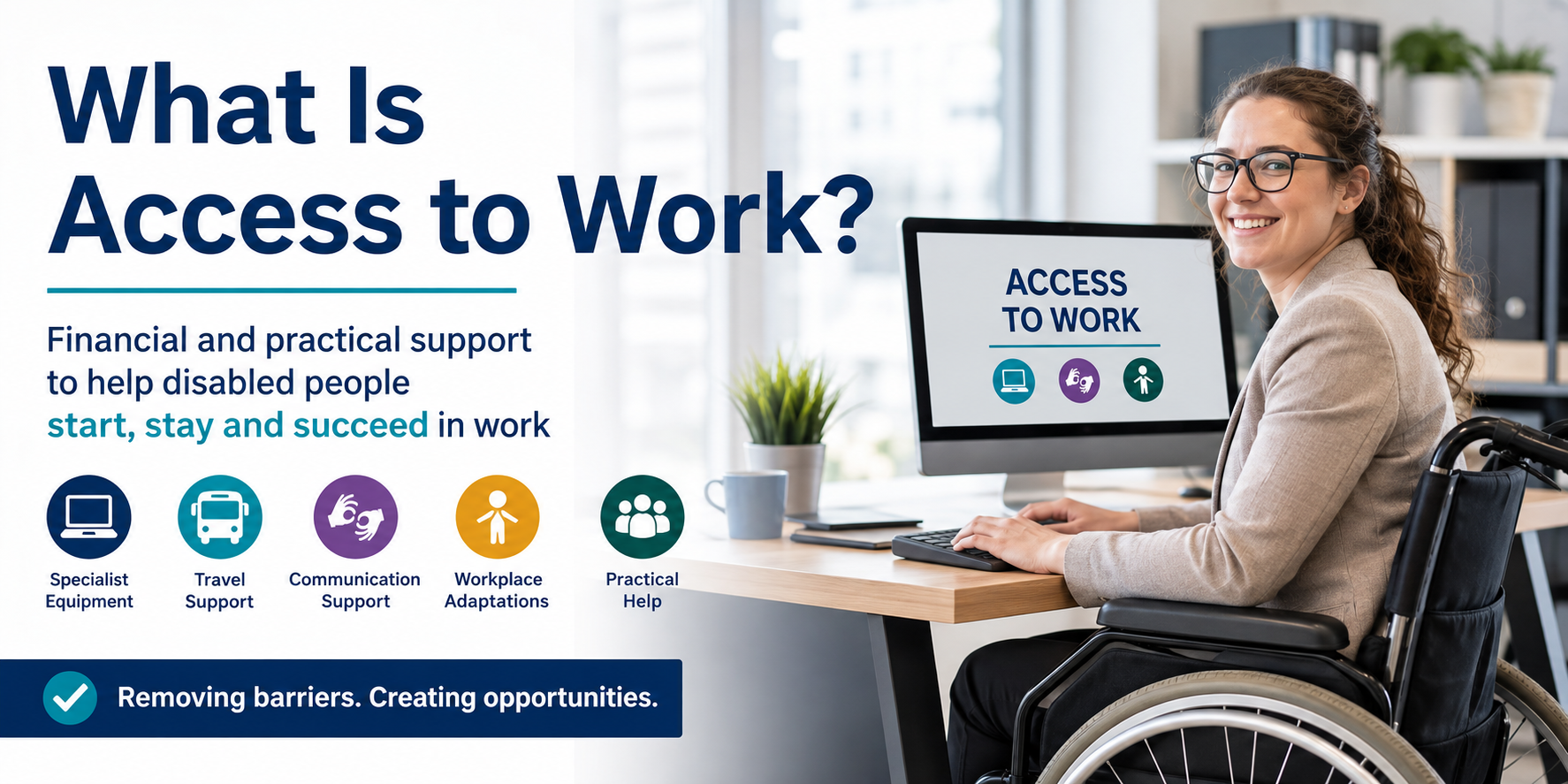
Access to Work helps people whose disability or health condition affects their ability to do their job.
Rather than replacing wages or benefits, it provides funding for practical adjustments that make work more accessible.
Support may include:
The scheme aims to ensure disabled people have equal opportunities in the workplace.
The main goal is to remove workplace barriers so disabled people can:
You may qualify if:
You do not have to receive disability benefits to qualify.
Many people who receive no disability benefits at all are still eligible.
Each application is assessed individually.
You normally need to:
| Requirement | Details |
|---|---|
| Age | At least 16 years old |
| Location | Live in Great Britain |
| Employment | In paid work, starting work or self employed |
| Health | Disability or health condition affects work |
| Need | Require practical support beyond reasonable workplace adjustments |
The support must relate directly to work.
Access to Work is not designed to fund general healthcare or personal living costs.
No.
There are no income limits for Access to Work.
Your earnings do not usually affect whether you qualify.
Whether you earn a modest salary or a high salary, eligibility is based on your disability related workplace needs rather than your income.
This makes Access to Work different from means tested benefits such as Universal Credit.
| Benefit | Income Tested |
|---|---|
| Access to Work | No |
| Universal Credit | Yes |
| Pension Credit | Yes |
| Housing Benefit | Usually yes |
No.
Savings do not normally affect eligibility.
Whether you have savings or investments does not usually determine whether you can receive Access to Work support.
The assessment focuses on your workplace needs.
There is no standard payment amount because every award is based on individual circumstances.
The amount depends on:
Support can include thousands of pounds worth of specialist equipment or long term support workers if needed.
Examples include:
| Support Needed | Possible Funding |
|---|---|
| Specialist chair | Cost covered where approved |
| Screen reader software | Cost covered where approved |
| BSL interpreter | Approved communication support |
| Taxi travel | Approved travel costs |
| Job coach | Approved support sessions |
| Mental health support | Approved workplace support |
There is an annual maximum award set by the Government, which is reviewed periodically.
Applications are made directly to Access to Work.
The process is straightforward.
Submit an application online or by telephone.
Provide information about:
An adviser may contact you to discuss your needs.
In some cases, a workplace assessment is arranged.
A decision is made.
Funding arrangements are agreed.
Some support can begin quickly, while more complex cases may take longer.
Having the right information can speed up your application.
You may need:
Medical evidence is not always required immediately but may sometimes be requested.
Support depends entirely on individual needs.
Examples include:
Where public transport is unsuitable because of disability.
Examples include:
People with mental health conditions may receive:
Yes.
Many people receive Access to Work alongside other benefits.
Examples include:
| Benefit | Can Be Claimed Together |
|---|---|
| Personal Independence Payment | Yes |
| Universal Credit | Yes |
| Employment and Support Allowance | Sometimes, depending on work circumstances |
| New Style ESA | Yes in some situations |
| Carer’s Allowance | Depends on individual circumstances |
| Disability Living Allowance | Yes |
| Attendance Allowance | Yes if working and eligible |
Receiving another benefit does not automatically prevent Access to Work support.
Yes.
You should report changes including:
Updating your information helps ensure your support remains appropriate.
Common mistakes include:
Providing detailed, accurate information usually leads to a smoother application.
Situation
Sarah has severe hearing loss and starts a customer service role.
Outcome
Access to Work funds communication support and specialist hearing equipment, enabling her to perform her role effectively.
Situation
David has multiple sclerosis and struggles using a standard office chair.
Outcome
Funding is approved for an ergonomic workstation and specialist seating.
Situation
Emily has anxiety and finds commuting overwhelming.
Outcome
Access to Work approves alternative travel support while adjustments are explored.
Situation
James is self employed and has a visual impairment.
Outcome
Funding helps purchase specialist software that allows him to manage clients independently.
It is a Government grant that funds workplace support for disabled people and those with health conditions.
No. You do not need to receive PIP.
Yes, provided they meet the eligibility rules.
No. It is not treated as taxable income.
Access to Work itself does not normally reduce Universal Credit because it funds workplace support rather than providing income.
Yes. People with a confirmed job offer can apply.
Usually yes, because employers are often involved in arranging workplace support.
Times vary depending on individual circumstances and the complexity of the support required.
Yes. Home workers may qualify if disability related adjustments are needed.
Yes. Workplace mental health support can be available where appropriate.
People receiving Access to Work may also be eligible for other forms of support, including:
Each scheme has its own eligibility criteria, so qualifying for one does not automatically qualify you for another.
Information reviewed against current UK Government guidance and official sources.
Useful resources include:
| Resource | Purpose |
|---|---|
| GOV.UK Access to Work guidance | Eligibility, applications and updates |
| Department for Work and Pensions | Policy and support information |
| Jobcentre Plus | Employment support and referrals |
| Advisory, Conciliation and Arbitration Service (Acas) | Workplace rights and reasonable adjustments |
| Equality Advisory and Support Service | Equality rights advice |
Always refer to the latest official guidance, as eligibility rules and funding arrangements may change.
Access to Work is one of the most valuable employment support schemes available for disabled people and those with long term health conditions in Great Britain. Rather than replacing your income, it helps remove practical barriers that could otherwise make work difficult or impossible.
Whether you need specialist equipment, workplace adjustments, communication support, travel assistance or help managing a mental health condition at work, the scheme can provide tailored support based on your individual needs.
Importantly, Access to Work is not means tested, so your income and savings do not usually affect your eligibility. You also do not need to receive Personal Independence Payment or another disability benefit to apply. If your health condition affects your ability to work, it is worth exploring whether this Government grant could help you start, remain in or progress in employment.
Benefits Advice UK provides free information to help people better understand the UK benefits system. Always check the latest Government guidance before making financial decisions.

Information on this site is based on official UK guidance.
About our information and sources


Sign up for our newsletter to receive updates when there are changes to Universal Credit.