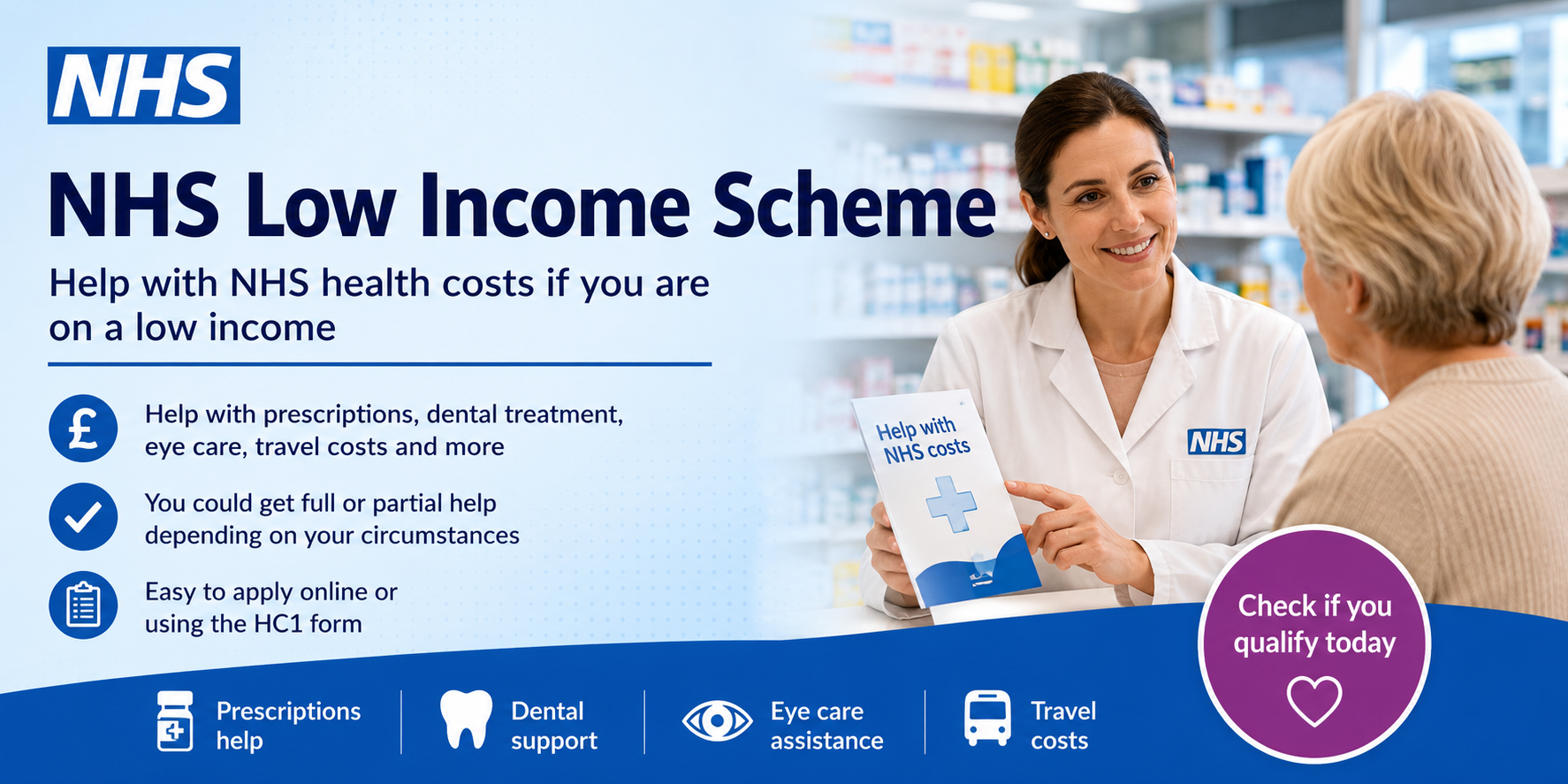
Many people in the United Kingdom struggle with the cost of prescriptions, dental treatment, eye tests and other NHS charges. The NHS Low Income Scheme exists to help people on lower incomes reduce or completely remove these costs.
Whether you are working, unemployed, self employed, retired or studying, you may qualify for financial help if your income is below a certain level.
This guide explains everything you need to know about the NHS Low Income Scheme, including who qualifies, how much help is available, how to apply and the mistakes to avoid.
The NHS Low Income Scheme helps people on lower incomes pay for NHS health costs. Depending on your financial circumstances, you may receive full help through an HC2 certificate or partial help through an HC3 certificate. The scheme can cover prescription charges, NHS dental treatment, eye tests, glasses, travel costs for NHS treatment and wigs or fabric supports.
The NHS Low Income Scheme provides financial support for people who do not automatically qualify for free NHS healthcare costs but have a low income.
It is designed to ensure that people are not prevented from accessing essential healthcare because of financial difficulties.
The scheme is available throughout England.
Depending on your circumstances, you may receive help with:
If you qualify for full assistance, most NHS health costs will be completely free.
You may qualify if your income is low enough after your household income, savings and living costs have been assessed.
You do not have to receive benefits to apply.
People who commonly qualify include:
The scheme looks at your overall financial situation rather than simply whether you receive benefits.
Some people automatically receive free NHS health costs because they receive qualifying benefits or fall into specific exemption categories.
For example, people receiving certain means tested benefits often receive automatic help without needing an NHS Low Income Scheme certificate.
To qualify you normally need to:
The assessment considers your:
Each application is assessed individually.
| Circumstance | May Qualify |
|---|---|
| Low earnings | Yes |
| Self employed with low profits | Yes |
| Pensioner with limited income | Yes |
| Student with low income | Yes |
| High household income | Usually No |
| Large savings | May reduce eligibility |
The NHS Low Income Scheme assesses your available income after taking account of reasonable living costs.
Income can include:
The assessment aims to establish whether you have enough disposable income to pay NHS charges.
Every household is different, so there is no single income figure that guarantees entitlement.
If you live with a partner, both incomes are normally considered together.
The number of dependent children may also affect the assessment.
Savings are considered when assessing your application.
Savings can include:
Different savings limits may apply depending on where you live and your personal circumstances.
Some forms of capital may not count.
If your savings exceed the relevant limits, you may receive reduced help or not qualify.
The amount you receive depends on your financial assessment.
There are two main outcomes.
| Certificate | Help Available |
|---|---|
| HC2 Certificate | Full help with eligible NHS costs |
| HC3 Certificate | Partial help towards NHS costs |
An HC2 certificate usually provides free:
An HC3 certificate provides partial help.
You may need to pay some costs yourself, but your contribution will normally be lower.
Applications can be made online or by completing the official HC1 application form.
The process usually involves:
If approved, you will receive either:
Keep your certificate safe because you may need to show it when receiving NHS treatment.
Having your documents ready can make the application process much easier.
You may need:
Not everyone will need every document.
Many applications are delayed because of missing information.
Common mistakes include:
Always double check your application before submitting it.
| Situation | Outcome |
|---|---|
| Sarah works twenty hours each week on a low income and has little savings. | She qualifies for an HC2 certificate and receives free prescriptions and dental treatment. |
| Situation | Outcome |
|---|---|
| David receives a small pension but has modest savings. | He qualifies for partial assistance with an HC3 certificate. |
| Situation | Outcome |
|---|---|
| Emma is self employed and her income varies throughout the year. | Following assessment, she receives help with NHS charges based on her average financial circumstances. |
| Situation | Outcome |
|---|---|
| A student living independently with limited income applies. | The application is assessed using household income and other financial information before a decision is made. |
Yes.
If your financial circumstances improve or worsen significantly, your entitlement may change.
Examples include:
Keeping your information up to date helps ensure you receive the correct level of support.
Yes. Employment does not automatically prevent you from qualifying. Your income and financial circumstances are assessed.
No. Many successful applicants receive no benefits at all.
Different NHS charging arrangements apply across the UK. The scheme is primarily used in England for NHS charge assistance.
Certificates are normally issued for a limited period and include an expiry date.
Yes, if you qualify and the travel relates to eligible NHS treatment.
Yes, students with low incomes may qualify.
Yes, pensioners on lower incomes may qualify.
You may ask for your application to be reviewed if you believe the decision is incorrect.
No. The scheme relates to eligible NHS charges rather than private treatment.
In some situations, you may be able to claim a refund if you were entitled to help when you paid the charge and you meet the relevant conditions.
The NHS Low Income Scheme may work alongside other forms of financial support depending on your circumstances.
You may also wish to check whether you qualify for:
Receiving one form of support does not automatically guarantee entitlement to another, but many people qualify for several forms of assistance.
This article has been reviewed against current UK Government guidance and official NHS information available at the time of writing.
The information is intended to provide clear and accurate guidance for general information purposes. Benefit rules, NHS charging arrangements, eligibility criteria and financial thresholds can change over time.
Always check the latest official guidance before making financial decisions or submitting an application.
The following official resources provide further guidance:
| Resource | Purpose |
|---|---|
| NHS Low Income Scheme | Information about eligibility and applications |
| HC1 Application Form | Apply for financial help with NHS health costs |
| NHS Help with Health Costs | Information about prescriptions, dental treatment and eye care |
| GOV UK Benefits Checker | Check entitlement to other Government support |
The NHS Low Income Scheme provides valuable financial help for people who struggle to meet the cost of NHS health charges. Whether you need help with prescriptions, dental treatment, eye care or travel costs, the scheme can significantly reduce your healthcare expenses.
Many people assume they are not eligible because they work or do not receive benefits, but the scheme is based on your overall financial circumstances rather than your employment status alone. Taking a few minutes to check your eligibility could save you hundreds of pounds each year.
If your income is limited, it is well worth applying. Even if you do not qualify for full assistance, partial help may still reduce the amount you need to pay.
Benefits Advice UK provides free information to help people better understand the UK benefits system. Always check the latest Government guidance before making financial decisions.
Information on this site is based on official UK guidance.
About our information and sources
Sign up for our newsletter to receive updates when there are changes to Universal Credit.