
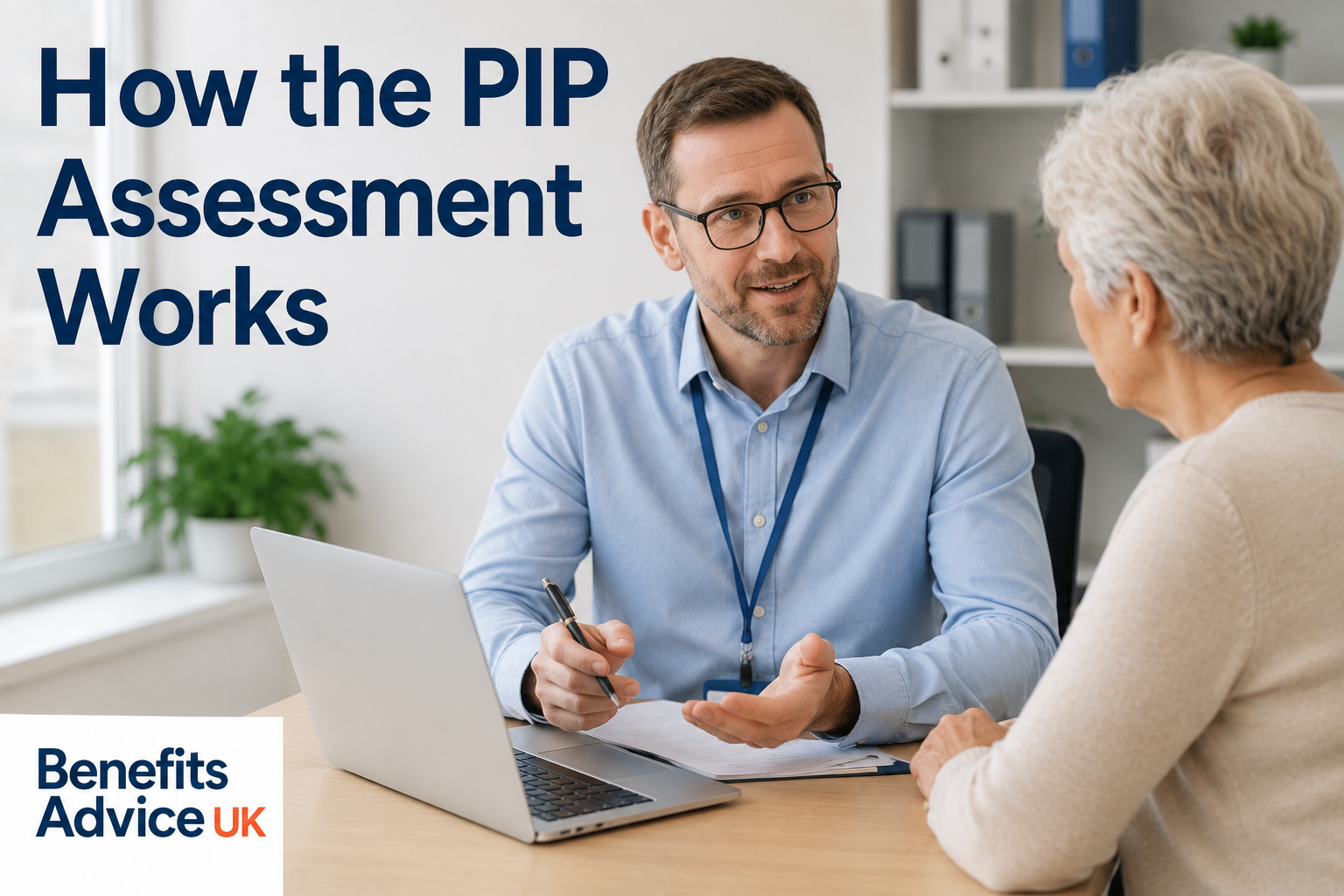
Applying for Personal Independence Payment (PIP) can feel daunting, especially if you are unsure what happens during the assessment. Understanding how the PIP assessment works can help you prepare, reduce anxiety and improve your confidence throughout the process.
This guide explains each stage of the assessment in simple language, including who carries out the assessment, what questions you may be asked, how your evidence is considered and what happens after your appointment.
The PIP assessment is designed to understand how your health condition or disability affects your daily life and your ability to move around. It is not a medical examination to diagnose your condition. Instead, an independent health professional reviews your application, considers supporting evidence and usually carries out an assessment by telephone, video call, in person or occasionally on paper if enough evidence is available. The Department for Work and Pensions (DWP) then uses the assessment report alongside your evidence to decide whether you qualify for PIP.
The PIP assessment is part of the process used to decide whether you qualify for Personal Independence Payment.
Rather than focusing on your diagnosis, the assessment looks at how your condition affects your ability to complete everyday activities safely, repeatedly, to an acceptable standard and within a reasonable amount of time.
The assessment is based on specific legal descriptors that award points for different levels of difficulty.
The assessor considers whether you can carry out activities such as:
Most people applying for PIP will go through an assessment before a decision is made.
You may be eligible if:
The assessment is designed to understand how these difficulties affect your everyday life rather than how serious your medical diagnosis appears.
The assessment follows a points based system.
Points are awarded against official descriptors covering daily living and mobility activities.
| Component | Maximum Points |
|---|---|
| Daily Living | 48 |
| Mobility | 24 |
You generally need:
| Award | Points Needed |
| Standard Daily Living | 8 to 11 |
| Enhanced Daily Living | 12 or more |
| Standard Mobility | 8 to 11 |
| Enhanced Mobility | 12 or more |
Each activity has several possible descriptors that reflect different levels of difficulty.
No.
Personal Independence Payment is not means tested.
Your assessment is based entirely on how your condition affects your daily life.
Your salary, pension or other income will not reduce your entitlement.
No.
There is no savings limit for PIP.
Whether you have no savings or substantial savings, your assessment is based solely on your needs and the evidence you provide.
PIP has two components.
Each component has a Standard rate and an Enhanced rate.
Your payment depends on the number of points awarded during the assessment process.
You may receive one component or both, depending on your circumstances.
| Possible Outcome | Payment |
| Daily Living only | Standard or Enhanced rate |
| Mobility only | Standard or Enhanced rate |
| Both components | Combination of both rates |
Payments are usually made every four weeks.
The assessment process usually follows these stages.
| Stage | What Happens |
| Start claim | Contact DWP to begin your claim |
| Application form | Complete the How Your Disability Affects You form |
| Evidence | Submit supporting documents |
| Assessment booking | Appointment arranged if required |
| Assessment | Telephone, video, face to face or paper based review |
| Assessment report | Sent to DWP |
| Decision | DWP considers all evidence |
| Award letter | You receive the outcome |
Every claim is different, so timescales can vary.
The assessment is carried out by an independent healthcare professional working for an assessment provider contracted by the DWP.
Assessors may include:
Their role is to understand how your condition affects your daily life.
They do not make the final decision.
The DWP decision maker reviews:
Most assessments are conversational rather than clinical.
The assessor may ask:
They may ask follow up questions to better understand your difficulties.
It is important to answer honestly and describe your worst days if they occur regularly.
Yes.
You can usually have:
They may help explain your difficulties or remind you of important information.
Good supporting evidence helps the DWP understand your situation.
Useful documents include:
The strongest evidence explains how your condition affects your daily life rather than simply naming your diagnosis.
The process usually involves:
Keeping copies of everything you send is recommended.
Preparing documents in advance can make the process easier.
You may need:
Having these ready helps you complete your application accurately.
Following the assessment:
The letter explains:
Yes.
You should inform the DWP if:
Failing to report important changes could affect your entitlement.
Many applications are delayed or unsuccessful because important information is missing.
Common mistakes include:
Always explain how your condition affects your daily life rather than simply naming it.
| Situation | Possible Outcome |
| Arthritis makes cooking painful | Points may be awarded for preparing food |
| Severe anxiety prevents independent travel | Mobility points may be awarded |
| Memory problems require medication reminders | Daily Living points may be awarded |
| Chronic fatigue limits walking distance | Mobility points may apply |
| Vision impairment affects reading information | Communication related points may apply |
Each case is assessed individually.
Most applicants do, although some claims can be decided using paper evidence alone.
Usually not. It focuses on how your condition affects your everyday life.
The assessment itself is not a pass or fail test. It gathers information to help the DWP make a decision.
In some circumstances this may be possible if agreed in advance with the assessment provider.
Many assessments last between 45 and 90 minutes, although this varies.
Contact the assessment provider immediately to rearrange your appointment.
Yes. PIP covers both physical and mental health conditions.
Yes. You can ask for a Mandatory Reconsideration and, if necessary, appeal to an independent tribunal.
No. The DWP makes the final decision after considering all available evidence.
If requested or if relevant evidence becomes available before a decision is made, it can still be helpful to provide it.
Receiving PIP may increase eligibility for other forms of support depending on your circumstances.
You may also wish to explore:
Each benefit has its own eligibility rules.
The most reliable information is available through official Government guidance.
Useful resources include:
Always use official guidance when checking the latest eligibility rules or payment rates.
This article has been reviewed against current UK Government guidance relating to Personal Independence Payment.
Every effort has been made to ensure the information is accurate and easy to understand. However, benefit rules can change. Individual circumstances also vary, so official guidance should always be checked before making financial decisions or submitting a claim.
Understanding how the PIP assessment works can make the application process much less stressful. The assessment is designed to measure how your health condition affects your everyday life rather than simply confirming a medical diagnosis.
Preparing thoroughly, providing detailed evidence and explaining your daily challenges honestly can help ensure the decision maker has a complete picture of your circumstances.
Remember that every claim is considered individually, and if you disagree with a decision, there are formal processes available to ask for it to be looked at again.
Benefits Advice UK provides free information to help people better understand the UK benefits system. Always check the latest Government guidance before making financial decisions.

Information on this site is based on official UK guidance.
About our information and sources


Sign up for our newsletter to receive updates when there are changes to Universal Credit.