
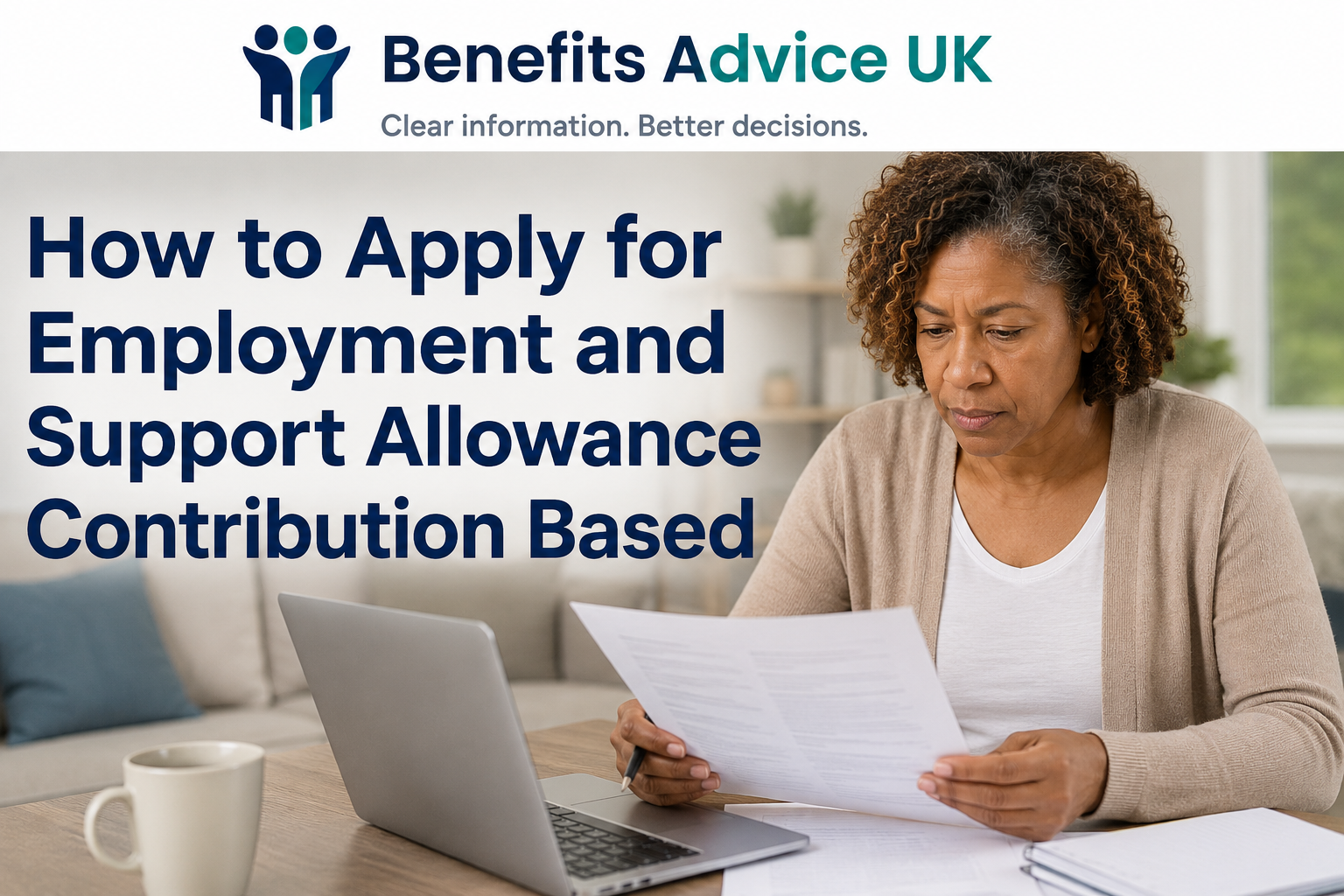
Many people become too ill or disabled to continue working and suddenly face uncertainty about their income. Understanding how to apply for Employment and Support Allowance Contribution Based can make this difficult period less stressful and help ensure you receive the financial support you have earned through your National Insurance contributions.
This guide explains who can claim, how much you could receive, how the assessment process works, what documents you will need and the common mistakes that delay claims. Everything is explained in clear, simple language to help you understand your options.
How do you apply for Employment and Support Allowance Contribution Based?
To apply for Employment and Support Allowance Contribution Based, you usually make a claim through the Department for Work and Pensions, provide details of your health condition, submit a fit note from your GP if required and complete a Work Capability Assessment. Your National Insurance contribution record is used to determine eligibility rather than your household income or savings.
Employment and Support Allowance Contribution Based is a benefit for people whose ability to work is limited because of illness or disability and who have paid enough National Insurance contributions.
This type of Employment and Support Allowance is now known in many situations as New Style Employment and Support Allowance. It replaced the older contribution based version for most new applicants, although many people still refer to it as Contribution Based Employment and Support Allowance.
Unlike means tested benefits, entitlement is based mainly on your National Insurance record rather than your partner’s income, your savings or your household finances.
The benefit aims to provide financial support while you recover, manage a long term health condition or undergo assessment to determine your ability to work.
You may qualify if you cannot work because of illness or disability and have paid or been credited with enough National Insurance contributions.
In general, you must:
You may qualify whether you:
Eligibility depends mainly on your health condition and National Insurance record rather than your income.
The Department for Work and Pensions considers several factors before awarding the benefit.
| Requirement | What It Means |
|---|---|
| Health condition | Your illness or disability affects your ability to work |
| National Insurance | You have sufficient qualifying contributions |
| Medical evidence | You provide supporting medical information |
| Assessment | You complete the Work Capability Assessment if required |
| Residency | You meet UK residence rules |
Medical conditions can include:
Every application is assessed individually.
Employment and Support Allowance Contribution Based is not usually affected by your household income.
Unlike many other benefits, your entitlement does not normally depend upon:
However, some income may affect the amount you receive in certain circumstances, particularly larger pension payments.
If you also claim Universal Credit, your Universal Credit award may take your Employment and Support Allowance payments into account.
Your savings generally do not affect Contribution Based Employment and Support Allowance.
This is one of the biggest differences compared with many means tested benefits.
Savings that usually do not affect eligibility include:
This means someone with significant savings could still qualify if they satisfy the National Insurance contribution rules.
The amount you receive depends on your circumstances and where you are in the assessment process.
Payment rates are reviewed regularly by the Government and usually increase each April.
Your award may include:
| Stage | What Happens |
| Assessment phase | Initial payments while your claim is assessed |
| Work Related Activity Group if applicable | Support with preparing for future work |
| Support Group | Higher ongoing payments for those with limited capability for work related activity |
Your exact entitlement depends upon:
Always check the latest official payment rates before budgeting.
The Work Capability Assessment determines how your health affects your ability to work.
It usually involves several stages.
You will normally complete a detailed questionnaire explaining:
Evidence may come from:
Some applicants attend an assessment, while others may have a telephone, video or paper based assessment depending on their circumstances.
Following the assessment you will receive a decision explaining the outcome.
The application process is straightforward if you prepare the necessary information before starting your claim.
Check that you meet the National Insurance contribution requirements.
Gather your documents before applying.
Begin your application through the Department for Work and Pensions.
Submit a fit note from your GP if required.
Complete any forms sent to you, including the Work Capability Assessment questionnaire.
Provide additional medical evidence if requested.
Attend any assessment if required.
Wait for the Department for Work and Pensions to make a decision.
Having the correct paperwork ready can help avoid delays.
Useful documents include:
Supporting evidence explaining how your condition affects everyday life is often more useful than simply listing your diagnosis.
Most applicants receive updates throughout the assessment process.
The Department for Work and Pensions may:
If your condition changes while your application is being processed, you should report this as soon as possible.
Many delays happen because important information is missing rather than because people are not entitled to the benefit.
Common mistakes include:
Always explain how your condition affects daily activities such as walking, concentrating, lifting, communicating or managing everyday tasks.
Sarah stopped working because her mobility deteriorated.
She had sufficient National Insurance contributions from many years of employment.
After completing the Work Capability Assessment and providing consultant reports, she qualified for ongoing support.
David was unable to continue working because of panic attacks.
He supplied evidence from his GP and therapist.
Following assessment, he was found to have limited capability for work and received Employment and Support Allowance.
James had built up savings during his career.
Because Contribution Based Employment and Support Allowance is based mainly on National Insurance contributions, his savings alone did not prevent him from qualifying.
You should report significant changes as soon as possible.
Examples include:
Prompt reporting helps avoid overpayments or interruptions to your benefit.
Yes, many people receive Employment and Support Allowance alongside other support depending on their circumstances.
You could also qualify for:
| Benefit | Purpose |
| Universal Credit | Extra financial support for living costs |
| Personal Independence Payment | Help with disability related daily living and mobility costs |
| Housing Benefit in limited circumstances | Help with rent |
| Council Tax Reduction | Lower council tax bills |
| Carer’s Allowance | Support for eligible carers |
| Attendance Allowance | Support for older people with care needs |
| Disabled Facilities Grants | Help with home adaptations |
Each benefit has its own eligibility rules.
Yes. Some people may qualify for permitted work provided they stay within the relevant rules.
Generally, Contribution Based Employment and Support Allowance is based on your National Insurance contributions rather than your partner’s income.
In most cases, savings alone do not affect entitlement.
Usually yes, particularly when making a new claim before your Work Capability Assessment.
Times vary depending on demand and individual circumstances.
Yes. You can request a Mandatory Reconsideration and, if necessary, appeal to an independent tribunal.
It may be taxable depending on your circumstances.
Yes, provided they meet the National Insurance contribution requirements.
You should notify the Department for Work and Pensions if your ability to work changes.
No. They are different benefits with different qualifying rules, although some people receive both.
This article has been reviewed against current UK Government guidance relating to:
As benefit regulations and payment rates can change, always refer to the latest official Government information before submitting a claim or making financial decisions.
Knowing how to apply for Employment and Support Allowance Contribution Based can make a significant difference if illness or disability affects your ability to work. Although the application process involves medical evidence and assessment, preparing your documents carefully and explaining how your condition affects daily life can improve the quality of your application.
Remember that Contribution Based Employment and Support Allowance is designed around your National Insurance contribution history rather than your income or savings, making it an important source of financial support for many people who have previously worked.
Taking time to understand the eligibility rules, preparing strong medical evidence and responding promptly to requests from the Department for Work and Pensions can help your claim progress as smoothly as possible.
Benefits Advice UK provides free information to help people better understand the UK benefits system. Always check the latest Government guidance before making financial decisions.

Information on this site is based on official UK guidance.
About our information and sources


Sign up for our newsletter to receive updates when there are changes to Universal Credit.