
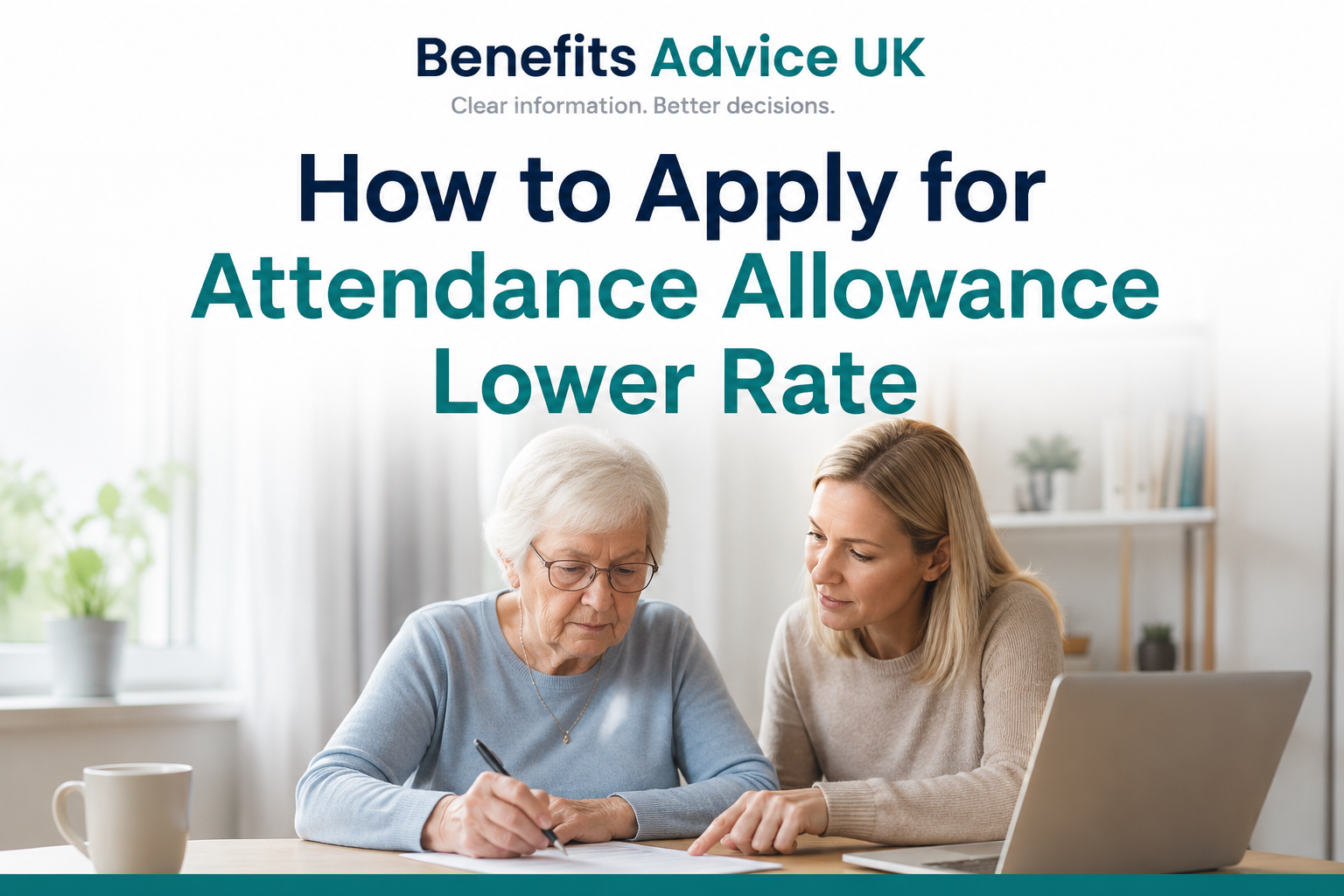
If you are over State Pension age and need help because of an illness or disability, you could be entitled to Attendance Allowance. Many people miss out simply because they believe their condition is not serious enough or they assume their income prevents them from claiming. Neither is necessarily true.
Understanding how to apply for Attendance Allowance Lower Rate can make a significant difference to your finances and quality of life. This benefit is designed to help people who need regular care or supervision during the day or at night because of a physical or mental health condition.
This guide explains everything you need to know, including who qualifies, how much you could receive, how to complete the application correctly, common mistakes to avoid and where to find official guidance.
To apply for Attendance Allowance Lower Rate, you must complete the official Attendance Allowance claim form, either by requesting a paper form or downloading one from the UK Government website. You will need to explain how your illness or disability affects your daily life, provide supporting medical evidence where available and return the completed application to the Department for Work and Pensions. Your income and savings do not affect eligibility.
Attendance Allowance Lower Rate is financial support for people over State Pension age who need regular help or supervision because of a disability, long term illness or health condition.
It is intended to help with the extra costs of living with a disability rather than paying for a specific carer.
You do not need someone to actually provide care. The important factor is whether you reasonably need help.
Examples include needing assistance with:
Attendance Allowance is tax free and is paid separately from your State Pension.
You may qualify if all of the following apply.
| Requirement | Details |
|---|---|
| Age | You have reached State Pension age |
| Disability | You have a physical disability, mental health condition, learning disability or long term illness |
| Care Needs | You need regular help during the day or night |
| Duration | Your care needs have existed for at least six months unless you are terminally ill |
| Residency | You meet UK residence and presence rules |
Attendance Allowance covers many different conditions including:
Many successful claims relate to multiple smaller difficulties rather than one major disability.
Eligibility depends on your care needs rather than your diagnosis.
The Department for Work and Pensions considers:
This includes assistance with:
Some people need someone nearby because they:
The help must be needed frequently rather than occasionally.
Even if family members already provide this support without payment, you may still qualify.
No.
Attendance Allowance is not means tested.
This means your entitlement is not affected by:
You can have a high income and still qualify if you meet the care requirements.
No.
There is no savings limit.
Whether you have:
your savings do not prevent you from claiming Attendance Allowance.
This is one reason many older people wrongly assume they cannot claim.
Attendance Allowance has two payment rates.
| Rate | When Paid |
| Lower Rate | If you need frequent help or supervision during either the day or the night |
| Higher Rate | If you need help during both the day and night, or you are terminally ill |
The exact payment amount changes periodically following Government benefit uprating.
Attendance Allowance is usually paid every four weeks directly into your bank account.
Receiving Attendance Allowance can also increase entitlement to other benefits such as:
Applying involves several straightforward steps.
Obtain the Attendance Allowance claim form.
You can:
Complete every section carefully.
Describe:
Do not simply list your medical condition.
Instead explain how it affects everyday life.
Gather supporting evidence.
Useful evidence includes:
Supporting evidence strengthens your application but is not always essential.
Return the completed form.
Keep copies of everything you send.
Using recorded delivery can provide reassurance that your claim has arrived.
Wait for a decision.
The Department for Work and Pensions may:
Having the correct information ready makes completing the application much easier.
Useful documents include:
| Document | Purpose |
| National Insurance number | Identifies your claim |
| GP details | Medical evidence |
| Hospital information | Supports your health condition |
| Medication list | Shows ongoing treatment |
| Care records | Demonstrates care needs |
| Bank account details | Payment information |
It can also help to keep a diary showing:
A diary provides practical evidence of your day to day difficulties.
Many applications fail because people understate their difficulties.
Avoid these common mistakes.
Many older people say they cope well.
Instead explain honestly what happens on difficult days.
Decision makers assess your care needs rather than your medical label.
Memory loss, confusion, anxiety and depression can all be highly relevant.
Answer every applicable question.
Although not compulsory, evidence often strengthens a claim.
Take time to explain your situation fully.
| Situation | Outcome |
| Margaret is 79 and has severe arthritis. She struggles with dressing, washing and preparing meals every day. | She may qualify for Lower Rate Attendance Allowance. |
| Situation | Outcome |
| David is 81 and has early dementia. His daughter supervises him every afternoon because he forgets medication and leaves appliances switched on. | He may qualify because he requires regular supervision. |
| Situation | Outcome |
| Sheila has heart disease and becomes breathless walking around the house. She needs regular help bathing safely. | She may qualify based on her care needs rather than the diagnosis itself. |
Yes. Living alone does not affect entitlement.
Some people still work after reaching State Pension age and may qualify if they meet the care rules.
Yes. Attendance Allowance is paid alongside your State Pension.
No. It does not reduce your State Pension.
Yes. The benefit looks at the help you need rather than the help you actually receive.
Yes. Many people with dementia receive Attendance Allowance.
Yes, if arthritis creates sufficient care or supervision needs.
Yes. You can ask for a Mandatory Reconsideration and later appeal to an independent tribunal if necessary.
No. It is tax free.
Yes. It can increase entitlement to certain means tested benefits and support schemes depending on your circumstances.
Receiving Attendance Allowance may open the door to additional financial help.
Possible support includes:
Always check whether an Attendance Allowance award affects your wider entitlement.
The most reliable sources include:
Always use official guidance when making a claim.
This guide has been prepared using current UK Government guidance relating to Attendance Allowance eligibility, application procedures and benefit rules.
Benefit rates, qualifying conditions and Government policies can change over time. Applicants should always confirm the latest information before submitting a claim.
Understanding how to apply for Attendance Allowance Lower Rate is the first step towards receiving valuable financial support that could help with the extra costs of living with a disability or long term health condition.
Remember that eligibility is based on the help or supervision you reasonably need rather than your income, savings or diagnosis. Many people wrongly assume they do not qualify because they manage independently or have family members helping them, but Attendance Allowance recognises the care needs themselves, not just the care provided.
Take time to complete the application thoroughly, explain how your condition affects everyday life, include supporting evidence wherever possible and answer every question honestly. A well prepared application gives decision makers the clearest picture of your circumstances.
Benefits Advice UK provides free information to help people better understand the UK benefits system. Always check the latest Government guidance before making financial decisions.

Information on this site is based on official UK guidance.
About our information and sources




Sign up for our newsletter to receive updates when there are changes to Universal Credit.